Nick Clegg issues apology for breaking tuition fee pledge
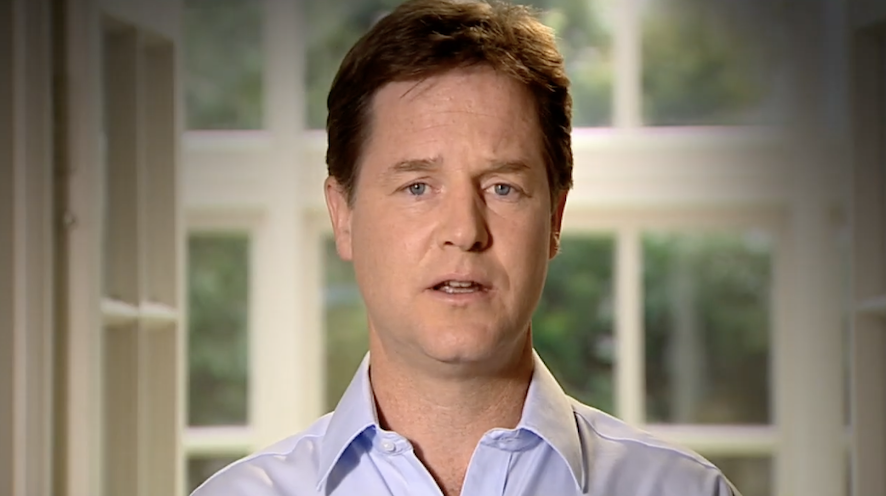
On 19 September 2012, the deputy prime minister, Nick Clegg, released a party-political broadcast in which he apologised for breaking his pledge to oppose any increase in university tuition fees.
The apology, an ill-fated attempt to draw a line under the most damaging episode of his time in government, began: “There’s no easy way to say this: we made a pledge, we didn’t stick to it and for that I am sorry.”
Clegg added: “When you’ve made a mistake you should apologise. But more importantly – most important of all – you’ve got to learn from your mistakes. And that’s what we will do.”
Before the 2010 general election, Liberal Democrat candidates, including Clegg himself, signed a high-profile ‘Vote for Students’ pledge by the National Union of Students (NUS), vowing to vote against any rise in fees.
The vow stated: “I pledge to vote against any increase in fees in the next parliament and to pressure the government to introduce a fairer alternative.”
Clegg also campaigned on a platform of restoring trust in politics. One memorable Liberal Democrat election broadcast urged voters to “Say goodbye to broken promises”.
Speaking directly into camera, Clegg stated: “Broken promises – there have been too many in the last few years… Our nation has been littered with them, a trail of broken promises… This election is different to other elections. The trail of broken promises can come to an end.”
The 2010 Liberal Democrat election manifesto read: “We will scrap unfair university tuition fees so everyone has the chance to get a degree, regardless of their parents’ income.”
***
The 2010 election produced a hung parliament, and Clegg became deputy prime minister in the new Conservative-Liberal Democrat coalition.
The official coalition agreement was conspicuously ambiguous when it came to education funding, stating: “We will await Lord Browne’s final report into higher education funding, and will judge its proposals.”
It added: “If the response of the Government to Lord Browne’s report is one that Liberal Democrats cannot accept, then arrangements will be made to enable Liberal Democrat MPs to abstain in any vote.”
In December 2010, however, Clegg was among 27 Liberal Democrat MPs who voted to triple maximum tuition fees in England from £3,000 to £9,000 per year. (21 Lib Dem MPs voted against the proposals at the time, including former leaders Charles Kennedy and Menzies Campbell.)
The vote passed with a majority of 21.
The episode triggered student protests – as well as a catastrophic collapse in the Liberal Democrats standing in the polls.
Clegg ultimately resolved on a strategy of maximum contrition.
In his 2012 broadcast, Clegg argued that, as the junior partner of a coalition government, the Liberal Democrats were forced to make unpalatable compromises. He apologised for making a “promise we were not absolutely sure we could deliver”.
Clegg added: “I shouldn’t have committed to a policy that was so expensive when there was no money around. Not least when the most likely way we would end up in government was in coalition with Labour or the Conservatives who were both committed to put fees up.”
He pledged to “never again make a pledge unless as a party we are absolutely clear about how we can keep it.”
Clegg concluded: “When we’re wrong we hold our hands up. But when we’re right we hold our heads up too. We were right to leave the comfort of opposition to face the realities of government.
“And I know we are fighting for the right things, day in, day out, too: rebuilding our economy to make it strong; changing the tax system to make it fair; defending the vulnerable in these tough times.
“That’s what my party believes in. That’s what I believe in. And, if we’ve lost your trust, that’s how I hope we can start to win it back.”
The apology represented the culmination of a protracted political journey for Clegg, who initially rejected the need for contrition. On 5 December 2010, Clegg said he believed in the tuition fees hike, telling the Independent: “I really think we will look back in 10 or 15 years’ time and think, actually that was quite a brave and bold and socially progressive thing to do.”
A few days later, Clegg told BBC News that he was “not going to apologise for [his positions on education policy] for one minute”.
He argued that “to govern is indeed to choose, particularly when there is not very much money”.
***
Clegg’s eventual attempt at contrition was seized upon by satirists and his political opponents alike.
Harriet Harman, deputy leader of Labour, responded: “This was not just the small print of his manifesto, this was Nick Clegg’s key election promise when he asked people to vote for his party. It is not good enough for him to just brush that promise aside.
“Instead of crying crocodile tears he should vote with Labour to bring these tuition fees down. If Nick Clegg does not back his words with action he is just weak and spineless.”
The statement inspired a series of unflattering spoofs.
The most famous was curated by the satirical website, The Poke, which remixed the statement into a viral tune, “The Nick Clegg Apology Song”.
Clegg subsequently gave permission for the auto-tuned version of his apology to be released as a single on iTunes, requesting that all profits be given to the Children’s Hospital Charity in Sheffield (where he was an MP).
The song reached number 143 in the UK singles chart.
In 2014, Clegg claimed that, had he been elected prime minister in 2010, he would have followed through on the Liberal Democrat manifesto pledge and abolished tuition fees.
“If I could go back in time, and I could persuade millions of people I would have been prime minister and we would have won the general election, we would have got rid of fees, because that’s what the Liberal Democrats wanted”, he said.
The tuition fees debacle was one factor that informed the Liberal Democrats’ electoral collapse in 2015.
The party was reduced from 57 MPs to just eight.

Politics.co.uk Newsletters
DAILY
Politics@Lunch
WEEKLY
Week in Review
