Gordon Brown calls voter a ‘bigoted woman’ in campaign gaffe
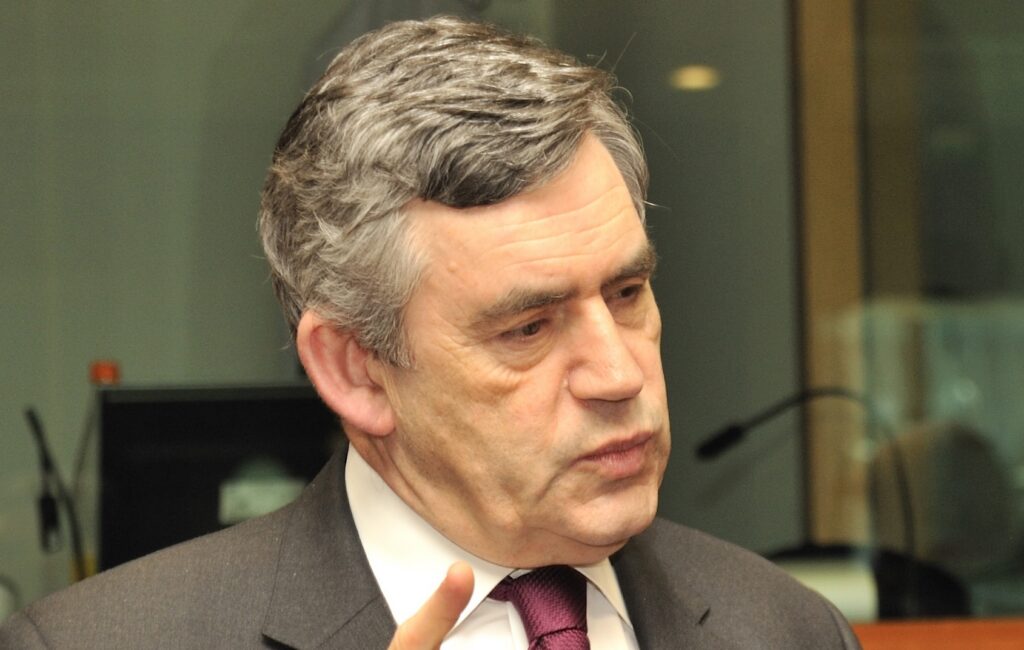
On 28 April 2010, just days before the general election, prime minister Gordon Brown was recorded describing a voter he had just spoken to as a “bigoted woman”.
The infamous incident occurred in Rochdale, Greater Manchester, during a walkabout. Brown had a seemingly cordial, if occasionally tense, conversation with Gillian Duffy, a 65-year-old widow.
Duffy had initially heckled the prime minister from afar, after which she was invited to speak to him by Sue Nye, Brown’s director of government relations. Duffy went on to question the prime minister on topics including the deficit, tuition fees, pensions and immigration from eastern Europe. But the exchange that produced Brown’s gaffe centred on her comments about migration.
Duffy originally asked Brown how he was going to “get us out of all this debt”. She then segued into comments on migration, claiming that “too many people now who are vulnerable can claim, while others who are vulnerable can’t get it”.
The lifelong Labour supporter added: “You can’t say anything about the immigrants… all these eastern Europeans what are coming in, where are they flocking from?”
Brown said while a million people had come from Europe, “a million British people have gone into Europe.”
After the exchange, the prime minister got into his ministerial car, still wearing a Sky News microphone. Unaware that he was still being recorded, he expressed his frustration to an aide, describing the encounter as a “disaster” and complaining that “they should never have put me with that woman”.
He added: “Whose idea was that? Ridiculous.”
Asked what Duffy had said, he responded: “Everything, she was just a bigoted woman.”
Duffy, meanwhile, told reporters that Brown was a “very nice man” and that she intended to vote for the Labour Party.
***
Brown’s private comments were broadcast on the same day and sparked a political firestorm. Still unaware that he had been caught on a “hot mic”, Brown was later interviewed on BBC Radio 2 by Jeremy Vine.
The prime minister immediately apologised upon being informed as to the nature of his remarks.
Brown told the programme: “I apologise if I have said anything like that. What I think she was raising with me was an issue about immigration and saying that there were too many people from eastern Europe in the country.
“And I do apologise if I have said anything that has been hurtful and I will apologise to her personally.”
The prime minister was then played the full recording. Vine asked Brown if Duffy was “not allowed to express her view to you?”
Brown responded: “Of course she’s allowed to express a view, and I was saying that. The problem was that I was dealing with a question that she raised about immigration and I was not given a chance to answer it because we had a whole milieu of press around.
“Of course I apologise if I have said anything that has been offensive, and I would never put myself in a position where I would want to say anything like that about a woman I met. It was a question about immigration that really I think was annoying.”
Duffy was also played a recording of the prime minister’s remarks.
She responded: “I’m not saying anything more to him… I am really disappointed.”
The voter said she did not expect that from Brown, adding: “He’s an educated person, why has he come out with words like that?
“He’s supposed to lead this country and he’s calling an ordinary woman who’s just come up and asked questions what most people would ask him – he’s not doing anything about the national debt and it’s going to be tax, tax, tax for another 20 years to get out of this mess – and he’s calling me a bigot.
“I thought he was understanding – but he wasn’t, was he, the way he’s come out with the comments.”
***
Brown was forced to deliver a series of apologies, first over the phone and then in-person. The Labour campaign was effectively suspended in order for Brown to return to Rochdale to express his regret to Duffy.
Shortly after meeting Duffy for a second time, the prime minister stated: “I’m mortified by what’s happened. I’ve given her my sincere apologies. I misunderstood what she said and she has accepted that there was a misunderstanding and she has accepted my apology.”
He added: “So I’ve made my apology. I’ve come here, it’s been a chance to talk to Gillian about her family and about her relatives and about her own history and what she’s done.
“But most of all, it’s a chance for me to apologise and say sorry and say sometimes you do make mistakes and you use wrong words and once you’ve used that word and you’ve made a mistake you should withdraw it and say profound apologies and that’s what I’ve done.”
Despite Brown’s contrition, the incident reinforced the negative narrative about his leadership and overshadowed Labour’s campaign at a critical moment.
The general election held on 6 May 2010 resulted in the country’s first hung parliament since February 1974, ending 13 years of Labour government and leading to the formation of a Conservative-Liberal Democrat coalition.
The Conservatives won 306 seats with 36.1% of the vote, a net gain of 96 MPs compared to the notional 2005 result. The Labour party lost 91 seats, returning 258 MPs on a 29.0% vote share.
Notably, Labour won the seat of Rochdale from the Liberal Democrats. It was one of the party’s few gains at the 2010 general election.
On the evening of 11 May, Brown resigned as prime minister, and David Cameron entered 10 Downing Street.

Politics.co.uk Newsletters
DAILY
Politics@Lunch
WEEKLY
Week in Review
