David Davis wins self-imposed by-election on civil liberties platform
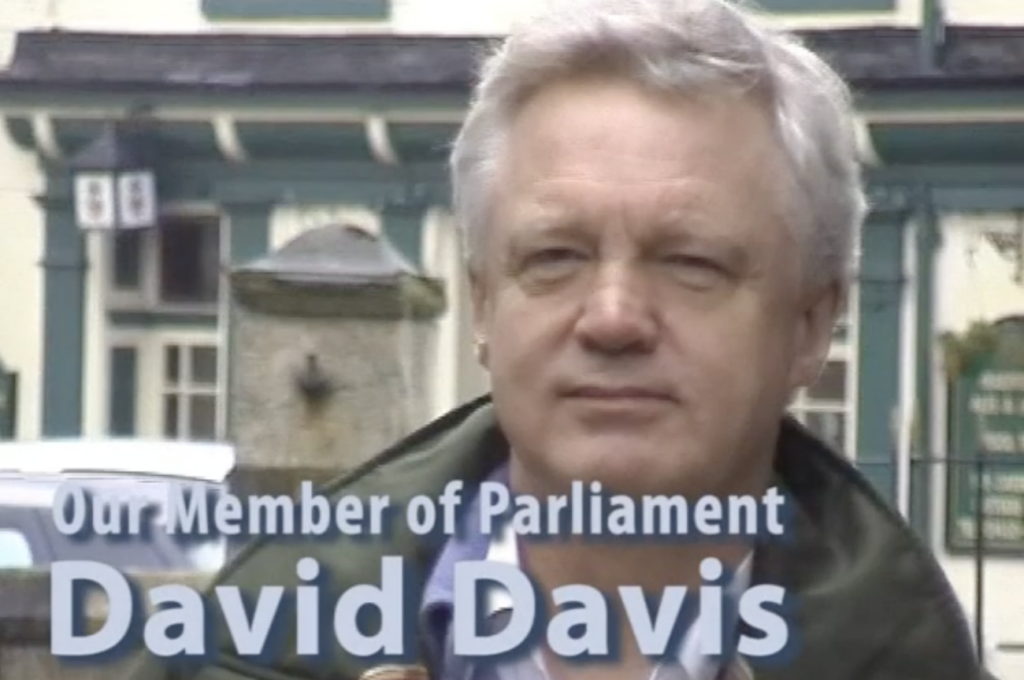
On 10 July 2008, the former shadow home secretary, David Davis, was comfortably re-elected in the Haltemprice and Howden by-election, a contest he had triggered as a protest against the “slow strangulation of fundamental British freedoms”.
Davis stood in the 2005 Conservative leadership contest, having entered the race as the clear frontrunner. He was ultimately defeated by David Cameron, then the shadow education secretary, in the final vote of the Tory membership.
Davis, who went into the race as shadow home secretary, retained this post on Cameron’s first frontbench.
***
In June 2008, Gordon Brown’s Labour government narrowly won a House of Commons vote (by a margin of nine) to extend the maximum pre-charge detention period for terror suspects from 28 to 42 days.
The following day, 12 June, Davis stunned Westminster when he announced he was resigning his safe seat and his shadow cabinet post.
Davis, a libertarian Conservative, viewed the government’s proposals as a dangerous expansion of state power. Speaking outside parliament (the speaker would not let him make the statement in the commons), Davis said the attempt to block the 42-day terror detention proposals was a “noble endeavour”.
“We defended the freedoms of the British people – or we did, up until yesterday. This Sunday is the anniversary of the Magna Carta [sic] – the right not to be imprisoned by the state without charge or reason.”
The Conservative MP added: “The counterterrorism bill will in all probability be rejected by the House of Lords very firmly. But because the impetus behind this is essentially political not security the government will be tempted to use the Parliament Act to overrule the lords. It has no democratic mandate to do this since 42 days was not in the manifesto.”
Davis described the 42-day pre-charge detention proposals as the most salient example of the “insidious, surreptitious and relentless erosion of fundamental British freedoms”, also citing the national DNA database, the proposed identity card system and the proliferation of CCTV.
He added: “I will be resigning my membership of this House and I intend to force a by-election in Haltemprice and Howden. I will not fight it on the government’s general record…
“I will fight it on my personal record. I am just a piece in this great chess game. I will fight it. I will argue this by-election against the slow strangulation of fundamental British freedoms by this government.”
As shadow home secretary, David had led his party in opposing 42-day pre-charge detention. But his decision to stand down came without the approval of the shadow cabinet. Cameron said he thought Davis had made a “very courageous and brave decision”, but insisted that it had been a “personal” one.
The home secretary, Jacqui Smith, said the Conservatives had “collapsed into total disarray” on the issue, calling on Cameron to “come clean on what has really happened”.
Brown, meanwhile, condemned the by-election as a “stunt that has become a farce”.
Andy Burnham, the culture secretary, called on Davis to foot the £80,000 bill for the by-election. “Why should the resources at local level and national level be devoted to this?”, he asked.
***
Davis stood on a “David Davis for Freedom” platform – an attempt to turn the contest into a referendum on civil liberties.
A record 26 independent and fringe candidates challenged Davis. These included David Icke, the author, conspiracy theorist and ex-Green Party spokesperson; Gemma Garrett, onetime Miss Britain representing the Miss Great Britain Party; and the National Front.
Kelvin MacKenzie, the ex-editor of the Sun newspaper, considered standing on a pro-42-day detention platform, but ultimately declined the opportunity.
Labour and the Liberal Democrats also did not stand in the contest. The former abstained in protest at Davis’ protest; the Lib Dems, meanwhile, were broadly sympathetic to his campaign.
Davis attracted a relatively broad spectrum of support, including from Tony Benn, the left-wing former Labour cabinet minister. Benn argued that “Libertarians from the Left and Right sometimes meet in the middle against an authoritarian state.”
In an article for the Daily Telegraph, Benn drew a parallel between Davis’ stand and his own experience seeking re-election to parliament after being unseated upon inheriting a hereditary peerage following his father’s death.
He wrote: “For many years the Labour government has boasted about the traditional values and freedoms of this country; and yet, when its MPs voted to amend the Terrorism Act and permit 42 days in prison without charge, they effectively repealed Magna Carta…
“If the Lords, as expected, also rejects 42 days, it would be a constitutional outrage to use the Parliament Act to enforce the will of the Commons on the second chamber.
“It is on the single, but vital, issue of civil liberties that I decided to support David Davis.”
Cameron visited the constituency to campaign alongside Davis, saying that he was “delighted” to do so.
Cameron and Benn’s respective endorsements reflect the novelty of the campaign.
In the end, Davis secured an overwhelming victory, winning 17,113 votes, or 72% of the total. The turnout, 34.5%, exceeded expectations
The closest challenge came from the Green Party and English Democrats, which secured 1,758 (7.4%) and 1,714 (7.2%) votes respectively. All other candidates, including the Church of the Militant Elvis and Make Politicians History parties polled less than 5% of the vote and lost their deposit.
Davis’ result marked the biggest increase in share of the vote, up 24.1%, for a Conservative by-election candidate since 1945.
In his victory speech, Davis claimed the result had “fired a shot across the bows of Gordon Brown’s arrogant, arbitrary and authoritarian government.”
He said he would return to Westminster with a mandate “to fight Gordon Brown’s vision of Big Brother Britain tooth and nail, to stop 42 days in its tracks, to prevent the disaster of ID cards before it happens, to protect our personal privacy from being ransacked by the ever-intrusive state”.
Cameron did not reappoint Davis to the shadow cabinet upon his re-election.
***
In October 2008, the Brown government abandoned its 42-day pre-charge detention proposals in the face of opposition from the House of Lords, as Davis had predicted.
Single issue by-elections remain a mostly rare feature in modern British politics. A further notable example came with the 2016 Richmond Park by-election, triggered by incumbent Conservative MP Zac Goldsmith.
Goldsmith resigned his seat over the government’s proposal for a third runway at the nearby Heathrow Airport. He ultimately lost the self-imposed contest to Liberal Democrat candidate Sarah Olney.

Politics.co.uk Newsletters
DAILY
Politics@Lunch
WEEKLY
Week in Review
