Gordon Brown defeated over Gurkha settlement rights
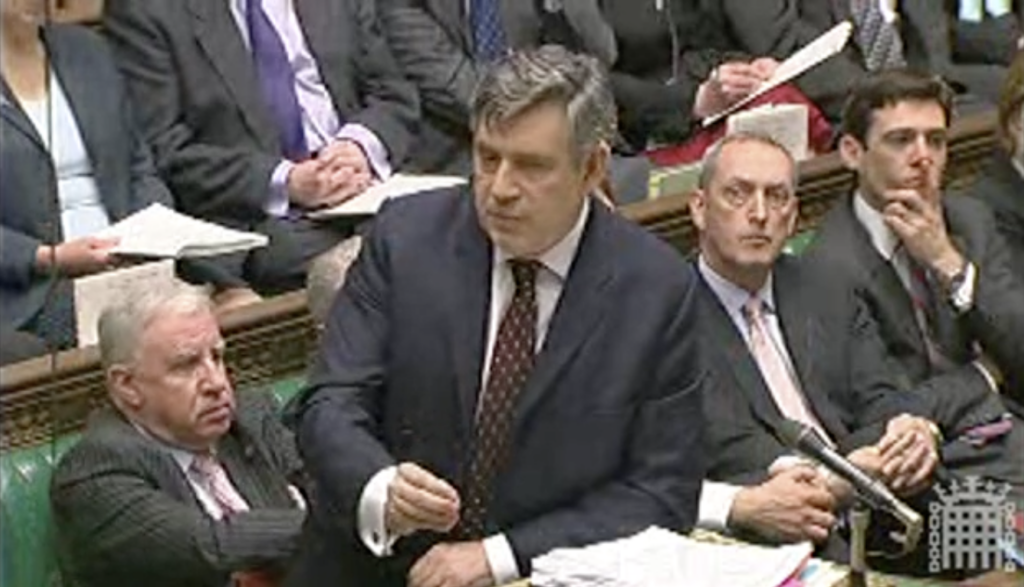
On 29 April 2009, Gordon Brown’s government suffered a rare defeat in the House of Commons over the right of former Gurkha soldiers to settle in the United Kingdom. MPs voted by 267 to 246 in favour of a Liberal Democrat motion to grant all Gurkhas an equal right of residence, a majority of 21.
The result, which saw 27 Labour MPs rebel against their own government, was a major victory for a high-profile public campaign. Keith Vaz, Diane Abbott, Glenda Jackson and Jeremy Corbyn were among the Labour MPs who voted for the motion. There were also a significant number of abstentions among Labour MPs – which was crucial to determining the outcome of the vote. The government had a majority of 63 at the time, suggesting there were as many as 70 abstentions.
***
The vote was the culmination of the Gurkha Justice Campaign, which sought to end a policy that denied automatic settlement rights to Gurkhas who had retired before July 1997, when the Gurkha Brigade headquarters moved from Hong Kong to the UK. (Before October 2004, Gurkhas were not allowed to settle in the UK).
Campaigners, most notably the actress and model Joanna Lumley, argued that the rules were unjust and dishonoured the soldiers’ service. Lumley’s father served for 30 years with the 6th Gurkha Rifles.
Lumley, the lead organiser and public face of the Gurkha Justice Campaign, was born in Kashmir and spent her early life in Hong Kong and Malaysia.
In September 2008, the high court ruled that immigration rules denying Gurkhas who retired before 1997 an automatic right to stay in the UK were unlawful. A November 2008 petition, calling on the government to allow all retired Gurkhas the right to settle, was signed by 250,000 people and delivered to Downing Street.
On 20 November 2008, Lumley led a group of Gurkhas, campaigners and cross-party MPs from Parliament Square to 10 Downing Street, where they delivered the petition.
An all-party parliamentary group (APPG) on Gurkhas’ rights was also constituted, led by Labour MP Martin Salter. The APPG went on to spearhead the revolt of Labour MPs during the opposition day debate, with Salter one of several who abstained.
In April 2009, Brown’s government unveiled new settlement rules in response to the high court ruling. Campaigners argued that they were still too restrictive; they set criteria based on residence in the UK, length of service, connection to family in the UK, medals received, and medical conditions aggravated by service. Gurkhas wanting to settle in the UK had to meet one or more of these requirements.
The Home Office maintained that rules would allow about 4,300 more to settle, but the Gurkha Justice Campaign claimed it would be just 100.
The successful opposition motion, tabled by the Liberal Democrats, called for these proposals to be withdrawn and “an equal right of residence for all Gurkhas”.
On the day of the opposition debate, Brown attended the commons for prime minister’s questions (PMQs). Clegg asked the prime minister how it was “honest or decent to say that Gurkha soldiers who have served 20 years can come and live in this country, when he knows full well that the majority of ordinary Gurkha soldiers serve only 15 years?”
The Liberal Democrat leader added: “How is it honest or decent to say that Gurkha soldiers must prove that their illness was caused by their military service, when he knows full well that the frailest Gurkha veterans cannot do that?
“Can he not see that there is a simple moral principle at stake, and it is this: if someone is prepared to die for this country, surely they deserve to live in this country?”
Brown argued that the government was “making progress stage by stage on the matter” and he urged Clegg to bear in mind that there were “public expenditure issues involved”.
Clegg responded that the government had “no principles and no courage” and reiterated that “soldiers who are prepared to die for this country deserve to live in this country.”
The prime minister responded: “I have to put it to him that governments must always balance the need to take action in stages with the resources that they have available.”
***
The commons vote later on 29 April was not binding, as is the nature of opposition day motions, but the defeat marked an embarrassing political blow to the government and Brown’s authority. It came at a time when the prime minister was facing intense criticism, including over his response to the expenses scandal. There were shouts of “resign” as the result of the vote was announced.
It was also the first time a government has lost an opposition day debate since James Callaghan in January 1978, and the biggest commons victory achieved by the Liberal Democrats since their formation in 1988.
After the vote, Clegg and Conservative leader David Cameron held a rare joint new conference – an early indication, perhaps, of what would come to pass after the 2010 general election.
Cameron and Clegg were joined by Joanna Lumley, who said: “Just before this vote was taken our spirits were nearly at zero.
“When it came through, we saw it on the screen in the corner, I can’t tell you the sense of elation, the sense of pride, pride in our country, pride in the democratic system, pride in our parliament, in the fact that people’s voices do matter.
“They are hurt by our politicians and we can change things.”
The Lib Dem leader said: “This is the kind of thing that I think people want this country to do, that we pay back our obligations and our debt of gratitude to generations of Gurkhas who laid down their lives for this country.”
Cameron said: “Today is a historic day where parliament took the right decision. The basic presumption that people who fight for our country should have a right to live in our country has been set out very clearly.
“The government should come back with immediate proposals.”
The Conservative leader also paid tribute to the role Clegg played in bringing the vote before parliament.
Later on 29 April, the minister for borders and immigration, Phil Woolas, returned to the House to give a ministerial statement responding to the debate. Woolas confirmed that the government would accept the “will of the House” and review its policy.
But the minister warned that the cost of “implementing the decision of the House of Commons could well run into billions of pounds.”
Woolas informed MPs that the government would nonetheless “come forward with proposals for the next stage of our reform of the rules, to ensure that the government continue to deliver a fair outcome for ex-Gurkhas and their families.”
Three weeks later, on 21 May, home secretary Jacqui Smith announced a policy reversal, granting all Gurkhas who had served more than four years the right to settle in the UK. Smith told MPs she was “proud to offer this country’s welcome to all who have served in the brigade of Gurkhas”.
The outcome was seen as a testament to the power of a well-organised public campaign and cross-party pressure. Responding to the announcement, Lumley said: “A great injustice has been righted. The Gurkhas are coming home… It is a day of such exhilaration. I can hardly believe it.”

Politics.co.uk Newsletters
DAILY
Politics@Lunch
WEEKLY
Week in Review