David Cameron dismisses Ukip as ‘fruitcakes and loonies’
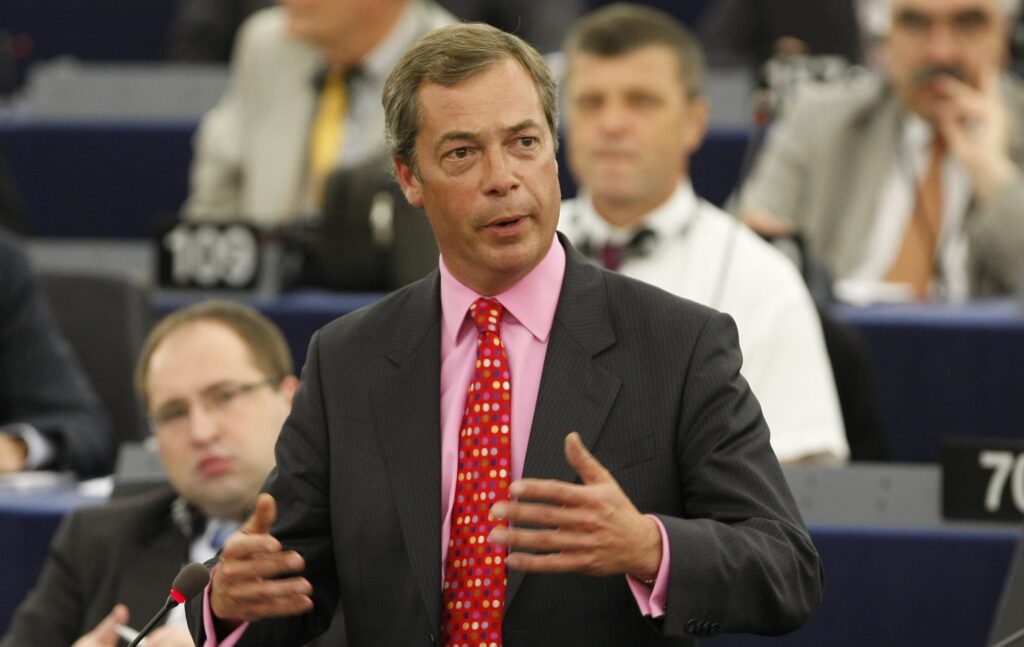
On 4 April 2006, David Cameron referred to the UK Independence Party (Ukip) as consisting of “fruitcakes”, “loonies” and “closet racists”.
The comment came during a radio phone-in interview on LBC, when the Conservative leader was asked about Ukip’s plan to press for the names of Tory donors to be made public under the Freedom of Information Act.
***
On 6 December 2005, Cameron was declared the new leader of the Conservative Party, securing a decisive victory over his rival David Davis. In a ballot of party members, the 39-year-old Old Etonian won 134,446 votes (68%) to Davis’ 64,398 (32%).
In his victory speech at the Royal Academy of Arts, Cameron promised to move away from the “Punch and Judy politics of Westminster, the name calling, backbiting, point scoring, finger pointing.”
Ukip, founded in 1993, had increased its representation to 12 MEPs at the 2004 European Parliament elections. These contests were fertile territory for the party – on account of the proportional electoral system, the issues at hand and the apparent opportunity for voters to register a protest.
At the 2005 general election, Ukip stood 496 candidates – the fourth most of any party – but only won 605,973 votes (2.2%).
At the time of Cameron’s 2006 interview, therefore, mere months into his tenure as Tory leader, Ukip had arguably not yet established itself as a serious threat on the right of British politics.
Speaking to LBC, Cameron argued that Ukip’s mission was mostly to cause mischief. He described the party as “sort of a bunch of… fruitcakes and loonies and closet racists, mostly.”
The remark provoked an immediate and furious reaction from Ukip. The party initially threatened legal action before later backing down.
Roger Knapman, Ukip’s leader at the time, said the attack on his party was a “sad, silly, stupid affair by… Mr Cameron who is inexperienced as party leader and as a politician generally.”
Nigel Farage, one of Ukip’s 12 MEPs, demanded an apology. “Let him tell us anything that we have said that could be construed as remotely racist, otherwise we demand an apology”, he said.
Farage added: “I don’t mind him calling us loonies – I don’t mind him calling us fruitcakes. We are big enough and ugly enough and we have a sense of humour. But what you cannot do in the 21st Century is to lob about accusations of racism.
“That is an absolute disgrace. We are a non-racist, non-sectarian party and we always have been, and frankly we’re a damn sight more cosmopolitan than Mr Cameron’s Conservative Party.”
Farage maintained that there was “a tradition of the Conservatives being very rude about Ukip.”
“After all, [former Tory leader] Michael Howard called us cranks and gadflies, and I’m wearing the gadfly tie today… I think it just shows that we’ve touched upon a nerve.”
He continued: “We’ve just elected Delroy Young [who is black] to our NEC [national executive committee.”
***
Cameron, however, defended his remarks.
“I don’t think I’m saying anything that hasn’t been said before”, he said. “Ukip have some issues – not least that their own founding member Dr [Alan] Sked left the party because he thought they had been infiltrated by the far right.”
He added: “I was making a general point that they are the ‘stop the world I want to get off’ party…
“I don’t think they’ve got anything to say to a modern country and I was being asked particularly about something they’re doing at the moment but, no, I think [it was] a very sensible thing to say.”
As Ukip’s support grew, Cameron’s “fruitcakes and loonies” quote came to symbolise an early underestimation of its political potency and electoral potential.
From 2010 to 2015, Ukip exerted considerable centrifugal pressure on the Conservative Party. This relationship was a critical factor in shaping Cameron’s 2013 pledge to hold an “in-out” referendum on EU membership.
Ukip then secured the largest share of the vote in the 2014 European parliament elections – a result that sent shockwaves through British politics. It was the first time in over a century (since 1910) that a national election had not been won by either the Conservative or Labour parties.
The eurosceptic party, now led by Farage, secured 27.5% of the vote, winning 24 of the UK’s 73 seats in the European parliament. This represented a 11-seat increase on its 2009 performance and marked the high point of its electoral success. The Labour Party came second with 25.4% of the vote and 20 seats (up seven), while the governing Conservative Party was pushed into third place with 23.9% and 19 seats (down seven).
Mere months later, Ukip gained its first MP in the form of Conservative defector Douglas Carswell. Carswell triggered a by-election in his Clacton constituency – and won it. He was followed by Mark Reckless, the MP for Rochester and Strood.
At the 2015 general election, Farage’s party secured 12.6% of the vote, finishing third in terms of votes cast. However, due to the first past the post electoral system, this translated into only one seat (Carswell in Clacton).
Farage’s status as arch-Tory tormentor, of course, did not end with the 2015 poll.
Cameron announced his intention to resign as prime minister and Conservative leader in the wake of the 2016 Brexit referendum.

Politics.co.uk Newsletters
DAILY
Politics@Lunch
WEEKLY
Week in Review
