Healey narrowly defeats Tony Benn after deputy leadership challenge
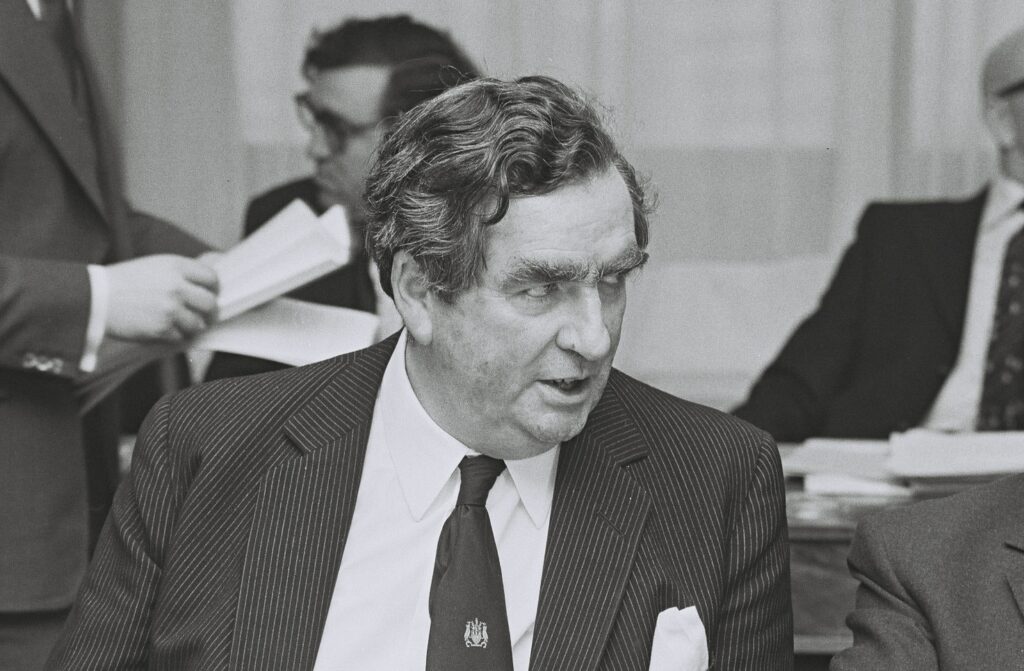
On 27 September 1981, Denis Healey was re-elected as deputy leader of the Labour Party, fending off a challenge from the left-winger Tony Benn. Healey prevailed by just 50.4% to 49.6% in the second ballot; the narrow margin of victory – by just 0.852% of the electoral college vote – carried profound consequences for the future of the Labour Party.
The contest was the first conducted under the party’s new electoral college system, of which Benn was a leading proponent. The system, agreed at a special Labour conference in Wembley, apportioned the vote between the trade unions/affiliates (40%), the constituency parties (30%), and the Parliamentary Labour Party (PLP) (30%).
Previously, only MPs could vote in internal leadership elections.
***
The 1981 contest came at a moment of crisis for Labour. Earlier in 1981, former cabinet ministers Roy Jenkins, Shirley Williams, Bill Rogers and David Owen – the ‘gang of four’ – all left Labour to found the Social Democratic Party (SDP). The SDP, which quickly forged an alliance with David Steel’s Liberals, was formed as a response to Labour’s leftward shift under the leadership of Michael Foot.
The famous ‘Limehouse Declaration’ (January 1981) was issued as an immediate reaction to the rule changes agreed at Labour’s Wembley conference. “The calamitous outcome of the Labour Party Wembley conference demands a new start in British politics”, the declaration began.
It added: “A handful of trade union leaders can now dictate the choice of a future prime minister.
“The conference disaster is the culmination of a long process by which the Labour Party has moved steadily away from its roots in the people of this country and its commitment to parliamentary government.”
Over the course of 1981, 28 Labour MPs defected to the SDP – which now threatened to ‘break the mould’ of British politics.
Labour, facing a new social democratic opponent, remained split between moderate and maximalist tendencies. The 1981 deputy leadership election, therefore, was framed as a battle for the soul of the party.
Healey and Benn were both political heavyweights. They were elected to parliament in 1952 and 1950 respectively, and had both served as senior cabinet ministers. Healey was Foot’s opponent on the social democratic right in the 1980 Labour leadership election. (Foot won the support of 139 MPs on the second ballot; Healey emerged with 129.)
Benn, the former peer, was a figurehead of the party’s socialist wing, having previously stood in the 1976 leadership election. His platform included unilateral nuclear disarmament, sweeping nationalisation and withdrawal from the European Economic Community (EEC).
The long campaign over the course of 1981 was bitter and divisive. It consumed Labour, meaning the party mostly failed to capitalise on prime minister Margaret Thatcher’s lagging position in the polls. The SDP-Liberal ‘Alliance’, meanwhile, had soared above Labour and the Conservatives to occupy first place.
Benn was denounced by some on the Labour frontbench for the way he went about the campaign. In September 1981, the Labour chief whip, Michael Cocks, said a Bennite victory would be “little short of a disaster.”
Cocks, who was supporting Healey, said that “there is a basic distrust, however unfounded, amongst most Labour voters about both Mr Benn’s motives and those of his supporters.”
***
In the first round of voting, the race’s third candidate, John Silkin, was eliminated. Silkin secured 18.0% of the electoral college vote; Healey and Benn stood on 45.4% and 36.6% respectively.
The final ballot proved incredibly close. Benn secured an overwhelming majority of the constituency party vote (81.1%). But Healey secured a commanding majority of the PLP (65.9%) and the heavily weighted trade union/affiliated bloc (62.5%).
Ironically, Healey had opposed the move to give the unions a plurality say in internal contests. At the time, Healey said the Wembley conference vote did “not reflect the majority view, and will have to be remedied.”
A crucial factor in Healey’s victory was the decision of approximately 20 MPs from the Tribune Group, including Neil Kinnock, to abstain. These Tribune Group MPs – said to represent the ‘soft left’ – voted for Silkin in the first round but absented themselves in the second.
Kinnock, the shadow education secretary, said he had refused to vote for Benn as he stood “for victory in the next general election”. The future Labour leader also said he expected to lose his seat on the national executive committee (NEC) as retribution for his abstention.
This split prompted committed Bennites to form the Campaign Group/Socialist Campaign Group.
Despite Benn’s defeat, the conference in Brighton advanced the adoption of a left-wing programme. The 1,300 delegates voted to outlaw private schools, to nationalise most banks and financial institutions, and to reject a mandatory policy of wage restraint. A measure to pay all 16 to 19-year-olds, whether they had jobs or not, was also approved.
Some of these measures, or moderated versions of them, would later find a place in Labour’s 1983 election manifesto – the “longest suicide note in history”.
In the immediate term then, Benn’s defeat intensified rather than resolved Labour’s internal conflict. Some of Benn’s supporters said they would urge the leading left-winger to challenge Healey again the following year.
David Winnick, however, a Bennite Labour MP, said that “there should be no election next year so that Labour can concentrate its whole attention on forcing out this terrible Thatcher government”.
In any case, Benn’s narrow defeat was ultimately interpreted as a moral victory by the Labour left. Benn confided in his diary that he entered the Brighton conference hall on 27 September 1981 “prepared for a massive defeat”.
The result effectively guaranteed that factional conflict would persist within Labour for the remainder of the 1980s.
Moreover, the Bennite overperformance in the 1981 deputy leadership election helped develop the politics and careers of several prominent future left-wingers – including Jeremy Corbyn, John McDonnell and Diane Abbott.
Healey’s victory, however, was viewed by the party’s right as crucial in preventing a full-scale takeover by the Bennite left. Contemporary commentators suggested that a defeat for Healey could have triggered a further exodus of MPs to the SDP.
Tony Blair, prime minister from 1997 to 2007, later remarked that Healey’s 1981 victory “probably saved the Labour Party as an instrument of government”.
***
In November 1981, Michael Foot announced he would not vote for Tony Benn in the shadow cabinet elections, stating he could not trust him to uphold collective responsibility. The electorate for the shadow cabinet was, at the time, confined to the PLP.
The announcement followed a commons debate on North Sea oil where two separate positions were set out by Labour frontbenchers. The party’s energy spokesperson, Merlyn Rees, opened the debate entirely on-message. He stated that a future Labour government would “restore the assets to public ownership on terms that will ensure that no private speculative gains are made at the nation’s expense”.
Benn, closing the debate from the Labour frontbench, described the “reacquisition of public assets without compensation” as “the policy of the Labour Party”.
He added that the party’s “long-term policy” was to “bring all oil into public ownership, including BP”. This strategy, the former peer said, would be “buttressed by price controls, exchange controls, the planning of our trade, and withdrawal from the common market”.
This policy discrepancy was seized upon by government ministers, including the newly appointed energy secretary, Nigel Lawson.
Lawson responded: “[Benn] has committed his party to re-nationalisation without compensation of all assets that are privatised and to the total nationalisation of the oil companies and a number of other things.”
He added: “Is that the position of the opposition? Is that the policy of his right honourable friends on the opposition frontbench?”
Hamish Gray, the minister of state for energy, asked: “For whom does [Benn] speak? Is he speaking for himself, the Labour Party, the national executive of the Labour Party or is he just having a general kick-around?”
Foot described the situation as a “shambles”. He said that a commons debate “that should have concentrated our attack on the Tory policy about North Sea oil was transformed by Tony Benn into a quarrel about our own policy on the issue of compensation.”
Benn responded by defending his actions. “I will not allow the shadow cabinet to silence me or anybody else on policies the party has agreed”, he stated. The Labour MP confirmed he was standing for the shadow cabinet to “make it absolutely clear that if I am elected, I would want to be free to speak up for our policies – on Europe, on jobs, on defence, on peace”.
Benn ultimately lost the 1981 shadow cabinet election. He had previously replaced Bill Rodgers, one of the ‘gang of four’, around the shadow cabinet table.
However, the size of Benn’s vote among his PLP colleagues was reported as a “blow” to Foot.
***
The 1981 deputy leadership election ultimately represented the high-water mark of Bennite influence within Labour – a level of left-wing prominence not surpassed until Jeremy Corbyn’s election as leader in 2015.
Benn lost his Bristol East seat at the 1983 general election, ruling him out of the leadership contest that followed.
He returned to the commons as the MP for Chesterfield in 1984.
Healey served as shadow foreign secretary for most of the 1980s. He declined to run in the leadership contest that followed Foot’s resignation, and instead stood down as deputy leader.
Benn later launched a challenge against Neil Kinnock, Labour leader from 1983 to 1992. The 1988 leadership election resulted in an overwhelming victory for Kinnock with 88.6% of the electoral college vote.

Politics.co.uk Newsletters
DAILY
Politics@Lunch
WEEKLY
Week in Review