Callaghan’s ‘no chaos’ comment sparks outrage after Guadeloupe summit
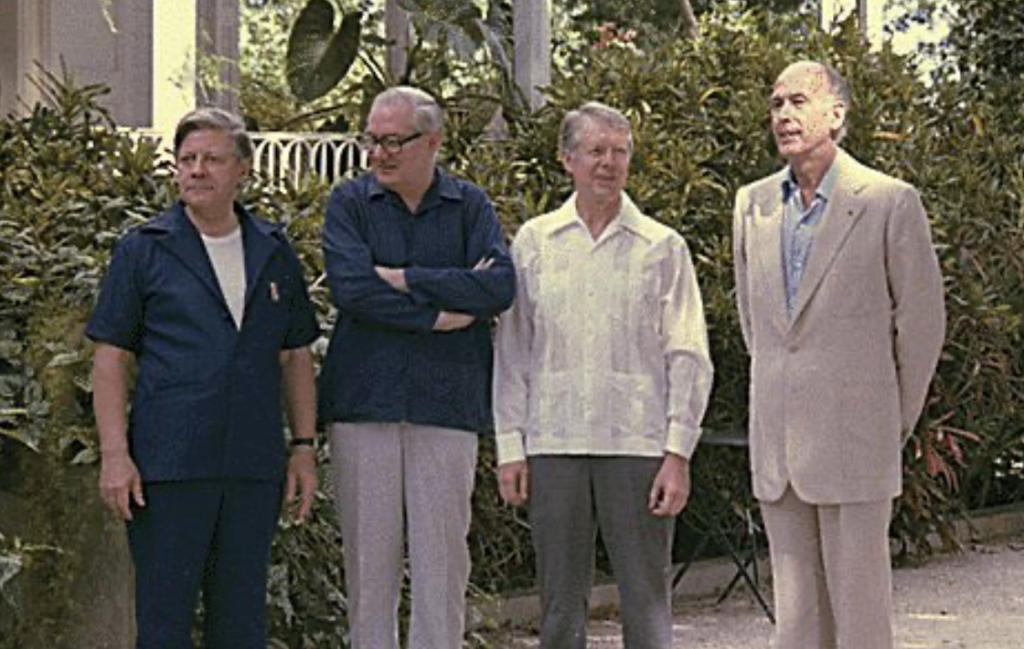
On 10 January 1979, having arrived back in Britain from an international summit in Guadeloupe, prime minister James Callaghan implied that the country was not in “chaos”.
Callaghan was elected as the leader of the Labour Party in 1976, succeeding Harold Wilson in that capacity and as prime minister.
In assuming the role of prime minister, Callaghan – variously referred to as “Sailor Jim” and “Sunny Jim” – became the first and so far only politician in history to hold all four of the great offices of state: chancellor of the exchequer (1964 to 1967), home secretary (1967 to 1970), foreign secretary (1974 to 1976) and prime minister.
But he inherited a precarious political and economic situation. The country was in the grip of an economic crisis with high inflation; Labour, meanwhile, stood on the cusp of losing its majority in parliament.
Shortly after entering Downing Street, Callaghan was forced to negotiate a deal with the Liberal Party, known as the Lib-Lab pact. The pact ended in the summer of 1978, depriving the government of 13 crucial parliamentary votes. Labour was left to rely on ad-hoc support and an often innovative whipping operation.
Callaghan passed up the opportunity to call an election in the autumn of 1978 – a decision that is now regarded as a major strategic miscalculation. On 14 December 1978, the government survived a vote of confidence by 10 votes after negotiating the support of the Ulster Unionists.
***
In January 1979, Callaghan faced criticism for attending a four nation summit in Guadeloupe during a period of widespread industrial unrest – a period now known as the “Winter of Discontent”.
In the Caribbean, Callaghan held talks on the escalating crisis in Iran and the proposed SALT II arms control treaty with the Soviet Union. US president Jimmy Carter, German chancellor Helmut Schmidt and French president Valéry Giscard d’Estaing were also in attendance.
Afterwards, the prime minister took a short holiday in Barbados, where he was snapped swimming in the sun.
Upon landing back in the UK, with the press having gathered in the airport, Callaghan appeared to downplay the domestic situation.
An Evening Standard reporter asked: “What of the mounting chaos in the country at the moment?”
Callaghan responded: “I promise if you look at it from the outside, I don’t think other people in the world would share the view that there is mounting chaos”.
Callaghan’s comment was memorably seized upon by the Sun newspaper, which subsequently ran the headline: “Crisis? What Crisis?”. The pointed paraphrase has been associated with Callaghan’s premiership ever since.
The article began: “Sun-tanned premier Jim Callaghan breezed back into Britain yesterday and asked: Crisis? What Crisis.”
The headline is said to have captured the public mood, which generally saw Callaghan’s government as flat-footed in responding to the turmoil.
Michael Heseltine, the shadow environment secretary, responded: “It’s quite obvious Mr Callaghan is out of touch with the deteriorating situation in Britain… to come back and suggest it all looks parochial is frankly patronising.”
***
On 17 January, a week after Callaghan’s infamous comments, Margaret Thatcher addressed the nation in a party-political broadcast.
The Conservative leader, delivering her lines from a sitting room, said that she did not want to use her broadcast to “make party political points”. Thatcher argued that the “crisis that our country faces is too serious for that.”
She questioned what happened to Britain’s “sense of common nationhood and even of common humanity.”
Thatcher added: “We’ve seen strikes called before agreements have ended. We’ve seen them used as a weapon of first resort, not as the last step after everything else has failed… The result of recent legislation and practice is that today almost any determined group can strangle the country.”
She said that there could be no solution to the crisis facing Britain that did “not include some restriction on the power of the unions.”
The Conservative leader concluded: “If the present crisis has taught us anything it has surely taught us that we have to think of others as well as ourselves; that no one, however strong his case, is entitled to pursue it by hurting others.
“There are wreckers among us who don’t believe this. But the vast majority of us, and that includes the vast majority of trade unionists, do believe it, whether we call ourselves Labour, Conservative, Liberal – or simply British.
“It is to that majority that I am talking this evening. We have to learn again to be one nation, or one day we shall be no nation. If we have learnt that lesson from these first dark days of 1979, then we have learnt something of value.”
On 28 March 1979, the Labour government was defeated by a single vote in a motion of no confidence. The successful ‘no confidence’ motion – passed by 311 votes to 310 – led directly to the 1979 general election.
During the 1979 general election campaign, a Conservative Party campaign broadcast began with the Sun‘s “Crisis? What Crisis?” headline. The phrase was then repeated by an increasingly desperate-sounding voice actor. The broadcast was interspersed with film footage of piles of rubbish, closed factories, picketed hospitals and locked graveyards.
Thatcher’s Conservatives ultimately secured 339 seats (up 62), securing a comfortable majority of 43. The Labour Party slumped to 269 seats (down 50). The swing to the Conservatives of 5.2 points was the largest since 1945.
***
Callaghan resigned as Labour leader in 1980. He stepped down from the commons at the 1987 general election, and was elevated to the House of Lords as Baron Callaghan of Cardiff shortly thereafter.
Speaking in 1999, Callaghan remarked that he would not be surprised if he was considered the worst prime minister for more than 200 years.
In an interview with The Oldie magazine, Lord Callaghan said: “I think we are all re-evaluated as time goes by and I should not be the slightest bit surprised if there is another evaluation after I die and people come to the conclusion that I was the worst prime minister since [Robert] Walpole.”
In the same interview, Callaghan admitted his remarks on 10 January 1979 had been “insensitive”.
He commented: “It was my fault in the sense that I was the leader of the country.
“I was the prime minister and we had got ourselves into a position that was really disgraceful. It was probably a combination of weak leadership among the trade unions and insensitivity on my part, but I must carry the can.
“I very much regret it. Even at my present age if I were to go back and be prime minister now I would certainly take more initiatives than I did then.”
Callaghan died on 26 March 2005, aged 92.

Politics.co.uk Newsletters
DAILY
Politics@Lunch
WEEKLY
Week in Review
