Harold Wilson announces shock resignation as prime minister
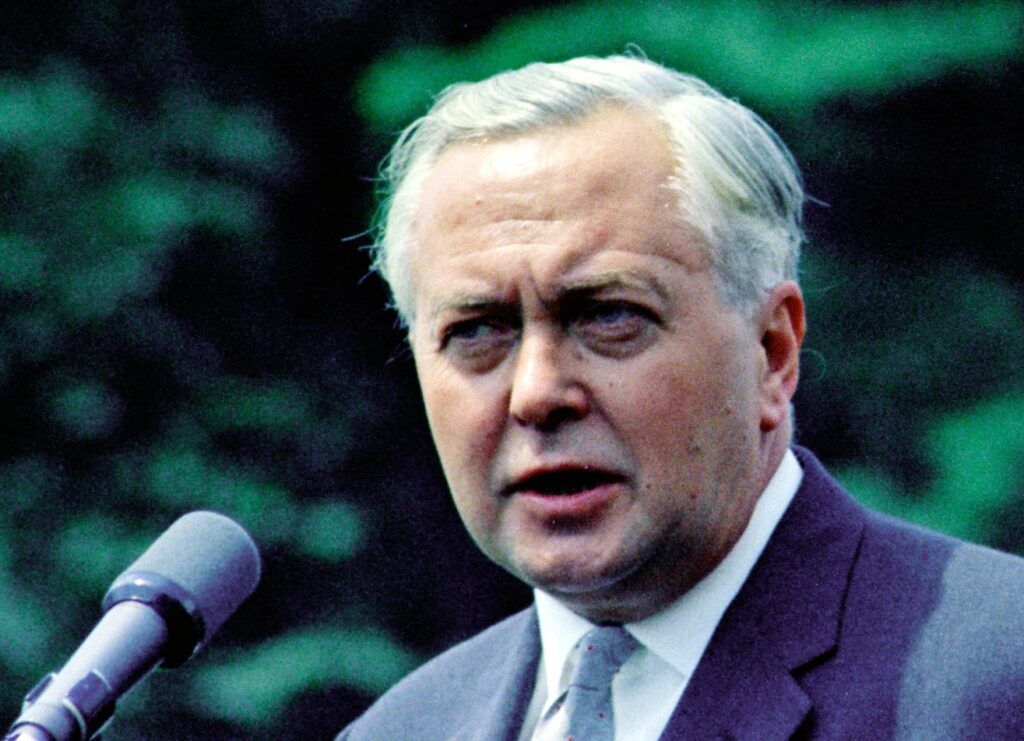
On 16 March 1976, prime minister Harold Wilson announced that he was resigning from office – a decision that took the country and most of his cabinet colleagues by complete surprise.
Wilson had been a fixture in British politics for three decades. He was elected leader of the Labour Party in February 1963, defeating George Brown.
As Labour leader, Wilson won four general elections in 1964, 1966, February 1974 and October 1974. He lost the 1970 general election to the Conservative Party under Edward Heath’s leadership.
During his tenure as prime minister, Wilson oversaw legislation that outlawed racial discrimination in public places, relaxed divorce laws, established the right to equal pay for equal work between men and women, and legalised abortion.
His resignation came just five days after his 60th birthday.
***
Wilson’s shock announcement sparked significant speculation about his motives and sense of timing. But the outgoing prime minister was adamant that his decision was entirely personal, owing to a calculation made after the October 1974 general election.
He told one senior adviser in 1974: “I have been around this racetrack so often that I cannot generate any more enthusiasm for jumping any more hurdles.”
According to his resignation statement, Wilson notified the queen of his intention to resign in December 1975.
Barbara Castle, a long-serving cabinet minister in the 1960s and 70s, later related that Wilson was fed up. “I’m tired of this job”, Castle quoted him as saying. “I’ve spent 13 years trying to keep this party together and it’s been a pretty thankless task.”
On 4 March 1976, Wilson reportedly said: “I want to talk to you as an old friend who has always been loyal to me. You are the only person I know who never leaks. I am getting tired of this job.
“I’ve spent 13 years trying to keep this party together and it’s been a pretty thankless task. Do you know I’ve only been to the theatre about twenty times in all those years? Because I have had to keep on top of everything that is happening.”
In his resignation statement, Wilson revealed that as early as March 1974 – shortly after that year’s first general election – he had decided he would serve for no more than two years in office. The outgoing prime minister said he had intended to stand down early but delayed his departure in order to ensure the implementation of the government’s counter inflation policy.
Wilson set out several reasons for his departure.
He referenced the long service on the political frontline, having first achieved cabinet office in 1947. He said his tenure as prime minister was “longer than that of any of my peacetime predecessors in this century.”
Wilson added: “To have led four administrations, dedicated not only to solving the nation’s economic problems but also to achieving a higher level of social justice and equality than our people have ever known is a privilege conferred on very few men.”
But he argued that no leader should remain indefinitely while “others are denied the chance”. The longstanding Labour leader described his top team as the most “experienced and talented” since that of Liberal prime minister Henry Campbell-Bannerman.
As far as any political calculation was considered, Wilson said he wanted to give his successor enough time to establish his own style and authority “for the remaining years of this parliament.”
He also warned of the danger that long-serving leaders might become resistant to reconsidering policies they had previously rejected, a tendency he was determined to avoid.
The outgoing prime minister stated: “Fourth, there is a danger to which I have been alerted all my working life. It is that, in times of rapid change, you may be faced with a decision which, perhaps in different conditions, you have faced before.
“If, on the earlier occasion you considered and rejected a particular course of action, there is a tendency to say you have been into that, so that you do not give the fresh consideration the circumstances may require.
“I am determined not to succumb to this danger”.
Wilson added: “I want to make it quite clear, with the agreement of all my cabinet colleagues, that these reasons represent the total explanation of my decision.”
He emphasised that there were no “impending problems or difficulties – economic or political” behind his decision.
Wilson confirmed his intention to remain in parliament to serve his constituents, declaring: “I am above all a parliamentarian. I love parliament and want to go on serving it and serving in it.”
***
Wilson’s voluntary resignation mid-term was almost unprecedented in modern British politics. He publicly denied that health concerns played any role in the decision, but this aspect has since been the subject of wide speculation. In his retirement years, the former prime minister was diagnosed with colon cancer and Alzheimer’s.
Notably, Wilson’s reputation was immediately tarnished by his controversial resignation honours list, nicknamed the “Lavender list”, which rewarded a number of businessmen and associates. Lord Kagan, elevated as part of the honours list, was convicted of fraud in 1980; another, Sir Eric Miller committed suicide while under investigation for fraud in 1977.
The original list of nominees was drawn up by Wilson’s political secretary Marcia Williams on lavender notepaper – hence its nickname. Roy Jenkins, the former home secretary, later noted that Wilson’s retirement “was disfigured by his, at best, eccentric resignation honours list, which gave peerages or knighthoods to some adventurous business gentlemen, several of whom were close neither to him nor to the Labour Party.”
***
Wilson’s departure triggered a leadership contest within the Labour Party.
Six senior cabinet ministers, including James Callaghan, the foreign secretary; Michael Foot, the employment secretary; Roy Jenkins, the home secretary; and Tony Benn, the energy secretary, entered the race. In the third and final ballot of Labour MPs, Callaghan defeated Foot by 176 votes to 137. He took over as prime minister on 5 April 1976.
Callaghan, considered a non-divisive and experienced candidate, entered the contest as the favourite. In his acceptance speech, the new Labour leader paid tribute to Wilson, but asked for the party to “wipe the slate clean”.
In assuming the role of prime minister, Callaghan became the first and so far only politician in history to hold all four of the ‘great offices of state’: chancellor of the exchequer (1964 to 1967), home secretary (1967 to 1970), foreign secretary (1974 to 1976) and prime minister.
On 28 March 1979, the Labour government was defeated by a single vote in a motion of no confidence. The successful no-confidence motion – passed by 311 votes to 310 – led directly to the 1979 general election and Margaret Thatcher’s elevation as prime minister.
Wilson remained in the House of Commons until retiring in 1983 when he was elevated to the peerage as Baron Wilson of Rievaulx.
In October 1979, while still serving as an MP, Wilson hosted two editions of BBC2’s live chat show Friday Night, Saturday Morning – the first time a past or sitting prime minister had fronted an entertainment programme. The experiment in drafting an ex-prime minister as a presenter, however, was widely judged to be a failure. The perceived decline in Wilson’s quick wittedness was later attributed to cognitive decline. Iain Johnstone, Friday Night, Saturday Morning producer, believed Wilson was suffering from Alzheimer’s disease at the time.
***
Wilson died in May 1995, aged 79.
Tony Blair described his predecessor – then the last Labour leader to win a general election – as “Labour’s most successful leader ever”.
Blair stated: “This brings to an end a life of extraordinary service both to the country and to the Labour Party. He was a source both of support and inspiration for all his successors.”
John Major, the Conservative prime minister, said Wilson had “served his country diligently and loyally”, praising his “lifetime of unstinting work as a parliamentarian and statesman.”
Thatcher also paid tribute to her erstwhile opponent as “the most skilful of politicians”.
She added: “I always admired his wit and often appreciated his kindness.”

Politics.co.uk Newsletters
DAILY
Politics@Lunch
WEEKLY
Week in Review