Labour’s George Lansbury denounces Asquith for ‘torturing’ suffragettes
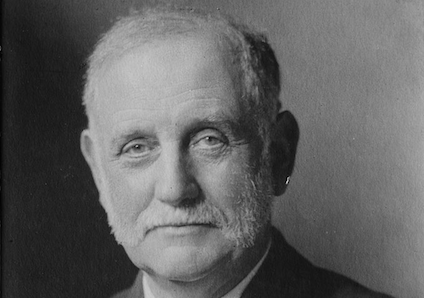
On 25 June 1912, the Labour MP George Lansbury was suspended from the House of Commons after delivering a furious broadside against the prime minister, H. H. Asquith, over the government’s policy of forcibly feeding imprisoned suffragettes.
The confrontation occurred at the height of a campaign of militant direct action by the Women’s Social and Political Union (WSPU). In response to the WSPU’s campaign, which included acts of arson and vandalism, the Liberal government had jailed numerous suffragettes. When many began hunger strikes in protest, the authorities sanctioned the use of force-feeding – a brutal and dangerous procedure which left some women with permanent injuries.
***
Lansbury’s outburst came after Labour MP Keir Hardie raised the case of Emily Davison, a suffragette hunger striker, in the commons.
Davison had a long history of militant action and enduring harsh treatment at the hands of the authorities.
In late 1909, she was imprisoned after throwing stones at Walter Runciman during a political meeting in Radcliffe, Greater Manchester, and was subsequently subjected to force-feeding. Her attempts to resist included barricading herself inside her cell and refusing entry to prison officials. In response, authorities broke a window pane and directed a fire hose into the cell for approximately 15 minutes while attempting to force entry. By the time access was gained, the cell was several inches deep in water. Davison was then taken to the prison hospital but force-fed shortly afterwards. Upon her release, she was awarded 40 shillings in damages.
In December 1911, Davison was sentenced to six months in Holloway Prison for arson, having set fire to the postbox outside parliament. Some months later, she jumped from one of the interior balconies of the prison.
Upon hearing of this incident, Hardie asked the junior Home Office minister, Ellis Griffith, for “information concerning the accident to Miss Emily Davison in Holloway Gaol”, further inquiring whether she had been forcibly fed, and, if so, how many times prior to the incident; the nature of the injuries she had sustained; whether she was now in hospital; and whether she continued to be subjected to force-feeding.
Griffith responded by delivering the state’s official account of events. He said that, after Davison refused to return to her cell after visiting the lavatory, she “threw herself on to the wire netting on the landing below, a distance of about eight feet.”
The minister reported that Davison sustained “a few small bruises and abrasions” and, after complaining of pain, was examined by a specialist from St George’s Hospital, who found “no evidence of gross injury nor any reason why forcible feeding should not be continued.”
Griffith added: “As she refuses to take her food in the natural way, she is being fed by tube. She is not in hospital, but she is under the special observation of the medical officer.”
Hardie suggested that Davidson had attempted to take her own life in order to “call attention to the cruel barbarities which are being inflicted on these ladies”.
Irish nationalist MP Tim Healy called for the prisoners in question to be discharged at once, adding: “Why keep up this needless torture?”
At this point, Asquith, who was in the chamber, intervened.
The prime minister claimed that there was “not a single one of those women” who would not be released if they gave an undertaking to cease militant activities.
Asquith’s remark provoked an immediate and explosive reaction from Lansbury, a pacifist and advocate for women’s suffrage. The Independent Labour Party (ILP) MP accused Asquith of making a “disgraceful” statement and, striding towards the government front bench, shook his fist at the prime minister.
Staring Asquith in the face, Lansbury asserted: “You are beneath contempt! You call yourselves gentlemen, and you forcibly feed and murder women in this fashion! You ought to be driven out of office.
“It is perfectly disgraceful… It is the most disgraceful thing that ever happened in the history of England! You will go down to history as the man who tortured innocent women. That is what you will go down to history as.”
Lansbury then returned to his seat, turned to the speaker of the commons, and concluded: “I have said my say, Mr. Speaker. It is disgraceful that the prime minister of this country should tell women in prison on principle that they can walk out.
With the speaker attempting to restore order, Lansbury reportedly continued his protest for a full five minutes.
The speaker commanded Lansbury to leave the House, on account of his “grossly disorderly conduct”, but the MP refused.
“I am not going out while this contemptible thing is being done. Murdering, torturing, and driving women mad and telling them they can walk out! You ought to be ashamed of yourselves”, he exclaimed.
“You may talk about principle and fight in Ulster. You ought to be driven out of public life. You do not know what principle is. These women are showing you what principle is. You should honour them standing up for their womanhood.
“I say for the prime minister to say they could walk out is beneath contempt, and I shall stick to it. I tell him it is beneath contempt to tell the commons of England that, and to laugh at the suffering of those women. You ought to be ashamed of yourselves.”
The speaker insisted that Lansbury leave the House having disregarded “the authority of the chair”.
The ILP MP responded: “I have no intention in any sort of way of being dishonourable to you, Sir, but I cannot contain myself when men sitting there say these women can walk out, when they know very well they cannot walk out.
“They are fighting for a principle, and members would be better employed if they were doing the same.”
The speaker once again ordered Lansbury to withdraw from the chamber, arguing that the “respect and authority” of the House was at stake.
Lansbury replied: “It has lost it already.”
He then withdrew.
***
Lansbury is said to have been emboldened by messages of support from suffragists. He had grown frustrated at the Labour Party’s perceived lack of enthusiasm and apparent ambivalence in advocating women’s suffrage, privately criticising his colleagues as a “weak, flabby lot”
On 11 November, without consulting party officials, Lansbury resigned his seat of Bow and Bromley to fight a by-election as a “Votes for Women” candidate. He was joined in his campaign by Sylvia Pankhurst.
Asked later why he resigned his seat, Lansbury explained: “Because I could not agree with my party in its attitude when it came to… woman suffrage.
“The Labour Party, which was my party in parliament, had supported woman suffrage outside, had rendered plenty of lip-service, but when it came to the crucial point it refused to stand by that measure…
“I wanted the Labour Party to use its 40 votes in support of woman suffrage. It would not do it.
“That made me at variance with my party and I did not feel, since I had been elected by my constituents as a representative of that party, that I was free to remain there and express my own independent convictions.
“I thought it right to resign and I did so. That is how I came to be known as ‘the man without a party.”
Lansbury lost the 1912 Bow and Bromley by-election to Conservative candidate, Reginald Blair, by 4,042 votes to 3,291. His opponent had campaigned on the slogan “No Petticoat Government”.
In April 1913, the government passed the Prisoners (Temporary Discharge for Ill-Health) Act. The legislation, known as the “Cat and Mouse Act”, allowed for the release of hunger-striking prisoners when they became seriously ill – only for them to be re-arrested to complete their sentence once they had recovered.
At this time, Lansbury was sentenced to six months imprisonment for endorsing militant methods in a speech. “Stand shoulder to shoulder with the militant women”, he had said. “Let them burn and destroy property and do anything that they will.”
Lansbury was released from Pentonville Prison after a hunger strike under the terms of the Cat and Mouse Act. He was never re-arrested.
In August 1914, upon the outbreak of the First World War, the government released all women hunger strikers and declared a general amnesty. The WSPU announced it would cease its campaigns; many suffragettes took to issuing white feathers to those men who did not enlist.
Davison died on 8 June 1913, after sustaining fatal injuries when she threw herself in front of the king’s horse at the Epsom Derby – an event remembered as the final major act of militant protest for the suffrage cause.
***
Lansbury returned to parliament as the MP for Bow and Bromley at the 1922 general election.
After the 1929 general election, Lansbury joined the cabinet as first commissioner of the works. He was among the nine ministers who opposed the report of the May Committee on National Expenditure, published July 1931, which recommended drastic cuts to public spending, including a significant cut to unemployment benefit, to balance the budget. A total of 11 ministers, including Ramsay MacDonald as prime minister and Philip Snowden as chancellor, signaled their support.
This schism directly precipitated the formation of the National Government in August 1931.
Lansbury was the only member of MacDonald’s second ministry from 1929 to 1931 to both remain with the party and retain his seat at the 1931 general election. In fact, he was one of only 52 Labour MPs to retain their seats.
Lansbury’s relative seniority led to his elevation as leader of the official opposition. He served in this capacity from 1932 to 1935 as leader of a diminished Labour Party.
Lansbury was a Christian pacifist. In 1933, Labour’s annual conference passed a resolution calling for “the total disarmament of all nations”.
In 1935, leading trade unionist Ernest Bevin ridiculed Lansbury for “hawking your conscience round from body to body asking to be told what to do with it”.
Lansbury resigned from the Labour leadership, aged 76, a few days later – with his pacifism at odds with the party and the times. His deputy, Clement Attlee, succeeded him as party leader.
Lansbury is the last Labour leader to stand down without contesting a general election.
Under Attlee’s leadership, Labour increased its representation to 154 seats (up 102) at the 1935 general election.

Politics.co.uk Newsletters
DAILY
Politics@Lunch
WEEKLY
Week in Review