Charles Stuart raises standard at Glenfinnan, beginning ’45 rising
On 19 August 1745, Charles Edward Stuart, known as ‘Bonnie Prince Charlie’, raised his father’s royal standard at Glenfinnan in the Scottish Highlands, formally igniting the final Jacobite rising.
Charles and his supporters planned to overthrow the Hanoverian regime under King George II, restoring the House of Stuart to the British throne. They championed the claim to the throne of James VII of Scotland and II of England, who was unseated as a consequence of the 1688 Glorious Revolution.
The revolutionary settlement was consolidated successively by the 1701 Act of Settlement, which limited the line of succession to Protestants, and the 1707 Acts of Union, which created the Kingdom of Great Britain. From 1714, with George I’s accession, the Kingdom of Great Britain was ruled by the Hanoverian dynasty.
***
Jacobitism was a political-religious ideology that comprised an assortment of attitudes and grievances. Discontent with the Union, for instance – especially in the Highlands of Scotland – became strongly affiliated with Jacobitism. But its focus was on the restoration of the deposed, Catholic Stuart dynasty.
Jacobite leaders mounted two serious challenges to the Hanoverian succession: in 1715, led by James Edward Stuart (the “Old Pretender”), and 1745. James Edward was the only son of James II of England, and Charles Edward’s father.
Jacobite is derived from the word Jacobus, Latin for James.
Charles Edward, the ‘Young Pretender’, landed in Scotland from France on 23 July 1745 with only a small contingent of supporters, known as the ‘Seven Men of Moidart’. At the time, much of the British Army, commanded by the Duke of Cumberland, was engaged in the War of the Austrian Succession. In May 1745, it had suffered a defeat at the hands of the French at the Battle of Fontenoy.
Britain’s difficulty was Charles Edward’s opportunity. He hoped to win the support of Highland clan chiefs as the basis for an insurgency throughout Britain. The 24-year-old prince was initially discouraged by the lack of enthusiasm among clan leaders. But the rising gained critical momentum when it secured the support of Donald Cameron of Lochiel, chief of Clan Cameron.
With a small army numbering an estimated 700, the silk standard was unfurled at Glenfinnan. Charles Edward’s proclamation was read out. It declared his father, James Edward, as King James VIII of Scotland and III of England, and himself as Prince Regent.
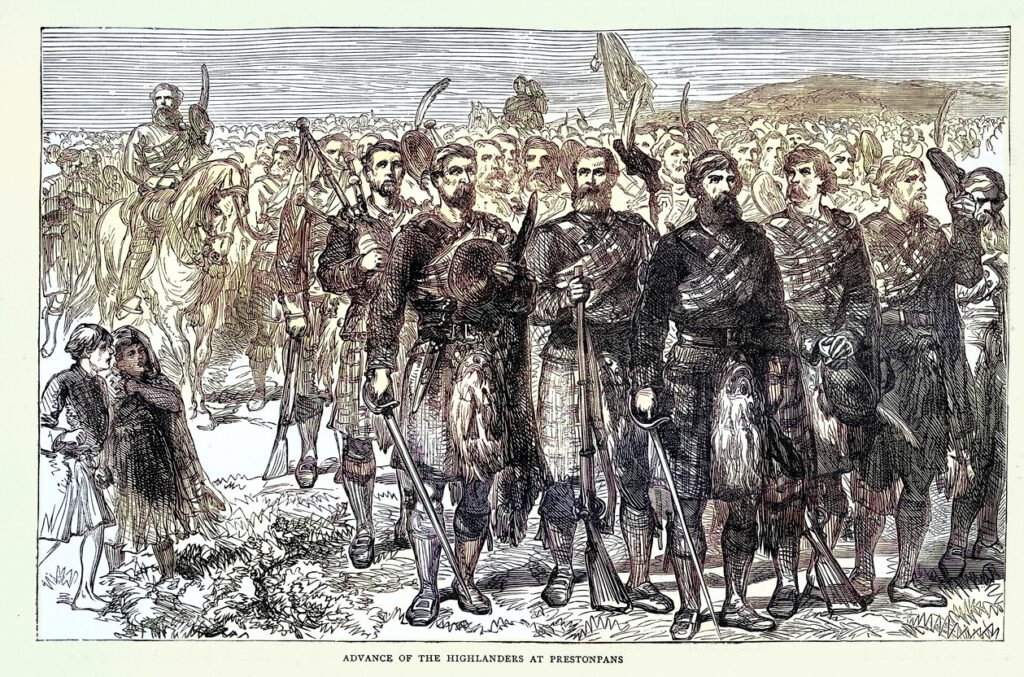
The rebellion, despite its small stature, achieved remarkable initial success: the Jacobite rebels captured Edinburgh on 17 September, defeated a government force at the Battle of Prestonpans under Sir John Cope on 21 September, and marched deep into England. Charles Edward, styling himself “Prince of Wales [and] Regent”, published two declarations on 9 and 10 October.
The first proclaimed the dissolution of “the pretended Union of these Kingdoms”, declaring that those sitting in the parliament at Westminster — termed “an unlawful Assembly” — “shall be proceeded against as Traitors, and Rebels to their King and Country.”
The second said that James Edward, styled as His Majesty, intended “to re-establish all His Subjects in the full Enjoyment of their Religion, Laws and Liberties”.
It condemned the “unlawful Government” of the Hanoverian regime, and pledged to submit “every Law or Act of Parliament since the Revolution” to a “free and legal Parliament”.
It acknowledged the prevalence of anti-Jacobite propaganda, stating: “Do not the Pulpits and Congregations of the Clergy, as well as your weekly Papers, ring with the dreadful Threats of Popery, Slavery, Tyranny and arbitrary Power, which are now ready to be imposed upon you, by the formidable Powers of France and Spain?
“Is not my Royal Father represented as a Blood-thirsty Tyrant, breathing out nothing but Destruction to all those who will not immediately embrace an odious Religion? Or have I myself been better used?
“But listen only to the naked Truth.”
***
By December, the Jacobite insurgents had reached Derby. But lacking English Jacobite support, and with no reinforcements from France, the army retreated to Scotland.
At the Battle of Culloden on 16 April 1746, the Jacobite army of 5,000 Highlanders was defeated by a government force of 7,000, commanded by George II’s youngest son, William, Duke of Cumberland.
1,600 men were killed, 1,500 of them Jacobites, in what would be the last major battle ever fought on the British mainland.
The government and Cumberland responded with a policy of “pacification” – the brutal suppression of the Highland clan system and culture by the British government. Jacobites were rounded up, imprisoned or executed. Estates were forfeited. The Heritable Jurisdictions Act 1746 ended the feudal power of chiefs over their clansmen. “Highland Dress”, the kilt and tartan, was banned.
Under the Dress Act 1746, the penalties for sporting such clothing were “imprisonment, without bail, during the space of six months, and no longer; and being convicted for a second offence before a court of justiciary or at the circuits, shall be liable to be transported to any of his Majesty’s plantations beyond the seas, there to remain for a space of seven years.”
After five months as a fugitive in the western Highlands, Charles Edward left Scotland for France, never to return. He died in Rome in 1788.

Politics.co.uk Newsletters
DAILY
Politics@Lunch
WEEKLY
Week in Review
