Rump Parliament votes to create court for trial of Charles I
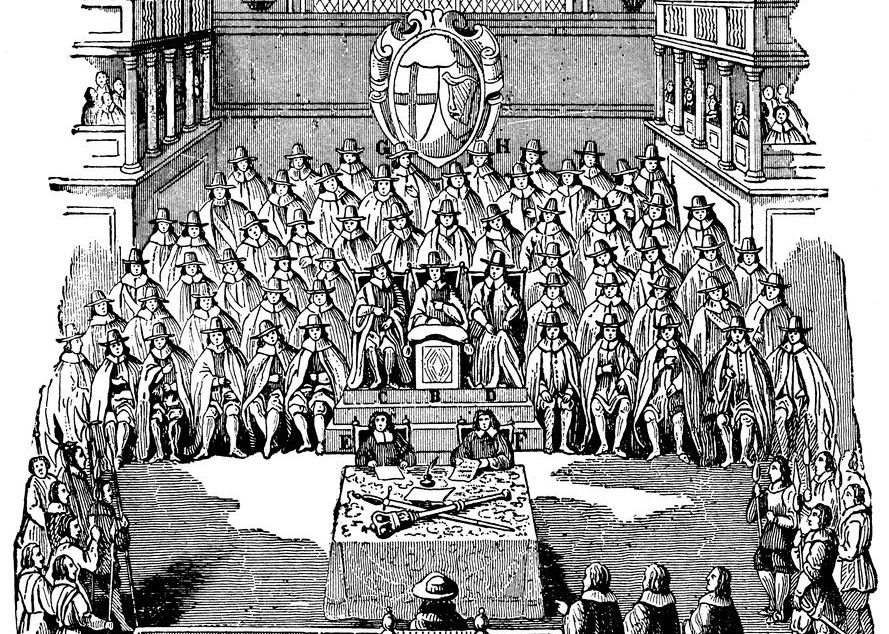
On 6 January 1649, the Rump Parliament forced through an act to establish a High Court of Justice to put King Charles I on trial for treason. The move followed the rejection of a similar ordinance by the House of Lords, which had been agreed by the House of Commons on 4 January.
***
The Rump Parliament was created after a military intervention in December 1648 expelled those seen to be sympathetic to the king. Pride’s Purge, conducted by New Model Army troops on the orders of Colonel Thomas Pride, removed members who were understood to be against trying Charles for high treason.
The purge, a comprehensive military coup, radically changed the composition of the original Long Parliament, which first sat in 1640. Only a “rump” of about 80 more radical members remained; a total of 470 MPs had been elected to the parliament that convened in November 1640.
In January 1649, the House of Commons responded to the Lords’ refusal to sanction the creation of a court to try Charles I by asserting itself as the sole source of sovereignty in the land.
The Rump Parliament declared on 4 January that “the people, are, under God, the original of all just power… That the Commons of England in Parliament assembled being chosen by, and representing the people, have the supream power in this nation… That whatsoever is enacted or declared for law by the house of Commons assembled in Parliament, hath the force of law… And all the people of this nation are concluded thereby: although the consent and concurrence of the King or House of Peers, bee not had thereunto.”
Under this assumed authority, the Rump Parliament bypassed peers in the upper chamber and erected the court to try Charles I.
The 6 January act, entitled “An Act of the Commons of England Assembled in Parliament, for Erecting of a High Court of Justice, for the Trying and Judging of Charles Stuart, King of England”, passed by 29 votes to 26.
The decision to sideline the House of Lords reconfigured the traditional formula for passing legislation. But the commons, which now styled itself as the “Parliament of England”, assumed all legislative responsibility under the new settlement. The 6 January act was said to hold “the force of law” under the declaration issued two days previously.
The act accused Charles I of a “wicked Design” to subvert the “Ancient and Fundamental Laws and Liberties of this Nation, and in their place to introduce an Arbitrary and Tyrannical Government”.
Moreover, the king acted “with Fire and Sword, Levied and maintained a cruel War in the Land, against the Parliament and Kingdom, whereby the Country hath been miserably wasted, the Publick Treasure Exhausted, Trade decayed, thousands of People murdered, and infinite other mischiefs committed”.
The act insisted that parliament had hoped the “Restraint and Imprisonment [of Charles]… would have quieted the distempers of the Kingdom”. But it found that such “Remissness served only to encourage him and his Complices in the continuance of their evil practices, and in raising of new Commotions Rebellions and Invasions.” To prevent future attempts by rulers to “enslave or destroy” the nation, parliament resolved that judicial action against the king was necessary.
The act arranged for the creation of a trial court comprising 135 commissioners, and authorised the court to find Charles guilty of treason – a charge punishable by death. Among the 135 commissioners were prominent parliamentary and army leaders such as Thomas Fairfax, Oliver Cromwell, and Henry Ireton. At this stage, Cromwell was member of parliament for Cambridge and lieutenant-general of the New Model Army.
In the event of a conviction, the court was required to proceed to a “final Sentence” and execute it “speedily and impartially.”
The commissioners met to make arrangements for the trial on 8 January.
On 30 January, at the end of the four-day trial, Charles I was publicly executed. Of the 135 commissioners appointed, 59 signed the king’s death warrant.
Charles was judged to have “traitorously and maliciously levied war against the present parliament and the people therein represented”. The king was “guilty of all the treasons, murders, rapines, burnings, spoils, desolations, damages and mischiefs to this nation, acted and committed in the said wars, or occasioned thereby.”
***
In March, the Rump Parliament passed acts providing for the abolition of the monarchy and the House of Lords.
Conscious of accusations that their actions lacked legitimacy, on 22 March the Rump agreed a declaration that publicly justified their “late proceedings” – namely the execution of the king and the abolition of the House of Lords.
The document began by asserting that parliament, elected to represent the people, had struggled “to remove Oppression, Arbitrary power, and all Opposition to the Peace and Freedom of the Nation.”
To this end, MPs had implemented alterations “which they judge most conducible to the honor of God, and the good of the Nation, the only end and duty of all their Labors.”
First and foremost, the declaration defended the unprecedented decision to put a king on trial, arguing that “the Crimes of the late King” were also unprecedented.
It stated: “The Representatives of the People now Assembled in Parliament, have judged it necessary to change the Government of this Nation from the former Monarchy, (unto which by many injurious incroachments it had arrived) into a Republique, and not to have any more a King to tyrannize over them.
Parliament then turned to the abolition of the House of Lords, arguing that the upper chamber “did not at all represent” the people in blocking legislation. The declaration argued that “neither the Government [or] Republique, nor the common safety could bear the Delays and Negatives of a House of Lords”.
Parliament vowed to continue to make alterations “for the taking away of corruptions, and abuses, delays, vexations, unnecessary travel and expences, and whatsoever shall be found really burthensome and grievous to the people.”
On 19 May, parliament passed An Act Declaring and Constituting the People of England to be a Commonwealth and Free-State.
This legislation stated that the country would be governed “by the Supreme Authority of this Nation” with power exercised by “the Representatives of the People in Parliament, and by such as they shall appoint and constitute as Officers and Ministers under them for the good of the People, and that without any King or House of Lords”.
***
The abolition of the monarchy and resultant republic were, in the end, impermanent constitutional fixtures.
The monarchy was restored on 8 May 1660 after eleven years of republican rule under the Commonwealth and Protectorate. The Convention Parliament proclaimed that King Charles II had been the lawful monarch since the execution of Charles I in January 1649.
The Restoration regime granted a general amnesty for treasonous acts under Indemnity and Oblivion Act, with the exemption of Charles I’s “regicides” – those deemed to have directly participated in or sanctioned his execution in 1649. A previous proclamation by Charles II, dated 6 June 1660, stated that the 1649 execution was the “most horrid and execrable Treason and Murder committed on the Person, and against the Life, Crown and Dignity of Our Late Royal father Charles the First of Blessed Memory.”
In January 1661, under parliament’s orders, the bodies of prominent regicides Cromwell, Ireton, and John Bradshaw (the president of the court that tried Charles I), who had been interred in Westminster Abbey, were exhumed.
The corpses were brought to Tyburn, where they were posthumously executed. Their heads were displayed on the roof of Westminster Hall, the scene of Charles I’s execution and trial.

Politics.co.uk Newsletters
DAILY
Politics@Lunch
WEEKLY
Week in Review