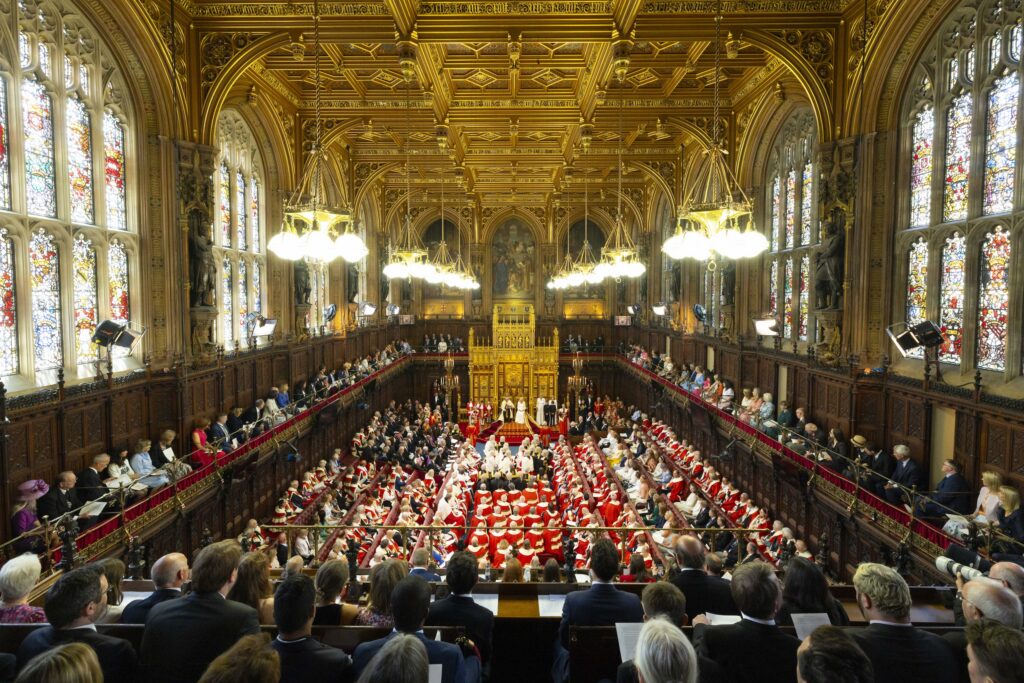
The House of Lords is the second chamber of the United Kingdom parliament, also known as the upper House.
The UK parliament is a bicameral legislature, made up of the House of Commons and Lords. The commons, or lower House, is the democratically elected body of 650 MPs, each representing a specific geographic constituency.
As the House of Lords is an unelected chamber, its powers are limited. Its primary role is to act as a revising and scrutinising body, complementing the work of MPs in the commons. Its members, known as peers, can collectively delay but not block most legislation passed by the commons.
Evaluation question
Given that it can only delay rather than permanently block legislation, to what extent does the unelected status of the House of Lords pose a genuine threat to democratic decision-making?
The influence of the lords is exercised by asking the government to think again, proposing amendments to bills, and conducting in-depth inquiries through its select committees.
Members of the House of Lords are divided into two main categories: the lords spiritual, who are senior members of the Church of England, and the lords temporal, historically comprising both life peers and hereditary peers. (The House of Lords Act 2026 successfully removed all remaining hereditary peers from the chamber.)
The Marquess of Salisbury, who left office in 1902, was the last prime minister to sit in the Lords. By convention, it is now accepted that the prime minister must be a member of the House of Commons. However, ministers can and do continue to sit in the upper House. The most senior minister in the House of Lords is the leader of the House of Lords.
Baroness Smith of Basildon (Angela Smith) was appointed as leader of the Lords in July 2024.
Functions of the House of Lords
Making laws
The House of Lords helps shape legislation. Like the commons, the upper chamber considers proposed legislation (bills) in stages, namely first reading, second reading, committee stage, report stage and third reading.
It mostly scrutinises bills sent to it by the House of Commons; its members propose amendments in the hope of improving the legislation. The commons can ultimately overturn these changes, but many are accepted by the government. Peers can also introduce bills themselves, but the vast majority of legislation is introduced in the commons.
The constitutional primacy of the elected commons over the unelected Lords was formally established by two key pieces of legislation in the 20th century. The Parliament Act 1911, which was the culmination of a constitutional crisis triggered by the Lords’ rejection of the 1909 “people’s budget”, removed the upper house’s power to veto any bill certified by the commons speaker as a “money bill”. For all other public legislation, it replaced their absolute veto with a power to delay a bill for a maximum of two years.
The primacy of the Commons was both affirmed and strengthened by the Parliament Act 1949, which was introduced by Clement Attlee’s post-war Labour government to prevent the Conservative-dominated Lords from obstructing its iron and steel nationalisation plans. This second act further curtailed the Lords’ influence by reducing their delaying power from two years down to just one year.
Holding government to account
Peers question government ministers at the start of each sitting day through oral questions for up to 40 minutes. Four questions are asked on matters for which the government is responsible, and a minister or government spokesperson must respond.
Peers may also apply to the lord speaker to ask a short-notice question. A private notice question (PNQ) gives members of the House of Lords the opportunity to raise urgent matters on any sitting day. A PNQ is submitted in writing to the lord speaker by 12:00 pm on the day on which it is proposed to ask it, or by 9:30 am on Thursdays, Fridays and any other days when oral questions are taken before 1:00 pm. The decision whether the question is of sufficient urgency and importance to justify an immediate reply rests with the lord speaker, after consultation.
Government ministers also make statements in the House of Lords to announce significant policy developments or to report on national and international issues. These statements are usually made in both Houses; just as in the commons, they are followed in the Lords by a question-and-answer session, allowing peers to scrutinise the minister’s remarks.
In addition, the Lords holds debates on major policy issues that are not connected to specific legislation. There are three main types of debate. General debates are long-form discussions, often lasting around five hours, on broad motions such as “that this House takes note of” a particular issue. These debates usually take place on Thursdays. Short debates occur at the end of the day’s business and typically last between 60 and 90 minutes. A peer raises a focused question to the government, which is debated by members before the responsible minister delivers a detailed closing response; they are broadly comparable to adjournment debates in the House of Commons.
The House of Lords also conducts much of its work through cross-party select committees, which carry out detailed, evidence-based inquiries across a wide range of policy areas. Committees include the constitution committee and the economic affairs committee. Their reports are frequently debated in the chamber, providing an opportunity for scrutiny of government policy and performance. Such debates are opened by the committee chair, and a government minister is required to respond to the committee’s findings.
Evaluation question
Given that the House of Lords is unelected and can only delay legislation, how significant is its power to hold the government to account in practice?
Providing expertise
The membership of the House of Lords is its defining feature. It is sometimes characterised as a “chamber of experts” – albeit unelected, usually older experts. Peers can therefore bring unique expertise and experience to the legislative process; many are former frontline politicians possessing decades of accumulated knowledge. In certain cases, they may be better placed to understand current affairs and evolving issues than their elected counterparts in the commons.
Membership of the House of Lords
The House of Lords is unique among the upper chambers of the world in that it has more members than the lower/primary chamber.
Unlike the commons, the upper House does not have a fixed membership. Its size changes constantly due to retirements and deaths, typically ranging between 800 and 830 members. This makes it the second-largest legislative chamber in the world, after China’s National People’s Congress.
Life peers
A life peer is an individual who has been appointed to be a member of the House of Lords for their lifetime. The title and the right to sit in the House are not hereditary and are extinguished upon the peer’s death. Life peers constitute the overwhelming majority of the House of Lords, generally numbering around 700 out of a total membership of 800.
Life peerages are formally granted by the monarch on the advice of the prime minister. These appointments are made to bring a wide range of experience and expertise from different fields into the legislative process.
It was the Life Peerages Act, passed by Harold Macmillan’s Conservative government in 1958, allowed for the creation of non-hereditary members. Significantly, the act allowed women to sit and vote in the House of Lords for the first time.
Life peers, alongside hereditary peers, comprise the secular lords temporal.
Lords spiritual
The House of Lords includes up to 26 Church of England bishops. The United Kingdom is the only Western democracy to grant religious representatives an automatic place in its legislature. In fact, the UK is one of only two countries, alongside Iran, to provide an automatic place for religious clerics in its legislature.
Evaluation question
To what extent can the privileged legislative status of one Christian denomination still be justified?
The 26 places for the lords spiritual are allocated by seniority. Five seats are reserved for the Archbishops of Canterbury and York, and the Bishops of London, Durham, and Winchester. The remaining 21 seats are taken by the longest-serving and most senior diocesan bishops of the Church of England.
Bishops get some unique privileges as a member of the House of Lords. If a bishop stands up to speak during a debate, it is convention for other peers in attendance to resume their seats and listen. The lords spiritual also wear distinct clerical attire, traditionally consisting of a rochet and chimere, when present in the upper chamber.
The lords spiritual serve as the religious counterpart to the secular lords temporal.
Hereditary peers and recent reforms
Hereditary peers are members of the aristocracy who inherit their titles, such as Duke, Marquess, Earl, Viscount, or Baron, from a relative. Historically, all hereditary peers were entitled to sit and vote in the House of Lords.
However, the House of Lords Act 1999 fundamentally reformed this principle. While hundreds of hereditary titles still exist in the UK, the act removed the automatic right of their holders to a seat in parliament. As a result of a compromise made during the passage of that act, 92 seats in the House of Lords were reserved for hereditary peers.
According to this settlement, when one of those peers died or retired, a replacement was chosen in a unique by-election where only other hereditary peers can vote.
The House of Lords (Hereditary Peers) Act 2026 marked the final abolition of the hereditary principle in the British parliament. The legislation fulfilled a Labour manifesto commitment from the 2024 general election and effectively completed the process initiated by the House of Lords Act 1999.
The act removed the right of the remaining 92 excepted hereditary peers to sit and vote in the upper chamber. The act stipulated that the rights of hereditary peers would expire at the end of the 2025-2026 parliamentary session.
The act also permanently abolished the system of hereditary by-elections, which had been used to fill vacancies among the 92 since 1999.
The government agreed to offer additional life peerages to the official opposition in the House and crossbenchers to compensate for the loss of hereditary representatives.
With the passage of the act, the UK joined the majority of 21st-century democracies in removing hereditary elements from its legislature – leaving Lesotho’s Senate chamber as the only remaining body of its kind with a hereditary component.
The leader of the House of Lords, Baroness Smith, described the Bill as a “major first step”.
Smith stated: “The Lords plays a vital role within our bicameral parliament, but nobody should sit in the House by virtue of an inherited title. That is why the government committed to removing the remaining hereditary peerages, completing the reforms that were started over a quarter of a century ago.
Evaluation question
How far does the removal of the final 92 hereditary peers under the House of Lords (Hereditary Peers) Act 2026 complete the reform of the upper chamber?
“Getting this bill through is a major first step towards reform of the Lords, with further changes to follow – including on members’ retirement and participation requirements.”
Crossbenchers and party composition of the House of Lords
Compared to the House of Commons, the key difference in party composition in the upper House is the existence of the crossbenchers.
The crossbenchers are peers who accept no party allegiance. They speak and vote independently on each issue and tend to have accumulated a great deal of experience in their field. The crossbenches include former civil servants, retired defence chiefs of staff and ex-speakers of the House of Commons (excluding John Bercow, commons speaker from 2009 to 2019, who was not elevated to the upper chamber). There is some organisation among crossbenchers. A convenor is elected who engages with the government on behalf of independent peers.
Consequently, unlike the House of Commons, no single party holds a majority in the House of Lords. It has been argued that this enhances the scrutinising function of the upper chamber, as bills must gain support across party lines to progress.
Evaluation question
To what extent does the absence of a built-in government majority in the House of Lords enable it to function as a more effective and collaborative scrutinising body than the highly partisan and heavily-whipped House of Commons?
There are, however, more Conservative peers represented in the upper chamber than Labour peers. This is due to the long list of appointments made by Conservative prime ministers from 2010 to 2024.
The lord speaker
The House of Lords is a self-regulating body, meaning its members are collectively responsible for maintaining order and upholding the rules of the House. This fact means the role of lord speaker is very different from that of the speaker of the House of Commons.
The office of lord speaker is a modern creation, established by the Constitutional Reform Act 2005. They serve as the presiding officer of the House of Lords, responsible for chairing daily business in the chamber and acting as the highest authority within the House. But they have no power to:
- Call members to order for disruptive behaviour.
- Decide who speaks next if two members rise at the same time.
- Select which amendments to legislation are debated.
Instead, the lord speaker’s primary procedural functions during debates are to formally put the question to the House before a vote and to announce the result of any vote. They may also offer procedural advice to the House when required.
The lord speaker is elected by the members of the House of Lords and is expected to be politically impartial, resigning their party affiliation upon election. As well as their procedural duties, the lord speaker acts as a key public figure; they represent the House of Lords both in the UK and internationally.
Lord Forsyth of Drumlean began his tenure as lord speaker in February 2026.
Language and layout of the House of Lords
All speeches in the upper House begin with the words: “My Lords”.
Language must be “parliamentary”. Any “unparliamentary language”, such as swearing or accusing another member of lying, is forbidden. Moreover, peers are not supposed to refer to the House of Commons by name; they instead use the phrases “another place” or “the other place”.
Peers must also not refer to each other by name in the chamber. Instead, they refer to each other as “noble Lords” or “the noble Lord/Lady, the Lord/Lady X”. They may also use the term “my noble friend” to refer to fellow members of a political party. Peers can refer to ministers by their title.
Members of the lord spiritual can be referred to as “the right reverend Bishop”, “the most reverend Archbishop” or the “the Bishop/Archbishop of…”.
The lord speaker presides from the Woolsack, a large, armless seat stuffed with wool and covered in red cloth. The Woolsack, which dates to the 14th century, is said to symbolise the historic importance of the wool trade to the wealth of the English economy. It is technically not located within the formal bounds of the House, so the lord speaker must step to the side of it to address the members as a peer.
The Woolsack stands in front of the chamber’s golden throne. The throne serves as the seat for the sovereign or their representative when they attend the chamber, most notably during the state opening of parliament, when the monarch delivers the king’s speech outlining the government’s legislative agenda.
In the House of Lords chamber, peers are arranged by three sets of benches.
The lords spiritual sit to the immediate right of the Woolsack. The government benches are located beyond the lords spiritual also to the right of the Woolsack. To the left, separated by a gangway, sit the official opposition and other non-government parties.
Government and opposition spokespeople (ministers and shadow ministers) speak from dispatch boxes located in the centre of the chamber.
Facing the Woolsack, between the government and opposition benches, are the crossbenches – where independent or non-aligned peers (crossbenchers) sit.
How much are members of the House of Lords paid?
Members of the House of Lords are not salaried. To cover the costs of attending Parliament, they are eligible to claim £371 per qualifying day of attendance. Peers may choose to claim a reduced rate of £185 or claim no allowance at all.
A report by the Guardian, published in March 2025, found that while the House of Lords often sits four days a week, there were 15 peers who claimed £585,000 while not speaking in a single debate.
It also found that 10% of peers make up 50% of all contributions to debates.
Because ministers in the House of Lords do not receive a standard salary (unlike MPs), their ministerial salary is higher to compensate. For example, cabinet ministers who sit in the House of Lords, such as the leader of the Lords or a secretary of state, claim £104,360. (The legal entitlement is £106,363; ministerial salaries have been voluntarily frozen by successive governments since 2015.)
A full list of ministerial salaries can be found here.
During the 2023-24 session, the House of Lords sat for a total of 102 days, with an average attendance of 410 Lords.
Can members of the House of Lords retire?
Members of the House of Lords are not required to retire at a certain age, but under the House of Lords Reform Act 2014, they can choose to retire voluntarily and permanently from the House.
Bishops retire from the House of Lords at the age of 70.
Prominent peers
The House of Lords comprises individuals with backgrounds in academia, business, politics and media, meaning that many recognisable faces often sit on the benches. They currently include:
- Lord (Alan) Sugar (Crossbench) – businessman and star of the TV show The Apprentice.
- Baroness (Theresa) May (Conservative) – prime minister from 2016 to 2019.
- Lord David Cameron (Conservative) – prime minister from 2010 to 2016, who also served briefly as foreign secretary under Rishi Sunak.
- Baroness (Ruth) Davidson (Conservative) – leader of the Scottish Conservative Party from 2011 to 2019.
- Lord (Michael) Heseltine (Conservative) – deputy prime minister from 1995 to 1997.
- Lord (Martin) Rees (Crossbench) – former Astronomer Royal, and former master of Trinity College, Cambridge.
- Baroness (Brenda) Hale (Crossbench) – President of the supreme court from 2017 to 2020.
- Lord (Andrew) Adonis (Labour) – Senior minister in the New Labour governments under Tony Blair and Gordon Brown.
- Lord (Peter) Mandelson (Labour) – Senior minister in the New Labour governments under Tony Blair and Gordon Brown; served as British ambassador to the United States in 2025.
- Baroness (Karren) Brady (Conservative) – businesswoman and star of the TV show The Apprentice.
- Lord (Michael) Cashman (Crossbench) – Actor and a founder of Stonewall.
Can members of the House of Lords serve as ministers?
Members of the House of Lords can serve in the government, and historically cabinets have often included a significant number of peers; nearly half of William Gladstone’s 1880 cabinet sat in the Lords.
The last prime minister to serve from the House of Lords was the Marquess of Salisbury (Robert Gascoyne-Cecil). Salisbury served as prime minister on three occasions from 1885 to January 1886, August 1886 to 1892, and 1895 to 1902.
The last non-Conservative prime minister to serve in the House of Lords was the Earl of Rosebery, who succeeded Gladstone in 1894. His Liberal government was decisively defeated by Salisbury’s Conservative-Unionists in the 1895 general election, marking the final occasion on which two peers vied for the premiership.
A convention has since emerged that the prime minister should sit in the House of Commons.
In the first half of the 20th century, the sovereign – exercising their prerogative power to pick the prime minister – passed over two well-qualified peers: Lord Curzon (in 1923) and the Earl of Halifax (1940). In both instances, the monarch selected a prime minister from the commons.
The existence of this convention was effectively confirmed during the October 1963 Conservative succession crisis (before the party introduced formal leadership elections). Two peers, the 14th Earl of Home (Alec Douglas-Home) and the 2nd Viscount Hailsham (Quintin Hogg), renounced their peerage in order to make their candidacies constitutionally viable.
The Peerage Act 1963 provided a means by which inherited hereditary titles could be disclaimed. (The legislation was provoked by the indefatigable campaigning of Tony Benn, who was for a brief period the 2nd Viscount Stansgate).
Douglas-Home was appointed prime minister in contested circumstances. Douglas-Home is therefore the last prime minister to have served in the House of Lords.
Today, it is far less common for a senior cabinet post to be held by a peer. Notable recent examples include Lord Carrington, who served in Maragret Thatcher’s cabinet as foreign secretary from 1979 to 1982, and Lord Mandelson, who served variously as business secretary, president of the Board of Trade, and secretary of state from 2008 to 2010.
A prominent recent example of a senior minister serving from the Lords occurred in November 2023, when Rishi Sunak created former Conservative leader David Cameron a life peer and appointed him as foreign secretary .
Lord Cameron’s appointment caused considerable controversy at the time. MPs objected to the fact that a head of one of the so-called “great offices of state” was subject to routine scrutiny by peers, as opposed to elected MPs. Upon Cameron’s appointment, the speaker of the House of Commons, Sir Lindsay Hoyle, said he would work to ensure that the new foreign secretary was “accountable”.
Evaluation question
How far does appointing a senior cabinet minister from the House of Lords weaken the ability of elected representatives to challenge the executive and maintain democratic accountability?
Hoyle declared that “given the gravity of the current international situation, it is especially important that this House is able to scrutinise the work of the Foreign, Commonwealth and Development Office [FCDO] effectively.”
https://x.com/Josh_Self_/status/1724089374260736109
David Lammy, the shadow foreign secretary, criticised Lord Cameron’s appointment. “Amid international crisis, Sunak has chosen an unelected failure from the past who MPs cannot even hold to account”, he stated.
Henry Smith, a Conservative MP and member of the foreign affairs select committee, told PoliticsHome that Cameron’s appointment presented a significant “scrutiny problem”.
He commented: “I do think there’s a bit of a constitutional issue here, certainly to be the first foreign secretary in the 21st century to not be accountable to the elected House directly is something that is worthy of coverage and discussion”.
The government subsequently announced that Andrew Mitchell would be the lead Foreign Office minister in the commons as the deputy foreign secretary.
Speaking in defence of Cameron’s appointment, the prime minister’s official spokesperson said there was a “longstanding precedent” for such elevations. “We had Nicky Morgan, who was secretary of state for culture, media and sport in the Lords in 2019”, they said. “Lord Mandelson served as business secretary under the last Labour government [and] Lord Carrington was foreign secretary in Margaret Thatcher’s government.”
Before Cameron, the most recent cabinet minister to be based in the House of Lords was Lord Frost. In his capacity as chief Brexit negotiator, however, Frost did not run a government department.
Interestingly, Carrington’s resignation as foreign secretary in 1982 came as he accepted responsibility for the failure to prevent the Argentinian invasion of the Falkland Islands. Carrington’s position in the Lords is said to have been a factor in his resignation: the absence of the foreign secretary from the House of Commons at a moment of national crisis was considered to be untenable.
While senior appointments from the Lords are now unusual, it is routine for junior ministerial posts to be filled by peers. In fact, this is a constitutional necessity, ensuring every government department has a spokesperson to answer questions and steer legislation through the upper house. It also allows a government to draw on specialist expertise from individuals who are not elected MPs.
In July 2024, Keir Starmer appointed Richard Hermer KC, a leading human rights lawyer, as attorney general. Because he was not an MP, like Cameron in 2023, Hermer was granted a life peerage. He took the title Lord Hermer and became the government’s chief legal adviser from the benches of the upper house.
Starmer also asked the king to ennoble Jacqui Smith, the former home secretary; James Timpson, the chief executive of the Timpson Group; and Patrick Vallance, the former chief scientific adviser – having signalled his intention to make them ministers.
House of Lords reform
The debate on the reform of the House of Lords, for the most part, centres on its composition rather than its powers. While supporters point to the independent expertise of its members as a vital check on the executive, critics argue that its unelected nature is an anachronism in a modern democracy.
Moreover, a leading argument for retaining an appointed chamber is that an elected second chamber would have its own democratic mandate. This could create legislative gridlock by empowering it to challenge the primacy of the House of Commons, which is directly accountable to the public.
Criticism is frequently directed at the appointments process, which is seen to enable prime ministers to reward political donors, former MPs and allies with lifetime peerages. This practice is accused of filling the chamber with “cronies” rather than independent experts. One example of an appointment that attracted significant criticism was the elevation of Charlotte Owen, a 30-year-old former advisor to Boris Johnson, to the Lords in 2023.
Even among opponents of the upper chamber, the question of how to reform the House of Lords remains a persistent sticking point. The debate encompasses several distinct, often conflicting, constitutional principles.
A fully elected chamber
Campaigners for a fully elected second chamber, advance a case rooted in democratic legitimacy. They contend that in a modern democracy, only those chosen by the public should hold legislative power. They point to the current system of appointments as a dangerous source of prime ministerial patronage, which has led to repeated “cash for honours” scandals and risks filling the chamber with party donors and loyalists, undermining its function as an independent revising body.
A ‘hybrid’ chamber
Conversely, defenders of an appointed or hybrid chamber (part-elected, part appointed) raise concerns about the constitutional consequences of a fully elected house. Their central argument centres on the imperative to maintain the primacy of the commons and the need to avoid institutional conflict and legislative gridlock, particularly if controlled by an opposing party.
Critics have also suggested that a partially elected, “hybrid” house – as advocated by the 2000 A House for the Future report or Wakeham Report – lacks a clear constitutional rationale, creating two classes of members with different claims to legitimacy.
Scrap lords spiritual
A more specific, yet persistent, area of contention concerns the presence of the Lords Spiritual. The automatic right of the 26 most senior bishops of the Church of England to sit and vote in the chamber is seen by many as a constitutional anachronism. In an increasingly secular and multi-faith society, critics argue that granting legislative power on the basis of religious office is discriminatory and indefensible, a privilege without parallel in other western democracies.
A House of the nations and regions
One reform proposal includes a “House of the Nations and Regions” to give a voice to the devolved parts of the UK, or a body composed of solely experts from specific fields such as science, medicine and the arts. The objective is to harness specialist knowledge and diverse experiences, creating a revising chamber whose authority derives from expertise, not a direct electoral mandate.
Official record of the House of Lords
A verbatim, official report of everything said in the House of Lords chamber is published daily. This report is known as Hansard.
Quotes
“Nobody cares a damn for the House of Lords; the House of Commons is everything in England and the House of Lords nothing.” – the Duke of Wellington, speaking in 1817 (11 years before he became prime minister in the upper House.
“Electing the second chamber is not self-evidently the democratic option – by dividing accountability it can undermine the capacity of the people to hold government to account (since policies may emerge for which it is not directly responsible) and can sweep away the very benefits that the present system delivers.” – Lord Norton, March 2012
Additional resources
- UK Parliament – What’s on in the Lords: https://www.parliament.uk/business/lords/
- UK Parliament – House of Lords Podcast: https://www.parliament.uk/business/lords/house-of-lords-podcast/

