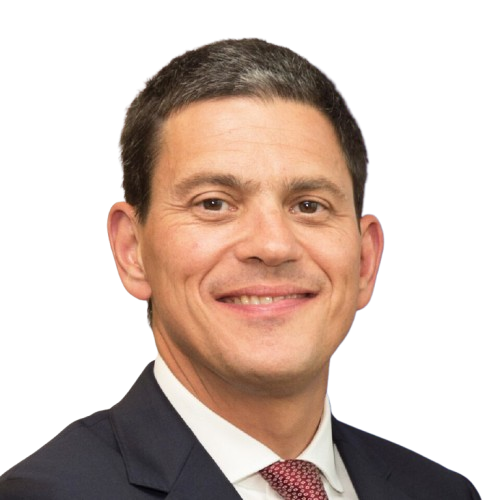
David Miliband served as secretary of state for foreign and commonwealth affairs from 2007 to 2010. At the time, he was widely regarded as a rising star and potential future leader of the Labour Party.
Miliband was linked with a leadership challenge to Gordon Brown as Labour approached the 2010 general election, but a full contest never materialised. In the leadership contest that followed the 2010 election, Miliband was beaten by his brother, Ed.
David Miliband responded by stepping back from frontline politics. He served on the backbenches until 2013, when he stood down from parliament and resigned as the Labour MP for South Shields.
In 2013, Miliband took up the post of president of the global humanitarian aid charity, the International Rescue Committee (IRC), based in New York.
What does David Miliband do now?
Miliband lives and works primarily in New York City as president of the IRC, a major global charity. The organisation was originally founded at the suggestion of Albert Einstein in the 1930s to assist refugees fleeing Nazi Germany.
The IRC provides emergency aid and long-term assistance to refugees and those displaced by war, persecution or natural disaster across the world.
As president of the IRC, Miliband frequently travels to crisis zones, engages with world leaders and speaks at international forums – usually to advocate for increased humanitarian funding and support for refugees.
Miliband occasionally still appears in the British media.
David Miliband’s political career (1989-2010)
Miliband worked as a research fellow at the Institute for Public Policy Research (IPPR) think tank from 1989 to 1994. During this period, Miliband served as secretary of the IPPR’s Commission on Social Justice, which was set up in 1992 by John Smith, the leader of the Labour Party.
In 1994, Miliband was appointed as head of policy for Tony Blair, who succeeded Smith as leader of the Labour Party.
During Blair’s first term as prime minister (1997-2001), Miliband worked at the heart of government as the head of the prime minister’s Policy Unit in 10 Downing Street. During this period, Miliband was reportedly nicknamed “Brains” by Blair’s powerful director of communications.
Miliband was first elected to parliament at the 2001 general election as the Labour MP for South Shields. He quickly rose up the ministerial ladder, serving as minister of state for schools in the Department for Education and Skills (2002-2004), minister of state in the Cabinet Office (2004-2005) and minister for communities and local government in the Office of the Deputy Prime Minister (2005-2006). In the latter two posts, Miliband attended cabinet.
Miliband was promoted to a full secretary of state rank in 2006 as secretary of state for environment, food and rural affairs, serving under Tony Blair.
When Gordon Brown succeeded Blair in 2007, Miliband was appointed as secretary of state for foreign and commonwealth affairs. At 41, Miliband was the youngest person to hold the post of foreign secretary for 30 years (since David Owen).
Miliband was heavily linked with a challenge to Brown in this period.
In 2008, Miliband was ridiculed for a food-themed gaffe. The then-foreign secretary was pictured arriving at Labour conference in 2008 with a banana. The press, and allies of Brown, seized on the image.
In his keynote address to the 2008 Labour conference, Brown told delegates that the tough economic moment meant this was “no time for a novice.” The comment was seen as an attack on David Cameron, the Conservative leader since 2005, but also would-be supporters of Miliband.
In June 2009, James Purnell resigned as work and pensions secretary in an attempt to force a leadership contest. Purnell, a prominent Blairite, effectively described the prime minister as unelectable. He urged Brown to “stand aside to give our party a fighting chance of winning”.
Miliband ultimately rowed in behind Brown.
In January 2010, two former cabinet ministers, Patricia Hewitt and Geoff Hoon, called for a secret ballot vote to resolve Brown’s future. The prime minister dismissed the challenge as a “form of silliness”, adding: “I am the prime minister and am determined to remain so. I am determined, I am resolute.”
Miliband was once again challenged on whether he would stand to replace Brown, and again he rowed in behind the prime minister.
David Miliband and Ed Miliband: 2010 Labour leadership election
Miliband stood as a candidate in the 2010 Labour leadership contest, triggered by Brown’s resignation and the formation of the Conservative-Liberal Democrat coalition. Under Labour’s leadership election rules, candidates needed to secure the support of 12.5% of the Parliamentary Labour Party (PLP). After the 2010 election, which returned 258 MPs, the threshold stood at 33. Five candidates successfully met this threshold: Miliband (81), his brother, Ed, (63), Ed Balls (33), Andy Burnham (33) and Diane Abbott (33). David Miliband nominated Abbott, a member of the left-wing Socialist Campaign Group (SCG), to ensure an ideologically broad debate.
The contest was quickly seen as a two-horse race between the Miliband brothers. David, long-touted as a future Labour leader, was seen as the frontrunner – and the favoured candidate of his party’s “Blairite” wing. Ed, the former energy secretary, positioned himself to the left of his older brother.
Launching his candidacy, Ed stated that he was “proud” of what the 1997-2010 Labour government achieved, but said “deep thinking” was needed about “what went wrong”. David Miliband, speaking at his campaign launch, said he would stand as a candidate “with humility in the face of the responsibility this post brings”.
He added: “We must renew, but we must be ready for government. We live in a new political world, and the responsibility of office may return sooner than people might think.
“I am standing because I believe I can lead Labour to rebuild itself as the great reforming champion of social and economic change in this country.
“The decision of the Liberal Democrats to join a Conservative government is a momentous one. It creates an enormous responsibility for the Labour Party, revitalised in the right way, to represent all shades of progressive opinion and present itself as an alternative government.
“That is the task in front of us.”
The 2010 contest was the last held under the Labour Party’s old electoral college system, which weighted votes equally among three sections: affiliated trade unions, individual party members, and Labour MPs/MEPs. In the final round of the alternative vote ballot, David won a clear majority of support from MPs (53.4%) and also narrowly won among party members (54.4%). However, Ed secured 59.8% of the affiliated supporters’ section. It was enough to overcome his brother’s lead among members and MPs, providing an overall victory of 50.7% to David’s 49.3%.
In his victory speech, Ed acknowledged the political and personal significance of the contest. He paid tribute to his brother and called on the party to unite against the coalition government.
Speaking to BBC News, David responded: “You don’t start these contests if you’re not keen to win, but also reconciled to the prospect that you might lose…
“This is Ed’s day – I’m obviously genuinely delighted for him, because if i can’t win, then he should lead the party. And the party’s now got a responsibility to look to the country, to set out what we stand for [and] expose what we think is wrong with what the coalition is doing…
“It’s a huge day for the Miliband family, not quite the day for the Miliband family that I would have wanted – the Miliband D family, rather than the Miliband E.
“But that’s the way things go.”
On 29 September 2010, David announced that he would not seek election to Ed’s shadow cabinet. In a letter to the chairman of his constituency Labour Party, David said the decision was about enabling his brother to make a “fresh start”.
He wrote: “This is now Ed’s party to lead and he needs to be able to do so as free as possible from distraction. Any new leader needs time and space to set his or her own direction, priorities and policies.”
David stood down from parliament in March 2013, saying he “feared being a distraction”.
He told the BBC: “I feel a sense of sadness because I am British. I love Britain. I am passionate about Labour, but I have had to make a choice about where I can make my best contribution.”
He added: “I am taking a job in America, not taking citizenship in America. I will continue to follow what’s going on here, but my focus is going to be making a difference through the International Rescue Committee.”
Ed Miliband led Labour into the 2015 general election, which resulted in a shock overall Conservative majority. The result defied pre-election polls, which had largely predicted another hung parliament. Labour won 232 seats, a net loss of 26.
In the aftermath of Labour’s defeat, political commentator John Rentoul declared that the 2015 contest was “an election that Labour could have won, and David Miliband could have won it”.
Rentoul’s “other brother” hypothesis has secured some unlikely seconders.
In 2019, comedian James Corden posted to Twitter (now X): “I truly believe the day David Miliband left politics it all started to unravel”.
David Miliband: speculation about a return to frontline politics
Miliband was a consistent critic of Jeremy Corbyn during his time as leader of the Labour Party (2015-2020).
In June 2019, Miliband called on Corbyn to make Labour the “unequivocal” party of a second Brexit referendum. “Clearly this isn’t a matter of whether or not you believe that Labour should appeal to Leavers and Remainers. Of course it should”, he said. “The question is how do you do so? You don’t do so by sitting on the fence. That’s evidently the case.”
In an interview conducted after the 2019 general election, Miliband accused supporters of Corbyn of being in “denial”.
He stated: “When people got to look at Labour in 2017, we couldn’t beat the worst Tory campaign in history… and then when people got the full measure of Jeremy Corbyn in 2019, he led us to the worst election defeat since the 1930s.”
During his tenure as IRC president, Miliband has been asked about a potential return to UK politics.
In 2020, Miliband said he did not want to “get into the ruling in ruling out, but there’s a new generation and I want to see them doing well, not badly.”
In November 2022, Miliband strongly hinted at a political comeback during an interview with LBC Radio. Asked if he would return to frontline politics, he responded: “That has not been decided yet. That has not been done.”
Miliband added: “The Labour party has, thank God, put itself into a position where it’s got good people leading it – it’s developing its plans for government… I think is really essential for the country”.
In June 2026, a Telegraph report suggested that allies of Andy Burnham were urging him to bring Miliband back to frontline politics. “There have been discussions about David returning, and it’s an idea that is worth taking seriously if Andy is back in parliament”, a source told the i paper.
David Miliband – family and personal life
David Wright Miliband was born on 15 July 1965, in London.
Miliband is married to Louise Shackelton, an American professional violinist who formerly played with the London Symphony Orchestra. The couple met in the 1990s and married in 1998. They live in New York City and have two adopted sons, Isaac and Jacob.
Before politics
Miliband attended Haverstock Comprehensive School in North London and then Corpus Christi College, Oxford University, where he studied philosophy, politics and economics (PPE).
Miliband was a Kennedy Scholar at the Massachusetts Institute of Technology between 1988 and 1989. He earned a master’s degree in political science from the institution.
David Miliband has not written for Politics.co.uk.