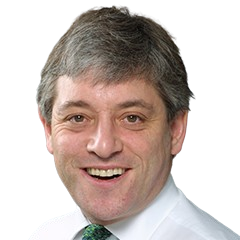
John Bercow served as the 157th speaker of the House of Commons from June 2009 until November 2019. He was the Conservative MP for Buckingham from 1997 until his election as speaker in 2009, at which point he relinquished his party affiliation as required by the role.
Bercow’s decade as speaker coincided with a period of significant political turbulence, particularly concerning Brexit. He became internationally known for his distinctive calls for “Order!” and his efforts to champion the rights of backbench MPs, notably through a significant increase in the granting of urgent questions.
Bercow’s tenure was also marked by accusations of bias, particularly regarding Brexit debates, and clashes with the government.
An Independent Expert Panel report in 2022 upheld numerous complaints from former staff, concluding Bercow had been a “serial bully” and “serial liar”.
John Bercow: election as speaker and early years (2009-2017)
John Bercow was first elected on 22 June 2009 following the resignation of speaker Michael Martin over the parliamentary expenses scandal.
In 2009, Bercow was one of 10 MPs to put their name forward. The candidates in question took part in unofficial hustings, organised by the Hansard Society. Bercow stood on a platform of reform and restoring trust in parliament after the expenses scandal. He was elected primarily with support from Labour and Liberal Democrat MPs.
Upon his election as speaker, Bercow stated: “I said only a few hours ago in my speech that if elected the speaker has a responsibility immediately and permanently to cast aside all of his or her political views. I said it and I meant it.
“My commitment to this house is to be completely impartial between members of one political party and another. That is what it is about. I will do my best faithfully and honourably and effectively to serve this house in the period ahead.”
During his tenure as speaker, Bercow sought to empower backbenchers and enhance parliamentary scrutiny of the executive. He granted an unprecedented number of urgent questions – much to the irritation of those ministers hauled to the commons.
In the 2017-2019 session, there was an average of 0.88 UQs a day. This is compared to less than 0.1 UQs a day in the sessions between 1990 and 2009. During the 2007-2008 session, a total of four urgent questions were asked of ministers in 165 sitting days. During the 2017-2019 session, 307 UQs were asked of ministers in 349 sitting days.
In a speech at the University of Birmingham in 2012, Bercow defended the increase in UQs: “I do not apologise for restoring this instrument of scrutiny. I believe the evidence demonstrates that it has helped revive the standing of the House by demonstrating its relevance.”
In the 2010 general election, the leader of the UK Independence Party (Ukip), Nigel Farage, stood against Bercow in his Buckingham constituency. By convention, the major parties do not contest the speaker’s seat at election time. Farage, who was badly injured in an aircraft crash on polling day, finished third with 8,410 votes (17.4%). He later admitted it was a “miscalculation” to try an unseat Bercow.
On 26 March 2015, the government was defeated over new rules that many saw as an attempt to oust Bercow as speaker. The vote, which came on the final day of commons business before parliament dissolved for the general election, sought to introduce a secret ballot to re-elect Bercow as speaker in the next parliament. This would have brought the process for re-electing an incumbent speaker into line with the rules used for a contested speakership election. Crucially, a secret ballot would have provided political cover for critical Conservative MPs who wished to remove Bercow from his post.
The proposal was spearheaded by the leader of the House of Commons, William Hague, and the Conservative chief whip, Michael Gove.
The timing of the motion sparked an acrimonious and at times emotional debate. Critics, comprising Labour, Liberal Democrat and some Conservative MPs, condemned the move as a cynical ploy to remove Bercow – who was unpopular with many on the government frontbench. In a deeply unusual final sitting day, Bercow was said to have granted three urgent questions to buy supportive MPs more time to rush back to the commons to defeat the government measure. Just one hour had been allotted by the government for MPs to debate the measure. And while the vote was nominally a ‘free vote’, Conservative MPs had been instructed to remain in parliament on a three-line whip.
Conservative MP Charles Walker, the chair of the commons procedure committee, said he had been “played for a fool” by ministers in a tearful speech.
He said: “I have been played as a fool and when I go home tonight I will look in the mirror and see an honourable fool looking back at me and I would much rather be an honourable fool in this and any other matter than a clever man.”
MPs, including a Conservative backbencher, rose to their feet to applaud Walker’s contribution – a symbolic break with commons convention. A tearful Bercow rose to bring the House to order. Walker, like the rest of the House, had been given virtually no notice of the government’s intention to bring the motion. He was informed of the government’s intention to consider the procedure committee’s report on the election of the speaker – his committee’s report – on the evening before the debate.
Sir Gerald Kaufman, a veteran Labour MP, accused Hague of a “grubby, squalid and nauseous” attempt to change the rules.
Having presided over the debate, Bercow was visibly emotional upon announcing the result. The government’s motion was defeated by 228 votes to 202 – a majority of 26. Opponents of the measure included 23 Conservative MPs and 10 Liberal Democrats.
The result was a personal victory for the speaker, but highlighted tensions between the government and the chair that would emerge again during the fraught debates on Brexit from 2016 to 2019.
Bercow was re-elected as speaker of the House unopposed following the 2015 election.
In 2017, Bercow controversially ruled that male MPs do not need to wear ties in the commons chamber. Lindsay Hoyle, Bercow’s successor as speaker, has taken a stricter sartorial approach, including when it comes to neckwear.
In February 2017, Bercow revealed that he supported Remain in the 2016 Brexit referendum.
In an address to students at Reading University, Bercow said: “Personally, I voted to remain. I thought it was better to stay in the European Union than not.”
He added: “I think for all the weaknesses and deficiencies of the European Union, it’s better to be part of that big power bloc in the world than thinking you can act as effectively on your own.”
John Bercow: the Brexit years (2017-2019)
The 2017 general election produced a hung parliament with the Conservatives as the largest party.
In the 2017-2019 hung parliament, Bercow’s active and verbose speakership regularly placed him at odds with the government of the day. Some of his procedural decisions drew accusations of partiality against the government’s position.
In January 2019, Bercow sparked outrage among Conservative MPs by allowing an amendment from Tory rebel Dominic Grieve to a business motion. The usually uncontentious business motion, which sets out how a debate should be structured and organised, was an attempt to change the terms of the debate that had been set back in December. This followed prime minister Theresa May’s decision to delay a vote on her Brexit deal.
Grieve’s amendment, which was backed by 308 votes to 297, required the government to return with a Brexit “Plan B” within three working days – in the event that its withdrawal agreement was rejected by MPs. A 21-day requirement was set out in the European Union (Withdrawal) Act 2018. This 21-day period was now considered to be too long in the view of those, like Grieve, opposed to a “no deal” Brexit. Britain was on course to leave the EU on 29 March, regardless of whether or not a deal was in place.
The speaker’s unprecedented decision to allow an amendment to a motion that was to be put “forthwith” – believed to mean without debate or amendment – was met with vehement opposition from Tory MPs. The clerk of the House, Sir David Natzler, reportedly advised Bercow that Grieve’s amendment was “out of order”.
But Bercow told MPs: “I interpret [forthwith] to mean that there can be no debate, but I must advise the House that the terms of the order do not say that no amendment can be selected or moved.”
Jacob Rees-Mogg, a leading eurosceptic Conservative, argued that the move was “deeply troublesome” for the neutrality of the chair. Fellow Conservative MP Adam Holloway challenged the speaker’s impartiality, citing a “derogatory” anti-Brexit sticker in his car. Bercow responded that the sticker was “affixed to, or in the windscreen of, my wife’s car” and that she was entitled to her own views.
Bercow said: “I am sure the honourable gentleman would not suggest for one moment that a wife is somehow the property or chattel of her husband.”
In April 2019, Bercow, the speaker of the House of Commons, used his casting vote to break a tie on a backbench amendment tabled by senior Labour MP Hilary Benn, which sought to secure further parliamentary time for a third round of “indicative votes” on alternative Brexit options. In accordance with precedent, Bercow cast his vote with the “Noes”, as there was no majority in favour of the amendment and no opportunity for further debate.
Bercow told the House: “In accordance with precedent, and on the principle that important decisions should not be taken except by a majority, I cast my vote with the Noes, so the Noes have it.
“By casting vote, it is 311 to 310. That is the proper way in which to proceed.”
Bercow went on to clash with Boris Johnson’s government in the latter stages of the 2017-2019 parliament.
During the Brexit years, Bercow sometimes allowed backbenchers to take control of the commons order paper – most notably for the passage of the so-called “Benn act”, which effectively blocked a no-deal Brexit. His ruling that led to the passage of the Benn act was made under standing order Number 24 – a procedure used to trigger emergency debates.
Such rulings made Bercow a pariah to the Johnson government and hardline eurosceptics. He was accused of abandoning the political impartiality in an attempt to frustrate Brexit. As a result, the government signalled it would stand a candidate against Bercow in his Buckingham constituency at the next election – a symbolic break with precedent.
Bercow regularly clashed with Andrea Leadsom during her tenure as leader of the commons from 2017 to 2019. On 8 September, after the passage of the Benn act, Leadsom accused Bercow of committing “flagrant abuse” of parliamentary process.
Leadsom, who served as business secretary under Johnson, said the role of the speaker was to be “a politically impartial, independent umpire of proceedings” and to “protect the constitution and oversee the behaviour of the House”.
She added: “But last week, the current speaker failed us”.
In August/September 2019, Bercow described the government’s choice to prorogue parliament in as a “constitutional outrage”. The government’s stated rationale was to end the parliamentary session, and introduce a new legislative agenda via a queen’s speech. However, critics argued that the move was an anti-democratic ploy to bypass MPs – at a time when the parliamentary arithmetic was finely balanced.
Prorogation occurred formally in the early hours of 10 September. Bercow then delivered a statement, referring to this procedure as “not a normal prorogation”.
Bercow told the House: “I am perfectly happy, as I have advised others, to play my part, but I want to make the point that this is not a standard or normal prorogation… It is one of the longest for decades, and it represents, not just in the minds of many colleagues but for huge numbers of people outside an act of executive fiat.”
Labour MP Lloyd Russell-Moyle then attempted to block Bercow from exiting the chamber by laying across the speaker’s chair. It was an attempt to reenact an event from 1629 when one of Bercow’s predecessors as speaker, Sir John Finch, was forcibly held down in his chair by two MPs, Denzil Holles and Benjamin Valentine.
The prorogation triggered street protests and immediate litigation. The supreme court ultimately ruled that the prorogation was “void and of no effect”, meaning parliament could be reconvened the following day on 25 September 2019.
On 9 September 2019, at the peak of the prorogation controversy, Bercow announced his resignation as commons speaker. His resignation announcement was timed to ensure his successor would be elected by the current parliament – rather than by a new parliament which might have a large Conservative majority. It was seen as a final act of defiance against the government.
In his resignation statement, Bercow said MPs in the next parliament could be “vulnerable to undue institutional influence”.
He added: “We would not want anyone to be whipped senseless, would we?”
Addressing MPs on 9 September, hours before the prorogation of parliament, Bercow said his tenure as speaker had been the “greatest privilege and honour of my professional life”.
He told the House: “At the 2017 election, I promised my wife and children that it would be my last. This is a pledge that I intend to keep… If the House does not [vote for a general election], I have concluded that the least disruptive and most democratic course of action would be for me to stand down at the close of business on Thursday 31 October.”
Bercow was utterly unapologetic about his role in empowering backbenchers to scrutinise legislation, and sometimes legislate themselves, describing himself as the “backbenchers’ backstop”.
He added: “Throughout my time as speaker I have sought to increase the relative authority of this legislature, for which I will make absolutely no apology to anyone, anywhere, at any time.”
Bercow also issued a veiled warning to the government, with an indirect reference to its prorogation plans. “We degrade this parliament at our peril”, he told MPs. Bercow’s statement was greeted with a standing ovation from the opposition benches. Among Conservative MPs, there was a smattering of applause.
Tributes were paid to Bercow on 30 October, his final session prime minister’s questions in the chair, and on 31 October, his last day as speaker. Speaking in the former session, which was dedicated to reflections on Bercow’s speakership, the new commons leader, Jacob Rees-Mogg, praised the “backbencher’s champion”.
Angela Eagle, the shadow commons leader, called on Rees-Mogg to confirm Bercow would be appointed to the House of Lords – as is tradition for former speakers. Rees-Mogg did not take the opportunity to do so.
Iain Duncan Smith, the former Conservative leader, said he “regularly used to curse” the speaker for granting urgent questions during his tenure as a cabinet minister.
He added: “However, having returned to the backbenches, I have to congratulate you on reinvigorating the UQ, turning it from being an unusual event to being a very standard one, and I hope I have taken advantage of that.”
Boris Johnson, speaking at prime minister’s questions, praised Bercow as a “great servant of this parliament”.
Speaking to a separate subject on 31 October, Conservative MP Andrew Bridgen excoriated Bercow’s speakership.
A longtime nemesis of the speaker, Bridgen declared: “I will bring my remarks to a conclusion, but it is clear to me, and it will be clear to the public, that to the fag-end of your tenure in that chair, you are defending the indefensible”.
Bercow’s resignation precipitated a speakership election, which ultimately returned Lindsay Hoyle, deputy speaker since 2010, to the chair. Hoyle bested rival candidates including Eleanor Laing, Harriet Harman, Edward Leigh and Chris Bryant.
John Bercow: post-speakership career (2019-Present)
Since leaving the speaker’s chair and parliament in 2019, Bercow has taken on several roles.
In January 2020, Bercow was appointed part-time professor of politics at Royal Holloway, University of London. He served as chancellor of his alma mater, the University of Essex, from July 2017 until November 2021.
Bercow published an autobiography, Unspeakable, in 2020. He is also available for paid public speaking engagements and has appeared on the personalised video message platform Cameo.
In November 2019, Bercow described Brexit as the “biggest foreign policy mistake in the post-war period”.
In May 2021, Bercow told ITV’s Good Morning Britain programme that he no longer considered himself a Conservative, having been elected as a Tory MP in 1997.
He said: “I have gone from being a rabid rightist to being a soft leftist.”
In June 2021, the former speaker announced he had joined the Labour Party, saying: “I am motivated by support for equality, social justice and internationalism. That is the Labour brand”.
Bercow’s controversial tenure as speaker extended to allegations of bullying. A report by parliamentary independent expert panel (IEP), published March 2022, described Bercow as a “serial bully” and found “his behaviour fell very far below that which the public has a right to expect”.
Bercow strongly refuted the allegations and the report’s findings, describing the investigation as a “travesty of justice” and a “kangaroo court”.
As a result of the IEP report into his conduct as speaker, Bercow was suspended from Labour.
The former speaker never was appointed to the House of Lords.
In 2024, Bercow appeared as a contestant on the second season of the US reality television show The Traitors.
John Bercow: political career before speakership (1986-2009)
Bercow’s political journey began as a “hard right” Conservative activist.
In his youth, Bercow was active in right-wing Conservative circles, including the Monday Club. He chaired the Federation of Conservative Students (FCS) in 1986, shortly before it was disbanded by Conservative Party chairman Norman Tebbit. His early political heroes included Margaret Thatcher and Enoch Powell.
First elected as the Conservative MP for Buckingham in 1997, Bercow initially aligned with the party’s right wing. However, in the early 2000s, his views moderated and Bercow established himself as a supporter of Conservative “modernisation”.
In November 2002, Bercow resigned from Iain Duncan Smith’s frontbench over Duncan Smith’s opposition to allowing unmarried couples to adopt children. The Conservative leader had instructed his MPs, by way of a three-line whip, to vote against an amendment to the Adoption and Children Bill that sought to enable unmarried couples to adopt children, opening the door for gay couples to adopt.
In total, eight MPs rebelled against Duncan Smith in the vote: Bercow, Ken Clarke, David Curry, Julie Kirkbride, Andrew Lansley, Andrew Mackay, Francis Maude and Michael Portillo.
In February 2003, Duncan Smith sacked Tory chief executive Mark MacGregor and head of policy Rick Nye, who were prominent supporters of Conservative “moderniser” Michael Portillo. MacGregor had been credited with drafting Theresa May’s famous “nasty party” speech. Bercow responded by claiming that “the modernising agenda has been at best, sidelined and at worst, lost”
Bercow briefly returned to the shadow cabinet under Michael Howard (2003-2004) but was removed after a year, leading to speculation about a possible defection to Labour, particularly after he praised Tony Blair’s role in the Iraq War. At the time, much was made of the influence of Bercow’s Labour-supporting wife, Sally Illman.
In March 2003, Bercow voted in favour of the government motion authorising military action against Iraq. The vote, one of the most contentious in recent parliamentary history, gave the prime minister, Tony Blair, the authority to join the US-led invasion.
Bercow celebrated Blair’s “outstanding statesmanship”.
In 2005, Bercow won Channel 4’s “Opposition MP of the Year” award and supported Ken Clarke over David Cameron in the Conservative leadership contest. Bercow believed that the party should not be led by an Old Etonian.
Before Politics
John Simon Bercow was born on 19 January 1963 in Edgware, Middlesex. His father, Charles, was a taxi driver.
Bercow attended Finchley Manorhill comprehensive school before studying government at the University of Essex, graduating in 1985.
Bercow’s early career centred on public relations. He worked for Saatchi & Saatchi Communications.
He served as a special adviser to government ministers Jonathan Aitken and Virginia Bottomley.
Bercow served as a Conservative councillor in the London Borough of Lambeth from 1986 to 1990. He unsuccessfully contested parliamentary seats in 1987 and 1992 before being elected MP for Buckingham in 1997.
Personal Life
Bercow married Sally Illman in 2002.
Sally Bercow, who was involved with Conservative student politics at Oxford, later became a Labour activist and once stood for election to Westminster City Council. She gained public attention through media appearances, including participating in Channel 5′s Celebrity Big Brother in 2011, where she was the first contestant evicted.
The Bercows have three children, Oliver, Freddie, and Jemima.
Bercow is 5 feet 6 inches (1.68m) tall. He is teetotal, has a phobia of wasps and dislikes heights.
Trivia
Bercow was a talented junior tennis player and is a qualified tennis coach. He authored a book ranking his top 20 male tennis players.
John Bercow has not written for Politics.co.uk.