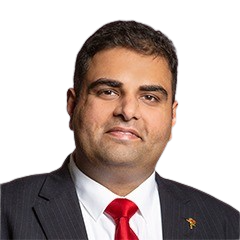
Navendu Mishra is the Labour MP for Stockport, having first been elected to parliament at the 2019 general election.
In the 2024 general election, Mishra won 21,787 votes, representing 49.9% of the vote. The Reform UK candidate, Lynn Schofield, received 6,517 votes (14.9%), while the Conservative candidate, Oliver Johnstone, secured 4,967 votes (11.4%). Mishra was duly elected with a majority of 15,270 votes.
The Stockport constituency is located in Greater Manchester. Historically held by the Conservatives in the 1980s, it has been a safe Labour seat since 1992. Mishra’s immediate predecessor as the MP for Stockport was Ann Coffey, who represented the seat from 1992 to 2019. Coffey was among the seven Labour MPs who resigned from the party in protest at Jeremy Corbyn’s leadership and went on to form the Independent Group (TIG) (later Change UK).
Political Career
Mishra is a member of the House of Commons administration committee (since June 2023) – the committee responsible for overseeing the internal running of the House and the services provided to its members and their staff. Its primary role is to ensure that the facilities and administrative support on the parliamentary estate are effective, efficient, and meet the needs of a modern legislature.
Mishra served as an opposition whip from January 2022 to September 2023.
Mishra was a member of the House of Commons international development committee (2020-202, transport committee (2022), and public administration and constitutional affairs committee (2020-2021).
Mishra served briefly as parliamentary private secretary (PPS) to the deputy leader of the Labour Party, Angela Rayner. A PPS acts as an unpaid parliamentary assistant, providing a link between the senior frontbencher and backbench MPs. Mishra resigned from this post in October 2020 to vote against the Human Intelligence Sources (Criminal Conduct) Bill at its commons third reading. The proposed legislation, often referred to as the “spycops bill”, was introduced by the Conservative government to authorise undercover agents and informants to commit crimes while on operations. The Labour Party whipped its representatives to abstain on the bill on the basis that the legislation is “far from perfect” yet “necessary” due to “the need to provide a clear lawful framework for the use of human intelligence sources”.
In total, 34 Labour MPs broke the whip by voting against the bill at third reading.
In his resignation statement, addressed to Keir Starmer, Mishra wrote: “I have thought at great length about this and, while I respect your decision, I still feel that voting against the bill sends a clearer message about the strength of our concerns.
“I would like to place on record my thanks to the Labour Party chair and deputy leader, Angela Rayner, for appointing me as her parliamentary private secretary earlier this year… I will continue to support her in the years ahead. Please be assured that I will continue to do all I can to assist you from the backbenches and work hard to deliver a Labour government at the next general election.”
Mishra is listed as a member of the all-party parliamentary group (APPG) for British Hindus.
Mishra delivered his maiden speech on 9 March 2020 during a debate on the Birmingham Commonwealth Games Bill.
In it, he said: “My constituency of Stockport is a beautiful part of the world, and, in my unbiased opinion, the jewel in the crown of our beloved north-west region. It has many iconic buildings and structures – and, of course, some of the warmest people in the world. Many people know Stockport because of our train station and the famous Stockport viaduct.”
He added: “Author and theorist Friedrich Engels described the viaduct in his book The Condition of the Working Class in England. Although many across the globe admire Engels’s political analysis, I do not share in his bleak and unflattering description of Stockport…
“I am glad to report that, while Engels’s analysis of the capitalist exploitation of working people remains true today, his words about Stockport do not.”
Before becoming an MP, Mishra served on Labour’s national executive committee (NEC) from 2018 to 2019 as a representative for constituency Labour parties (CLPs).
Political views
Leadership elections and loyalty
Starmer stand down: In May 2026, Mishra publicly called for Keir Starmer, the prime minister, to step down/set out a timetable for his departure. The move followed the 2026 local elections and devolved elections to the Scottish Parliament and Senedd Cymru.
Labour deputy leadership 2025: Mishra was one of 117 Labour MPs who nominated Lucy Powell for the party’s deputy leadership in September 2025. The election followed the resignation of Angela Rayner, who stepped down as deputy prime minister and deputy party leader after an investigation into her tax affairs. It marked the first time since 2007 that Labour had held a deputy leadership contest while in government.
Powell, the former leader of the House of Commons, was seen as a candidate representing the party’s “soft left”; she was supported by leading soft left figures including Ed Miliband and Andy Burnham. She secured 117 nominations from the Parliamentary Labour Party (PLP), above the 80 required, and went on to win the election – defeating Bridget Phillipson with 54.3% of the vote.
Labour leadership 2020: Mishra was one of 33 Labour MPs who nominated Rebecca Long-Bailey for the party’s leadership in early 2020. The election was triggered by the resignation of Jeremy Corbyn following the party’s defeat in the 2019 general election, which resulted in Labour’s fewest seats in the House of Commons since 1935.
Long-Bailey, then the shadow business secretary, was widely regarded as the continuity candidate for the party’s left/Corbynite wing. Long-Bailey finished second with 27.6% of the vote, losing to Keir Starmer, who won a decisive victory in the first round with 56.2%.
Factional identity and party tradition
Socialism26: In May 2026, Mishra was a signatory of Socialism26, a political initiative and pressure group launched by a coalition of Labour MPs and general secretaries from several major affiliated trade unions, including Unison, Aslef, the CWU, the TSSA and the FBU. The group described itself as advocating a “programme for change” intended to facilitate a “progressive political reset” within the Labour Party. It called for a return to traditional socialist values and greater internal party democracy.
The initiative was built upon a set of policy demands, including urging the government to “recognise the genocide in Gaza”, deliver full compensation for the “Waspi” women affected by state pension age changes, protect civil liberties and embrace intervention to lower energy bills.
Socialism26 described this programme as “the bare minimum to ensure that the public can see and feel the difference a socialist government makes to their lives.”
Usdaw: Mishra is a member of the Usdaw Union Parliamentary Group – a group of MPs who are members of the Union of Shop, Distributive and Allied Workers (Usdaw) and work generally to represent the union’s interests within parliament.
Socialist Campaign Group: Mishra was previously listed as a member of the Socialist Campaign Group (SCG) – the standard-bearer of the left wing within the Parliamentary Labour Party (PLP). Founded in 1982 by followers of Tony Benn, the group has traditionally advocated policies such as widespread public ownership, wealth redistribution and strengthened trade union rights.
In November 2020, Mishra was among the 32 SCG MPs to sign a statement declaring that they opposed the suspension of Jeremy Corbyn and calling for the disciplinary action to be “swiftly reversed”.
The statement read: “This decision and the division it causes severely undermines efforts to unite to defeat antisemitism and fully implement the EHRC [Equality and Human Rights Commission] recommendations and to challenge and defeat this disastrous Conservative government.”
Corbyn’s suspension came after he issued a response to the EHRC report, arguing “the scale of the [antisemitism] problem was also dramatically overstated for political reasons by our opponents”.
However, a report by the House magazine, published in May 2024, indicated that Mishra was one of a handful of MPs to have left the SCG.
Welfare
Welfare ‘reasoned amendment’ (June 2025): Mishra was one of the over 120 Labour MPs to sign the reasoned amendment to the government’s flagship welfare bill which aimed to reject the proposed legislation.
The amendment, in the name of senior Labour MP Dame Meg Hillier, objected to the fact that the bill had not been subject to a “formal consultation with disabled people” and that “250,000 people will be pushed into poverty” as a result of it, according to a government impact assessment.
The motion also called on the government to wait for the publication of the review into the Personal Independence Payment (Pip), helmed by minister Sir Stephen Timms, and the independent review, conducted by Sir Charlie Mayfield, into how the employment of disabled people could be boosted.
Welfare vote (July 2025): Mishra went on to vote against the bill at second reading. The vote came after ministers agreed to significant concessions to avoid defeat via a mass rebellion of Labour MPs on 1 July 2025.
Assisted dying
On the second reading of the Terminally Ill Adults (End of Life) Bill (Assisted Dying Bill) in June 2025, Mishra did not record a vote. Mishra voted in favour of the Terminally Ill Adults (End of Life) Bill, better known as the assisted dying bill, at the third reading (June 2025).
Social values and conscience issues
Abortion decriminalisation (2025): Mishra voted in favour of a backbench amendment to the Crime and Policing Bill that sought to decriminalise abortion in England and Wales in June 2025. The amendment, which was passed by a majority of 242 votes, removed women from the threat of prosecution for ending a pregnancy at any stage. As an issue of conscience, MPs were allowed to vote according to their personal beliefs.
Foreign policy and security
IPAC: Mishra is a member of the Inter-Parliamentary Alliance on China (IPAC) – an international, cross-party network of legislators from democratic countries focused on relations with the People’s Republic of China. The alliance, established on 4 June 2020, the anniversary of the 1989 Tiananmen Square protests and massacre, was formed to unite “lawmakers worldwide, promoting democracy and addressing threats to the rules-based and human rights systems posed by the rise of China.”
Palestine
LFPME: Mishra has been listed as a member of Labour Friends of Palestine and the Middle East (LFPME). The organisation’s stated aim is to promote peace and justice in the region through the application of international law and respect for human rights.
Before Politics
Born Navendu Prabhat Mishra on 22 August 1989 to Indian parents.
He was educated at Clifton College in Bristol before studying at the University of Hull and Keele University.
Before entering politics, Mishra worked for the John Lewis Partnership and later for the trade union UNISON, where he was a shop floor representative and later an organiser, focusing on care workers.
Personal Life
Mishra lives in Brinnington, Greater Manchester.
Trivia
Mishra is a member of the Offerton cricket club.



There should be no monopolies in a pandemic
20 November 2020