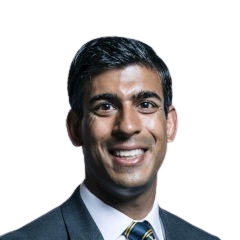
Rishi Sunak is the Conservative MP for Richmond and Northallerton, having first been elected to parliament for the predecessor seat of Richmond at the 2015 general election.
Sunak served as prime minister of the United Kingdom of Great Britain and Northern Ireland from October 2022 to July 2024.
In the 2024 general election for the new Richmond and Northallerton constituency, Sunak received 23,059 votes, representing 47.5% of the vote share. The Labour candidate, Tom Wilson, came second with 10,874 votes (22.4%), while the Reform UK candidate, Lee Taylor, secured 7,142 votes (14.7%). Sunak was duly elected with a majority of 12,185.
Rishi Sunak: career since 2024 general election
Sunak served as leader of the opposition from July to November 2024 on the interim/caretaker frontbench created after the general election of the same year. He returned to the backbenches in November 2024 after Kemi Badenoch’s election as Conservative leader.
As leader of the opposition, Sunak delivered a swansong frontbench performance when responding to the October 2024 autumn budget, delivered by Rachel Reeves as chancellor. Sunak said the budget was characterised by “broken promise after broken promise” and claimed that the government’s rhetoric about inheriting a crisis was nothing but a “cynical political device”.
In January 2025, it was announced that Sunak would take up unpaid fellowship roles at the Blavatnik School of Government, Oxford, and the Hoover Institution at Stanford University. In July, Sunak took on a further role advising clients at Goldman Sachs.
Rishi Sunak: 2024 general election
As prime minister, Sunak called the 2024 general election in a surprise statement in the pouring rain outside 10 Downing Street on 22 May – despite the technical freedom (under the Dissolution and Calling of Parliament Act 2022) to wait until January 2025. This inauspicious start kicked off an omnishambolic Conservative campaign, marred by a series of high-profile gaffes Conservative – including Sunak’s early departure from D-Day commemorations and a betting scandal in which several Conservative candidates and officials were investigated for allegedly betting on the July election date.
In the end, Sunak’s party was ravaged by Reform UK, led by Nigel Farage, on its right flank and by Ed Davey’s Liberal Democrats across the “blue wall” of affluent, traditionally Tory constituencies. The Conservatives won only 121 seats – the party’s worst defeat in modern history; a total of 12 cabinet ministers lost their place in parliament.
Sunak immediately announced his resignation as prime minister on the steps of Downing Street. The outgoing PM said he had “given this job my all” but voters had sent a “clear message”.
Sunak stated: “I would like to say first and foremost, I am sorry, I have given this job my all. But you have sent a clear signal that the government of the United Kingdom must change.
“And yours is the only judgment that matters. I have heard your anger, your disappointment. And I take responsibility for this loss to all the Conservative candidates and campaigners who worked tirelessly, but without success.”
Rishi Sunak: premiership (2022-2024)
Sunak was appointed as prime minister after winning the October 2022 Conservative leadership contest. His accession followed Liz Truss’ resignation as prime minister after just 44 days in office and was secured without a single vote being cast by either Conservative MPs or the wider party membership. Stringent rules put in place by the 1922 committee of Tory backbenchers after Truss’ downfall ensured an expedited contest with a narrow field of candidates. Those wishing to stand, including Sunak, were required to secure at least 100 nominations from Conservative MPs by a 2:00 pm deadline on 24 October.
The leadership election was dominated by speculation over a potential comeback by Boris Johnson. The former prime minister sensationally flew back from a holiday in the Dominican Republic on the morning of Saturday 22 October. His supporters quickly claimed he had secured the support of the necessary 100 MPs to progress to a vote of the Tory membership. However, Johnson withdrew from the contest on 23 October, having yet to formally declare his candidacy. In a statement, the former prime minister said he had been “overwhelmed by the number of people who suggested” he should stand.
Sunak’s victory was effectively confirmed after his final rival, Penny Mordaunt, withdrew from the race. At 2:00 pm on 24 October, Sunak was declared as the next leader of the Conservative Party.
In his first speech as prime minister on 25 October 2022, Sunak vowed to lead a government with “integrity, professionalism and accountability at every level”. The declaration amounted to a specific pledge to restore public trust following the scandals that precipitated the downfall of Boris Johnson.
Sunak’s immediate focus as prime minister was to restore economic stability. He also outlined five key priorities, namely halving inflation, growing the economy, reducing national debt, cutting NHS waiting lists and stopping small boat crossings. A notable achievement of Sunak’s tenure was the Windsor framework, which he negotiated to address post-Brexit issues in Northern Ireland.
Overall, however, Sunak’s time as prime minister was characterised by Conservative infighting and a failure to decisively reverse the polling lead established by Labour.
Sunak suffered a series of early setbacks as prime minister.
On 26 October, his first full day in office, Sunak reappointed Suella Braverman as home secretary. Braverman’s return came just six days after she had resigned from the short-lived Liz Truss government for a security breach involving the use of a personal email account to send sensitive documents. Braverman’s support had shored up Sunak’s standing in the October 2022 contest – and her reward was a return to cabinet. In Sunak’s first prime minister’s questions, Starmer argued that Sunak was “so weak that he has done a grubby deal, trading national security because he was scared to lose another leadership election.”
Then, in November 2022, Gavin Williamson resigned as a minister without portfolio following the publication of WhatsApp messages he sent to the former chief whip, Wendy Morton. Williamson had told Morton there was a “price for everything” after learning he was not invited to the state funeral of Queen Elizabeth II. Sunak told the House on 9 November that he regretted “appointing someone who has had to resign in these circumstances.”
Braverman’s appointment and Williamson’s resignation represented a test of the “integrity, professionalism and accountability” vow Sunak delivered on the steps of Downing Street. But a greater test came when Sunak, in January 2022, sacked Nadhim Zahawi as Conservative chairman following an investigation by Sir Laurie Magnus, the independent adviser on ministers’ interests, which concluded that Zahawi had committed a “serious breach” of the ministerial code regarding his tax affairs.
Some months later in April 2023, the deputy prime minister, Dominic Raab, resigned following a report that found he had bullied civil servants, marking the third major cabinet departure within six months of Sunak’s “integrity” pledge. An inquiry, conducted by senior lawyer Adam Tolley KC, found that Raab had “acted in a way which was intimidating, in the sense of unreasonably and persistently aggressive conduct in the context of a work meeting”.
Sunak’s mission to fulfill his “stop the boats” pledge sparked significant conflict in the Conservative Party – especially after the supreme court ruled the Rwanda deportations scheme unlawful in November 2023. The supreme court found that there were “substantial grounds for believing” that asylum seekers sent to Rwanda faced a “real risk of ill-treatment as a consequence of refoulement” (the practice of being returned to a country where they might face persecution or human rights abuses).
Two days before the supreme court delivered its verdict, Sunak dismissed Braverman as home secretary. Tensions between Braverman and Downing Street had been rising for some months. Braverman was sacked shortly after she penned an article for the Times, which stated there was a “perception that senior police officers play favourites when it comes to protesters” and were tougher on right-wing protesters than pro-Palestinian demonstrations.
On 14 November, in the wake of her dismissal, Braverman sent a scathing letter to Sunak, suggesting he had reneged on the terms of a deal the two had agreed during the October 2022 Conservative leadership contest. The terms of that agreement, according to Braverman’s account of events, pertained directly to the Rwanda scheme. She accused the prime minister of reneging on plans to “block off the ECHR, the HRA [Human Rights Act] and any other obligations” which inhibited the government’s ability to operationalise the scheme.
In the end, Sunak unveiled a two-pronged strategy to overcome the supreme court ruling: first, negotiate a new international treaty with Rwanda that would provide a legally binding guarantee against refoulement; and second, introduce emergency legislation that would enable parliament to confirm Rwanda as a safe country under UK law.
Robert Jenrick, the immigration minister and erstwhile Sunak ally, resigned on 6 December in protest over the government’s proposed Safety of Rwanda (Asylum and Immigration) Bill. Jenrick argued that the legislation did not go far enough. In his resignation letter, he wrote that the bill was “a triumph of hope over experience” and did not go far enough to disapply international law and end the “merry-go-round of legal challenges.”
The Safety of Rwanda (Asylum and Immigration) Bill, or Rwanda bill, passed its commons second reading by 313 votes to 269 – a majority of 44. During the bill’s committee stage, however, around 60 MPs from the party’s right wing backed amendments to strengthen the bill. Among those rebels were Lee Anderson, Brendan Clarke-Smith and Jane Stevenson – who all stepped down from their posts in order to support attempts to strengthen the bill. Anderson and Clarke-Smith both resigned as Conservative deputy chairmen.
In March 2024, Anderson defected to Reform UK. It followed Anderson’s suspension from the Conservative Party after he suggested Islamists had “got control” of the London mayor, Sadiq Khan. Anderson’s defection to Reform UK underlined the threat Reform UK posed to the Conservative Party as an insurgent party on the right of British politics – one untainted by any record in government.
The Safety of Rwanda Bill later passed its third reading in the commons on 17 January 2024, by 320 votes to 276. A total of 11 Conservative MPs, including Braverman and Jenrick, voted against the legislation. However, Sunak’s earlier-than-expected election meant the wider scheme was never operationalised.
As prime minister, Sunak suffered several by-election defeats – including in Tamworth (2023), Mid Bedfordshire (2023), Selby and Ainsty (2023) and Wellingborough (2024). The Conservative Party prevailed in the 2023 Uxbridge by-election under Sunak’s leadership, owing to a campaign focused on local opposition to the planned expansion of London’s Ultra Low Emission Zone (Ulez). The contest may even have marked a turning point for the government’s green and environmental policy. Sunak subsequently doubled down on his opposition to Ulez-style schemes and scaled back the government’s net zero commitments.
Rishi Sunak: rise to prominence (2015-2022)
Sunak succeeded William Hague, the leader of the Conservative Party from 1997 to 2001, as the MP for Richmond in 2015.
Sunak delivered his maiden speech in the House of Commons on 11 June 2015.
In it, he said: “The most remarkable aspect of my constituency is the strength, warmth and independent spirit of our communities. I am fiercely proud to represent them. And although I am not from Yorkshire, they were immensely relieved to learn I was not from Lancashire either!”
He added: “I intend to be a champion for the causes of the countryside. I want my hard-working rural constituents to have the strong public services they deserve and every opportunity to prosper.”
During his time as a backbencher, Sunak served as a member of the House of Commons environment, food and rural affairs committee from July 2015 to May 2017.
In Theresa May’s government, Sunak served as the parliamentary under-secretary for the ministry of housing, communities and local government from January 2018 to July 2019 – his first ministerial role.
Before standing for the Conservative leadership in 2022 Sunak established himself as a senior figure in the party. Under Boris Johnson, he served as chancellor of the exchequer (February 2020 – July 2022) and chief secretary to the Treasury from (July 2019 – February 2020).
Sunak was appointed as chancellor after the incumbent, Sajid Javid, shockingly resigned in February 2020. Javid resigned after the prime minister ordered him to dismiss his entire team of special advisers and replace them with ones selected by 10 Downing Street.
At the time of his appointment as chancellor, Sunak was considered to be a Johnson loyalist. In 2019, he was among the triumvirate of Conservative MPs, alongside Oliver Dowden and Robert Jenrick, who penned a piece in the Times backing Johnson as the next Conservative leader and prime minister. These MPs, considered to be rising stars in the party, described Johnson as the answer to the “existential threat” facing the Conservative Party.
Sunak’s tenure as chancellor was dominated by the economic response to the Covid-19 pandemic, during which he introduced large-scale support measures including the Coronavirus Job Retention Scheme (or “furlough”) and the Eat Out to Help Out scheme. As a result, Sunak’s popularity as chancellor initially rose significantly, inspiring the sobriquet “Dishi Rishi”. However, he later came under political pressure related to the cost of living crisis and scrutiny over his family’s financial affairs.
In April 2022, Sunak – alongside Johnson – was issued with a fixed penalty notice by the Metropolitan Police for breaching Covid-19 lockdown regulations. The announcement confirmed that the two most senior members of the government had broken the laws their own administration had imposed on the country. The specific event for which Johnson and Sunak were penalised was a birthday celebration for the prime minister held in the cabinet room on 19 June 2020, at a time when restrictions banned most indoor gatherings involving more than two people.
In a statement at the time, Sunak offered an “unreserved apology”.
The chancellor said: “I understand that for figures in public office, the rules must be applied stringently in order to maintain public confidence. I respect the decision that has been made and have paid the fine.”
On top of this, the relationship between Johnson and Sunak grew increasingly strained over time.
On 5 July 2022, Sunak resigned as chancellor over the so-called “Pincher affair”. Pincher, the deputy chief whip, was accused of drunkenly groping two men at the Carlton Club in London. In response, ministers were sent out to defend the prime minister with briefings that were later shown to be false, fatally undermining the government’s credibility.
Sunak resigned alongside Javid, the health secretary and his predecessor as chancellor. In his resignation letter, Sunak also referred to political differences over economic policy.
The outgoing chancellor wrote: “The public rightly expect government to be conducted properly, competently and seriously. I recognise this may be my last ministerial job, but I believe these standards are worth fighting for and that is why I am resigning…
“Our country is facing immense challenges. We both want a low-tax, high-growth economy, and world class public services, but this can only be responsibly delivered if we are prepared to work hard, make sacrifices and take difficult decisions.”
The mass ministerial exodus that followed ultimately triggered Johnson’s downfall and the July-September Conservative leadership contest.
Sunak stood as a candidate in the July-September Conservative leadership contest, finishing second to Liz Truss. During the contest, Truss and Sunak clashed repeatedly over the former’s proposed economic programme – termed “Trussonomics”. Truss, the then foreign secretary, accused Sunak of planning to “choke off” growth with tax rises. Sunak said Truss was peddling “something-for-nothing economics”.
In the end, Truss secured 81,326 votes (57.4%) from the party membership. Sunak won 60,399 votes (42.6%).
Political Views
Leadership elections and loyalty
In June 2022, Sunak publicly declared their loyalty in Boris Johnson ahead of a Conservative “no-confidence” in his leadership. The vote was triggered by discontent within the parliamentary party following the “partygate” scandal and the publication of the Sue Gray report. While the prime minister ultimately won the vote, the scale of the rebellion against him, with 148 of his own MPs voting to remove him, severely weakened his authority and presaged his resignation the following month.
In a post to social media at the time, Sunak stated: “From the vaccine rollout to our response to Russian aggression, the PM has shown the strong leadership our country needs.
“I am backing him today and will continue to back him as we focus on growing the economy, tackling the cost of living and clearing the Covid backlogs.”
Tory leadership 2019: Sunak supported Johnson for the party’s leadership in 2019. The election was triggered by the resignation of Theresa May following her inability to secure a Brexit deal acceptable to the Conservative Party.
Johnson, the former foreign secretary and mayor of London, campaigned on the central pledge to “deliver Brexit” by 31 October 2019, “deal or no deal”. He thereby positioned himself as the candidate best-placed to break the parliamentary deadlock. Johnson secured 114 votes in the first parliamentary ballot, and reached 160 votes in the final MP round. In the subsequent ballot of the party membership, Johnson won a decisive victory with 92,153 votes (66.4%).
Tory leadership 2016: Sunak supported Michael Gove during the party’s leadership election in July 2016. The contest was triggered by the resignation of David Cameron following the UK’s vote to leave the European Union.
Gove, then the justice secretary, had been expected to manage Boris Johnson’s campaign but made the surprise announcement that he would run for the leadership himself. Gove secured 48 votes in the first ballot, placing third, but his support fell to 46 votes in the second ballot on 7 July. As the candidate with the fewest votes in that round, Gove was eliminated from the contest.
Brexit and Europe
Brexit referendum: Sunak supported Leave in the 2016 Brexit referendum, and therefore agreed with a majority of constituents, 54.7% of whom voted to Leave.
Article 50: In February 2017, Sunak voted in favour of the European Union (Notification of Withdrawal) Bill. The legislation empowered the prime minister to notify the Council of the European Union of the UK’s intention to withdraw, formally triggering the process set out in Article 50 of the Treaty on European Union. MPs supported the bill by 498 votes to 114 at second reading.
Assisted dying
Sunak voted in favour of the Terminally Ill Adults (End of Life) Bill, better known as the assisted dying bill, at both second reading (November 2024) and third reading (June 2025). Sunak was one of 20 Tory MPs to back the assisted dying bill at third reading.
In a statement setting out his position, issued shortly after the bill’s second reading, Sunak said: “I believe that, where possible, we should prevent suffering. I know from speaking and listening to many of you, that too many people have to go through painful, traumatic, drawn-out deaths.
“These moving, deeply personal stories have left a profound impression on me. This bill will make these ordeals, which are so traumatic for patients and their families, less frequent: it will reduce suffering.”
Foreign policy and security
Trident renewal (2016): Sunak voted in favour of a government motion calling for the renewal of the Trident nuclear deterrent system in July 2016. The motion, which was passed by 472 votes to 117, committed the UK to constructing a new fleet of submarines to carry the nation’s nuclear weapons.
Syria airstrikes (2015): Sunak voted in favour of a government motion to extend UK airstrikes against Isis from Iraq into Syria in December 2015. The motion, which was passed by 397 votes to 223 after a 10-hour debate in the House of Commons, authorised the RAF to conduct strikes against Isis targets in Syria.
Before Politics
Born in Southampton on 12 May 1980, Sunak’s parents, Yashvir and Usha Sunak, are of Punjabi East African-born Hindu heritage and migrated to the UK from East Africa in the 1960s. His father was an NHS general practitioner (GP) and his mother ran her own pharmacy.
Sunak was educated at Winchester College, an independent boarding school, where he became head boy.
Sunak studied philosophy, politics and economics (PPE) at Lincoln College, Oxford, graduating with a first-class degree in 2001. He later earned an MBA from Stanford University as a Fulbright Scholar (2006).
After graduating, Sunak worked as an analyst for the investment bank Goldman Sachs. He later became a partner at the hedge fund management firms The Children’s Investment Fund Management (TCI) and Theleme Partners.
Sunak was also a director of Catamaran Ventures UK, an investment firm owned by his father-in-law.
Personal Life
While studying at Stanford University, Sunak met Akshata Murty, daughter of N. R. Narayana Murthy, the Indian billionaire co-founder of the IT services company Infosys. They married in Bangalore in 2009 and have two daughters.
The couple’s significant wealth, primarily due to Murty’s stake in Infosys, has attracted considerable media attention. In 2022, they were listed on the Sunday Times Rich List with an estimated combined fortune of £730 million.
In April 2022, while Sunak was chancellor, controversy arose over Murty’s non-domiciled tax status, which legally allowed her not to pay UK tax on overseas income. Following public pressure, Murty announced she would voluntarily pay UK tax on her global income.
At the same time, it emerged Sunak had held a US green card (a permanent residency permit) until October 2021 – more than six years after becoming an MP and 18 months into his tenure as chancellor. He subsequently gave it up.
Trivia
Sunak is a teetotaller, meaning he does not drink alcohol.
He is a supporter of Southampton Football Club.
In October 2022, Sunak became the second youngest ever UK prime minister. He was a year younger than Tony Blair and David Cameron – both of whom entered Downing Street at the age of 43. Only William Pitt the Younger, who became prime minister at the age of 24 in 1783, was younger than Sunak.
Sunak also became the UK’s first ever non-white prime minister and the first practising Hindu to become prime minister.
Rishi Sunak has not written for Politics.co.uk.