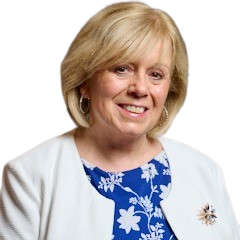
Mary Glindon is the Labour MP for Newcastle upon Tyne East and Wallsend, first elected for the predecessor seat of North Tyneside at the 2010 general election.
In the 2024 general election for the re-established Newcastle upon Tyne East and Wallsend constituency, Glindon received 21,200 votes (50.1%). The Reform UK candidate received 8,383 votes (19.8%), and the Green Party candidate secured 5,257 votes (12.4%). Mary Glindon was duly elected with a majority of 12,817.
The constituency covers the eastern suburbs of Newcastle upon Tyne and the town of Wallsend in Tyne and Wear. The area has a history linked to coal mining and shipbuilding.
The seat name existed previously (1997-2010). The current constituency was re-established for the 2024 election, combining parts of the abolished North Tyneside constituency (represented by Glindon 2010-2024) and the former Newcastle upon Tyne East seat. The area is considered safe for the Labour Party.
The Newcastle upon Tyne East seat was represented by Nick Brown from 2010 to 2024. Brown was Labour’s longest-serving chief whip, occupying the post both in government and opposition. He represented the previous Newcastle upon Tyne East and Wallsend seat from 1983 to 2010.
Political Career
Glindon is a member of the House of Commons backbench business committee (since October 2024). The backbench business committee is a select committee of the House of Commons that has the responsibility for scheduling debates on days set aside for “backbench business”. Established in 2010 as part of the Wright reforms, its creation helped transfer some control of the parliamentary timetable from the government to backbench MPs for the first time.
Glindon is also a member of the House of Commons administration committee (since October 2024) – the committee responsible for overseeing the internal running of the House and the services provided to its members and their staff. Its primary role is to ensure that the facilities and administrative support on the parliamentary estate are effective, efficient, and meet the needs of a modern legislature.
Glindon previously served as an opposition whip from April 2020 to May 2024, and before that as shadow minister for farming and rural communities (within the shadow environment, food and rural affairs team) from October 2016 to April 2020. She was also briefly a parliamentary private secretary (PPS) in the shadow transport team until 2014 (to shadow secretary of state Mary Creagh). A PPS acts as an unpaid parliamentary assistant, providing a link between the senior frontbencher and backbench MPs.
Glindon was a member of the environment, food and rural affairs committee from March 2020 to June 2020, the transport committee from July 2015 to October 2016, the housing, communities and local government committee from February 2013 to March 2015, and the environment, food and rural affairs committee from July 2010 to March 2015.
Glindon is listed as a member of the all-party parliamentary groups (APPGs) for grid networks, obesity, Hadrian’s Wall and responsible vaping among others.
Glindon delivered her maiden speech (as MP for North Tyneside) on 30 June 2010 during a debate on energy efficiency. In it, she said: “On several occasions, I have listened to [MPs] opposite mock when those of us with great mining and shipbuilding traditions tell of the devastating effects of the Tory cuts during the 1980s and 1990s.
“What they fail to understand is that those cuts were not simply about economic ruin for individuals, but dealt severe cultural blows to close-knit communities. I congratulate the Labour government on trying to right those wrongs with positive policies during the last 13 years.”
Glindon served as a Labour councillor on North Tyneside Council from 1995 to 2010, representing the Battle Hill ward. During her time on the council, she served as the civic mayor of North Tyneside and was also the cabinet member for Health and Wellbeing.
Political Views
Leadership elections and loyalty
Oppose leadership election: In May 2026, Glindon was among the over 100 Labour MPs who signed a joint statement insisting it was “no time for a leadership contest.” The letter was an intervention in the political crisis engulfing Keir Starmer’s premiership, after Labour suffered heavy losses in the 2026 local elections and devolved elections to the Scottish Parliament and Senedd Cymru. It was organised as a counterweight to a mounting rebellion that had seen high-profile figures, including some ministers, call for Starmer’s resignation.
The statement read: “Last week we had a devastatingly tough set of election results. It shows we have a hard job ahead to win back trust from the electorate.
“That job needs to start today – with all of us working together to deliver the change the country needs.
“We must focus on that. This is no time for a leadership contest.”
Labour deputy leadership 2025: Glindon was one of 175 Labour MPs who nominated Bridget Phillipson for the party’s deputy leadership in September 2025. The election followed the resignation of Angela Rayner, who stepped down as deputy prime minister and deputy party leader after an investigation into her tax affairs. It marked the first time since 2007 that Labour had held a deputy leadership contest while in government.
Phillipson, the serving education secretary, was widely viewed as the candidate favoured by Downing Street and the party leadership. She secured 175 nominations from the Parliamentary Labour Party (PLP), comfortably exceeding the 80 required to reach the final ballot. She was ultimately defeated by Lucy Powell.
Labour leadership 2020: Glindon was one of 82 Labour MPs who nominated Keir Starmer for the party’s leadership in early 2020. The election was triggered by the resignation of Jeremy Corbyn following the party’s defeat in the 2019 general election, which resulted in Labour’s fewest seats in the House of Commons since 1935.
Starmer’s 82 nominations were the highest of any candidate. The shadow Brexit secretary won a decisive victory in the first round with 56.2% of the vote, defeating Rebecca Long-Bailey and Lisa Nandy.
Labour leadership 2015: Glindon was one of 68 Labour MPs who nominated Andy Burnham for the party’s leadership in June 2015. The election followed the resignation of Ed Miliband after the party’s defeat in the 2015 general election. It was the first contest held under the “one member, one vote” system, which replaced the previous electoral college.
Burnham, the shadow health secretary, was initially considered the frontrunner. He secured 68 nominations from the Parliamentary Labour Party (PLP), comfortably exceeding the 35 required to reach the final ballot. He ultimately finished second in the contest with 19% of the vote, losing to Jeremy Corbyn in the first round
Corbyn loyalty list: In March 2016, Glindon was labelled as “core group plus” by the Corbyn leadership in a leaked list which categorised Labour MPs by their perceived loyalty.
Labour leadership 2016: Glindon supported Angela Eagle for the party’s leadership in July 2016. The election was triggered by a challenge to Jeremy Corbyn following the EU referendum, which led to a wave of shadow cabinet resignations and a vote of no confidence supported by 172 MPs.
Eagle, the former shadow first secretary of state, was the first to formally launch a challenge against Corbyn. However, she withdrew from the race on 19 July after attracting fewer nominations than Owen Smith.
Glindon shifted her support to Smith. Corbyn was ultimately re-elected with an increased mandate of 61.8% of the vote.
Labour leadership 2010: Glindon was one of 81 Labour MPs who nominated David Miliband for the party’s leadership in May 2010. The election followed the resignation of Gordon Brown, who stepped down as prime minister and Labour leader after the 2010 general election.
Miliband, the former foreign secretary, was seen as closely aligned with the New Labour project – a Blairite figure. He secured 81 nominations from the Parliamentary Labour Party (PLP), comfortably exceeding the 33 required to reach the final ballot, but was narrowly defeated by his brother, Ed Miliband, in the final round by 50.7% to 49.3%.
Factional identity and party tradition
Lucy Connolly EDM: In May 2025, Glindon joined a small, cross-party group of MPs in signing a parliamentary motion expressing concern over the imprisonment of Lucy Connolly, who was jailed for inciting racial hatred in a social media post following the knife attacks in Southport. Connolly posted online calling for “mass deportation now”, adding “set fire to all the… hotels [housing asylum seekers]… for all I care”.
The early day motion (EDM), tabled by the former Reform and now-independent MP Rupert Lowe, stated that Connolly was a young mother convicted of a non-violent offence during a period of “unprecedented overcrowding” in the prison system. Glindon was the only Labour MP to sign the motion.
The EDM called on the government to “expand the use of community-based alternatives, and ensure that limited prison space is prioritised for dangerous and violent offenders, not young mothers like Lucy Connolly.”
https://x.com/RupertLowe10/status/1952030790713213030
Labour Friends of Nato: Glindon is a patron of Labour Friends of Nato (LFN), a parliamentary network and pressure group established in January 2026 to reinforce the Labour Party’s commitment to the Atlantic alliance. According to a LabourList report, the group seeks to deepen understanding of Nato’s strategic role among MPs and party activists. It also seeks to provide a platform to rebut political arguments from both the left and right that seek to diminish Britain’s involvement in the treaty.
The formation of the network was framed by its founders as a return to the post-war traditions of the Clement Attlee government, which helped establish the alliance.
The group set up with plans to organise fact-finding missions to Nato’s military and political headquarters in Brussels and hosting an annual lecture in honour of Ernest Bevin, the former foreign secretary and Nato treaty signatory.
Brexit and Europe
Brexit referendum: Glindon supported the Remain campaign in the 2016 referendum on Britain’s membership of the European Union (EU), and therefore disagreed with a majority of her constituents, 59.5% of whom voted to Leave.
Article 50: In February 2017, Glindon voted in favour of the European Union (Notification of Withdrawal) Bill. The legislation empowered the prime minister to notify the Council of the European Union of the UK’s intention to withdraw, formally triggering the process set out in Article 50 of the Treaty on European Union. MPs supported the bill by 498 votes to 114 at second reading.
Welfare
Welfare ‘reasoned amendment’ (June 2025): Glindon was one of the over 120 Labour MPs to sign the reasoned amendment to the government’s flagship welfare bill which aimed to reject the proposed legislation.
The amendment, in the name of senior Labour MP Dame Meg Hillier, objected to the fact that the bill had not been subject to a “formal consultation with disabled people” and that “250,000 people will be pushed into poverty” as a result of it, according to a government impact assessment.
The motion also called on the government to wait for the publication of the review into the Personal Independence Payment (Pip), helmed by minister Sir Stephen Timms, and the independent review, conducted by Sir Charlie Mayfield, into how the employment of disabled people could be boosted.
In May 2025, Glindon had signed a letter warning the government that the cuts were “impossible to support” and calling for a change in direction.
The letter, signed by 42 Labour MPs, read: “The planned cuts of more than £7bn represent the biggest attack on the welfare state since George Osborne ushered in the years of austerity and over 3 million of our poorest and most disadvantaged will be affected.
“Whilst the government may have correctly diagnosed the problem of a broken benefits system and a lack of job opportunities for those who are able to work, they have come up with the wrong medicine. Cuts don’t create jobs, they just cause more hardship.”
Welfare vote (July 2025): Glindon went on to vote against the bill at second reading. The vote came after ministers agreed to significant concessions to avoid defeat via a mass rebellion of Labour MPs on 1 July 2025.
Winter fuel payment EDM: In September 2024, Glindon signed an early day motion expressing concern over the government’s proposed changes to the winter fuel payment. The motion called on the government to “postpone the ending of winter fuel payments and establish a comprehensive strategy to tackle fuel poverty, health inequality and low incomes among older people.”
Welfare vote (July 2015): Alongside almost one quarter of her colleagues, Glindon voted against the Conservative government’s Welfare Reform and Work Bill at second reading – defying the party whip which instructed Labour MPs to abstain. This decision to abstain, taken by interim Labour leader Harriet Harman, caused a furious backlash within the party, particularly from its left wing. It became a defining issue in the ongoing leadership contest. Jeremy Corbyn was the only candidate to vote against the bill. Overall, 48 Labour MPs voted against the proposed legislation.
Assisted dying
Glindon voted against the Terminally Ill Adults (End of Life) Bill, better known as the assisted dying bill, at both second reading (November 2024) and third reading (June 2025).
In an article for The House magazine, published June 2025, Glindon suggested that legalising assisted dying and improving palliative care were mutually exclusive options.
She wrote: “While those who support [Kim] Leadbeater’s bill may be motivated by good intentions, to suggest that the solution for those we have failed is assisted suicide is defeatist and wrong-headed. To put it bluntly, we are suggesting to the terminally ill that they should consider taking their own lives because of our failure to invest in palliative care.
“Furthermore, the reality is that given structural inequality in provision, the pressure to opt for assisted suicide will be felt most acutely by the most vulnerable, the poor, the isolated, those with conditions like dementia, and BAME communities.”
Social values and conscience issues
A practising Roman Catholic, Glindon holds socially conservative views on some issues.
Glindon is a member of the all-party parliamentary pro-life group, suggesting an opposition to abortion.
Speaking in a 2022 Westminster Hall debate on access to abortion, Glindon commented: “In this crucial debate, what about women’s aftercare? We are talking about changing the law, and a number of my constituents are concerned that that would lead to abortion up until birth. We know that about 80% of women want the time limit reduced.
“Beyond that, what about the mental health of women who have had an abortion – where is the care for them? Where does this address things that have never been properly addressed for years and years?”
In October 2018, Glindon voted against a bill seeking to decriminalise abortion in the UK, including Northern Ireland, by removing criminal liability for abortions performed with the woman’s consent up to 24 weeks of pregnancy. The bill, proposed by Labour MP Diane Johnson, sought to scrap the 1861 Offences Against the Persons Act.
Same-sex marriage (2013): In February 2013, Glindon was one of the 22 Labour MPs to vote against the Marriage (Same Sex Couples) Bill at its second reading. The landmark piece of legislation, which received its second reading by 400 votes to 175, legalised marriage for same-sex couples in England and Wales.
At the time, she signed a cross-party open letter protesting that the government had no mandate to “redefine marriage”.
The letter stated: “We are sceptical that the proposed protections will prevent the erosion of liberties of religion and conscience. The proposed redefinition of marriage is unnecessary, given the legal rights established through civil partnerships.
“We understand some parliamentarians support freedom for same sex couples to marry, but we support a freedom from the state being able to redefine the meaning of marriage.”
Foreign policy and security
Trident renewal (2016): Glindon voted in favour of a government motion calling for the renewal of the Trident nuclear deterrent system in July 2016. The motion, which was passed by 472 votes to 117, committed the UK to constructing a new fleet of submarines to carry the nation’s nuclear weapons.
Labour was split over the issue with 140 of its 230 MPs going against leader Jeremy Corbyn and backing the motion.
Syria airstrikes (2015): Glindon voted against a government motion to extend UK airstrikes against Isis from Iraq into Syria in December 2015. The motion, which was passed by 397 votes to 223 after a ten-hour debate in the House of Commons, authorised the RAF to conduct strikes against Isis targets in Syria.
Syria airstrikes (2013): Glindon voted against the government’s motion on the principle of military intervention in Syria in August 2013. The government motion was defeated by 285 votes to 272, a move which effectively ruled out UK participation in any US-led military strikes.
Palestine
LFPME: Glindon has been listed as a member of Labour Friends of Palestine and the Middle East (LFPME). The organisation’s stated aim is to promote peace and justice in the region through the application of international law and respect for human rights.
Palestinian recognition vote (2014): In October 2014, Glindon was one of 192 Labour MPs who voted in favour of recognising Palestine as a state. The motion, passed by 274 votes to 12, called on the government to “recognise the state of Palestine alongside the state of Israel as a contribution to securing a negotiated two-state solution”.
Before Politics
Born Mary Theresa Mulgrove in Newcastle upon Tyne on 13 January 1957, Mary Glindon attended Newcastle Polytechnic (now Northumbria University).
Personal Life
Glindon married Ray Glindon, who was also a long-serving Labour councillor in North Tyneside, in 2000.
She was widowed in April 2021 following her husband’s death from cancer. She has one daughter and two step-children.
Trivia
Glindon holds socially conservative views on some issues.
Mary Glindon has not written for Politics.co.uk.