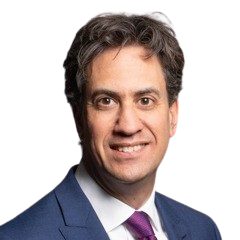
Ed Miliband is the Labour MP for Doncaster North, having represented the constituency since the 2005 general election.
In the 2024 general election, Miliband received 16,231 votes, representing 52.4% of the vote share. The Conservative candidate, Glenn Bluff, received 7,105 votes (22.9%), while the Social Democratic Party candidate, Dave Bettney, secured 1,960 votes (6.3%). Miliband was duly re-elected with a majority of 9,126 votes.
The Doncaster North constituency is located in South Yorkshire and covers areas north and west of the town of Doncaster, including Mexborough, Adwick le Street, Bentley, and Stainforth. It is a former coal mining area.
The seat has been held by Labour continuously since its creation in 1983, and predecessor seats covering the area returned Labour MPs since 1935. Miliband’s majority was significantly reduced in the 2019 general election, before increasing again in 2024. The constituency boundaries underwent changes for the 2024 election.
Ed Miliband: Labour leader and return to frontline politics
Ed Miliband currently serves as secretary of state for foreign, commonwealth and development affairs. Miliband was appointed to this role in July 2026, following the Labour leadership contest and Andy Burnham’s elevation as prime minister.
Miliband served as secretary of state for energy security and net zero from July 2024 to July 2026, having returned to the Labour frontbench as shadow secretary of state for business, energy and industrial strategy in April 2020.
Miliband was appointed as shadow secretary of state for climate change and net zero in November 2021. He held this post for three years until the 2024 general election.
Previously, Miliband served as leader of the Labour Party and leader of the opposition from September 2010 until May 2015.
Miliband was elected leader of the Labour Party on 25 September 2010, narrowly defeating his older brother and former foreign secretary David Miliband. The result, announced at a special conference in Manchester, marked a significant milestone in Labour’s transition to opposition after 13 years in government under Tony Blair (1997-2007) and Gordon Brown (2007-2010).
The 2010 Labour leadership contest was triggered by Brown’s resignation in May 2010 and the negotiation of the Conservative-Liberal Democrat coalition. Under Labour’s leadership election rules, candidates needed to secure the support of 12.5% of the parliamentary Labour Party (PLP). After the 2010 election, which returned 258 MPs, the threshold stood at 33. Ed Miliband secured 63 nominations from the PLP; David claimed 81.
The contest was quickly seen as a two-horse race between the Miliband brothers. David, long-touted as a future Labour leader, was seen as the frontrunner – and the favoured candidate of his party’s ‘Blairite’ wing. Ed positioned himself to the left of his older brother.
Launching his candidacy, Ed stated that he was “proud” of what the 1997-2010 Labour government achieved, but said “deep thinking” was needed about “what went wrong”.
He argued the “central lesson” of the 2010 general election was that the government “lost that sense of progressive mission” and became “more caretakers than idealists; more technocratic than transformative.”
He added: “When political parties lose that sense of idealism and mission they become much more vulnerable to the currents of events.”
The 2010 contest was the last held under the Labour Party’s old electoral college system, which weighted votes equally among three sections: affiliated trade unions, individual party members, and Labour MPs/MEPs.
In the final round of the alternative vote (AV) ballot, David won a clear majority of support from MPs (53.4%) and also narrowly won among party members (54.4%). However, Ed secured 59.8% of the affiliated supporters’ section. It was enough to overcome his brother’s lead among members and MPs, providing an overall victory of 50.7% to David’s 49.3%.
In his victory speech, Ed acknowledged the political and personal significance of the contest. He paid tribute to his brother and called on the party to unite against the coalition government.
He said a “new generation” had taken charge of Labour and vowed to change the party.
On 29 September, David announced that he would not seek election to Ed’s shadow cabinet. In a letter to the chairman of his constituency Labour Party, David said the decision was about enabling his brother to make a “fresh start”. David stood down from parliament in March 2013, saying he “feared being a distraction”.
The contest arguably came to define Ed Miliband’s tenure as leader, as he sought to move the party away from its New Labour years. As leader, the younger Miliband embraced a “One Nation Labour” image – a reference to the Conservative tradition associated with Victorian prime minister Benjamin Disraeli.
In October 2012, Miliband called for a “vision of a Britain where patriotism, loyalty, dedication to the common cause courses through the veins of all and nobody feels left out.”
He added: “Disraeli called it ‘One Nation’… We heard the phrase again as the country came together to defeat fascism. And we heard it again as Clement Attlee’s Labour government rebuilt Britain after the war.”
During his tenure as Labour leader, Miliband supported the “Yes” campaign during the 2011 alternative vote referendum.
In August 2013, Miliband helped inflict a historic defeat on the Conservative-Liberal Democrat coalition government, led by David Cameron as prime minister, when the House of Commons rejected a motion that sought parliamentary approval for military action against Syria.
The government’s final defeat on its own motion, by 285 votes to 272, was secured by a significant rebellion from within its own ranks. 30 Conservative MPs and nine Liberal Democrats voted with the opposition.
In the immediate aftermath of the vote, Miliband said that British involvement in any military action was now “off the agenda”, adding: “The prime minister has been cavalier and reckless. The result of the vote must be respected.”
Barack Obama, the US president, postponed US action in the aftermath of the vote.
Miliband ultimately led Labour to defeat at the 2015 general election. The party won 232 seats, a net loss of 26, after only recording a small increase in its vote share to 30.5%. Labour was decimated in its former stronghold of Scotland, where the Scottish National Party (SNP) won 56 of the 59 Scottish seats, an increase of 50.
The Conservative Party secured a majority and 330 seats, up 24, on a 36.9% vote share.
During the campaign, Miliband’s political opponents depicted him ungainly and not prime minister material. In its final front page before polling day, the Sun newspaper carried a photograph of the Labour leader under the headline “Save Our Bacon”, urging readers not to vote for Miliband. Miliband was haunted by an unfortunate May 2014 photograph that showed him awkwardly eating a bacon sandwich.
Miliband also committed a notable gaffe just four days before polling stations opened when he unveiled a large stone monolith with six election pledges carved into it. The 8ft 6in limestone tablet, quickly dubbed the “EdStone”, was presented at a press event in Hastings as a symbol of Labour’s commitment to its promises. The six vague-sounding vows featured on Miliband’s monolith included: “A strong economic foundation”.
In the immediate aftermath of the result, Miliband announced his resignation as Labour leader. He said it was “time for someone else to take forward the leadership of this party”.
Miliband added: “I want to do so straight away because the party needs to have an open and honest debate about the right way forward without constraint…
“It has been an enormous privilege. Thank you for the selfies, thank you for the support, and thank you for the most unlikely cult of the 21st century, Milifandom.”
Ed Miliband: rise to prominence
Miliband served in the cabinet during Brown’s tenure as prime minister. He was appointed the first secretary of state for the newly created department of energy and climate change (DECC) in October 2008, serving until May 2010. In this role, he oversaw the introduction of the Climate Change Act 2008.
Miliband was minister for the Cabinet Office and chancellor of the Duchy of Lancaster from June 2007 to October 2008. He also served as minister for the third sector from May 2006 until June 2007.
Miliband delivered his maiden speech on 23 May 2005.
In it, he said: “Mine is a constituency that surprises those who visit it. Far from being an urban seat, as many assume, it is composed of a series of villages to the north of the town. It is a place with great and sweeping countryside, including Sykehouse, the longest village in England, the Thorne and Hatfield moors, renowned for their natural beauty, and Askern lake.
“We are also home to Saxon churches and the Norman church of St. Mary Magdalene in Campsall, where it is said that Robin Hood and Maid Marian were married. As strong believers in redistribution, people in Doncaster, North are happy to reclaim his roots.”
He added: “I also want to put on the record, however, how much my family owes to this country. Our father left Belgium in 1940 on the last boat to Britain, the evening before the Nazis arrived, and would have perished without the welcoming arms of a country that recognised its duty to help those fleeing from terror.
“I hope that I and my brother, in the service that we give in the House, can in some small way help to repay the debt that we owe to this country.
“In my contributions in this House, I will strive to reflect not only the voices of the constituents who put me here this month, but the humanity and solidarity shown to my family more than 60 years ago, which led my family out of the dark times of despair to a place of hope, and me to the Floor of this House today.”
Political Views
Leadership elections and loyalty
Labour deputy leadership 2025: Miliband was one of 117 Labour MPs who nominated Lucy Powell for the party’s deputy leadership in September 2025. The election followed the resignation of Angela Rayner, who stepped down as deputy prime minister and deputy party leader after an investigation into her tax affairs. It marked the first time since 2007 that Labour had held a deputy leadership contest while in government.
Powell, the former leader of the House of Commons, was seen as a candidate representing the party’s “soft left”; she was supported by leading soft left figures including Miliband and Andy Burnham. She secured 117 nominations from the Parliamentary Labour Party (PLP), above the 80 required, and went on to win the election – defeating Bridget Phillipson with 54.3% of the vote.
Labour leadership 2020: Miliband was one of 82 Labour MPs who nominated Keir Starmer for the party’s leadership in early 2020. The election was triggered by the resignation of Jeremy Corbyn following the party’s defeat in the 2019 general election, which resulted in Labour’s fewest seats in the House of Commons since 1935.
Starmer’s 82 nominations were the highest of any candidate. The shadow Brexit secretary won a decisive victory in the first round with 56.2% of the vote, defeating Rebecca Long-Bailey and Lisa Nandy.
Labour leadership 2015: Miliband was one of 26 Labour MPs who did not nominate any candidate for the party’s leadership in June 2015. The election was the first to be conducted under the “one member, one vote” system, which Miliband introduced as leader. The contest eventually saw Jeremy Corbyn, a veteran backbencher, win a landslide victory in the first round with 59.5% of the vote, defeating Andy Burnham, Yvette Cooper and Liz Kendall.
Corbyn loyalty list: In March 2016, Miliband was labelled as “core group negative” by the Corbyn leadership in a leaked list which categorised Labour MPs by their perceived loyalty. This label suggested the Corbyn leadership viewed Miliband as a critic but not openly hostile.
Labour leadership 2016: Miliband was one of 162 Labour MPs who nominated Owen Smith for the party’s leadership in July 2016. The election was triggered by a challenge to Corbyn following the EU referendum, which led to a wave of shadow cabinet resignations and a vote of no confidence supported by 172 MPs. Smith, the former shadow work and pensions secretary, was ultimately defeated by Corbyn, who won with an increased mandate of 61.8% of the vote.
Factional identity and party tradition
Tribune group (2017): Miliband was listed among the supporters of the Tribune parliamentary group – a caucus generally described as representing the party’s “soft left”.
The Tribune group was initially formed in 1964 to support the newspaper of the same name. It served as a prominent forum for those parliamentarians situated on the left of the Labour Party – but it split over Tony Benn’s campaign for the deputy leadership in 1981. Benn’s supporters founded the Campaign group – which evolved into the Socialist Campaign Group (SCG). Today, the Bennite SCG is strongly associated with the Labour left tradition.
During the 1980s, the Tribune group emerged as a more natural home for those on Labour’s “soft left”.
In 2017, Efford officially re-launched the group with a new mission statement calling for “opportunity and aspiration” to be placed at the heart of the party’s programme. Efford said he had reformed the group to ensure that the centre-left of the Parliamentary Labour Party (PLP) “have a space in which to put forward ideas and debate which has not been there under successive leaders”.
He added: “The view of Labour MPs at the moment tends to be that too much are just Blairites who want to stab Jeremy Corbyn in the back. We want to show that is not where we are, and that we want to develop our own ideas that represent the centre-left of the party.”
SERA: Miliband has been listed as a member of the Socialist Environment and Resources Association (SERA) – a socialist society affiliated with the Labour Party. Founded in 1973, SERA is the party’s official environmental campaign group. The organisation campaigns on a wide range of issues, including renewable energy, biodiversity, air quality and the transition to a green economy. SERA describes its member MPs as “champions for the environment”.
Brexit and Europe
Brexit referendum: Miliband supported Remain in the 2016 Brexit referendum, and therefore disagreed with a vast majority of his majority of constituents, 71.7% of whom voted to Leave.
Article 50: In February 2017, Miliband voted in favour of the European Union (Notification of Withdrawal) Bill. The legislation empowered the prime minister to notify the Council of the European Union of the UK’s intention to withdraw, formally triggering the process set out in Article 50 of the Treaty on European Union. MPs supported the bill by 498 votes to 114 at second reading.
During the debate on the bill, Miliband warned that a “hard Brexit” would see Britain align with the recently inaugurated US president, Donald Trump.
Miliband told the House: “I can go along with the prime minister that Brexit means Brexit, but I cannot go along with the idea that Brexit means Trump.”
Welfare
Welfare vote (July 2025): Miliband voted in favour of the government’s flagship welfare bill at second reading. The vote came after ministers agreed to significant concessions to avoid defeat via a mass rebellion of Labour MPs on 1 July 2025.
Assisted dying
Miliband voted in favour of the Terminally Ill Adults (End of Life) Bill, better known as the assisted dying bill, at both second reading (November 2024) and third reading (June 2025).
Social values and conscience issues
Abortion decriminalisation (2025): Miliband voted in favour of a backbench amendment to the Crime and Policing Bill that sought to decriminalise abortion in England and Wales in June 2025. The amendment, which was passed by a majority of 242 votes, removed women from the threat of prosecution for ending a pregnancy at any stage. As an issue of conscience, MPs were allowed to vote according to their personal beliefs.
Same-sex marriage (2013): In February 2013, Miliband voted in favour of the Marriage (Same Sex Couples) Bill at its second reading. The landmark piece of legislation, which received its second reading by 400 votes to 175, legalised marriage for same-sex couples in England and Wales.
Foreign policy and security
Trident renewal (2016): Miliband voted in favour of a government motion calling for the renewal of the Trident nuclear deterrent system in July 2016. The motion, which was passed by 472 votes to 117, committed the UK to constructing a new fleet of submarines to carry the nation’s nuclear weapons. Labour was split over the issue with 140 of its 230 MPs going against leader Jeremy Corbyn and backing the motion.
Syria airstrikes (2015): Miliband voted against a government motion to extend UK airstrikes against Isis from Iraq into Syria in December 2015. The motion, which was passed by 397 votes to 223 after a ten-hour debate in the House of Commons, authorised the RAF to conduct strikes against Isis targets in Syria.
Syria airstrikes (2013): Miliband voted against the government’s motion on the principle of military intervention in Syria in August 2013. The government motion was defeated by 285 votes to 272, a move which effectively ruled out UK participation in any US-led military strikes.
Palestine
Palestinian recognition vote (2014): In October 2014, Miliband was one of 192 Labour MPs who voted in favour of recognising Palestine as a state. The motion, passed by 274 votes to 12, called on the government to “recognise the state of Palestine alongside the state of Israel as a contribution to securing a negotiated two-state solution”.
Before Politics
Edward Samuel Miliband was born on 24 December 1969 in London. He is the younger son of Marion Kozak, a human rights campaigner and academic, and Ralph Miliband, a prominent Marxist academic. Both his parents were Jewish immigrants who had fled Nazi persecution in Poland and Belgium respectively.
Miliband was educated at Haverstock comprehensive school in Camden, London. He studied philosophy, politics and economics (PPE) at Corpus Christi college, Oxford. He subsequently obtained a master’s degree in economics from the London School of Economics.
Miliband began his career as a researcher for Harriet Harman in 1993, later becoming a speechwriter.
In 1995, he joined Gordon Brown’s team as a researcher and later served as a special adviser to Brown as chancellor of the exchequer from 1997 to 2002.
Miliband spent a sabbatical year (2003-2004) at Harvard university as a visiting lecturer and scholar at the centre for European studies. He taught a course titled “What’s Left? The Politics of Social Justice”.
Upon returning, Gordon Brown appointed him chair of HM treasury’s council of economic advisers, a role he held until his election to parliament in 2005.
Personal Life
Miliband is married to Justine Thornton, an environmental lawyer who was appointed as a high court judge in 2019. The couple married in 2011 and have two sons born 2009 and 2010.
Although Miliband has Jewish heritage through both parents, he has described himself as an atheist.
In November 2013, Ed said his relationship with his older brother, David, had yet to fully recover after the 2010 leadership election.
He told BBC Radio 4‘s Desert Island Discs: “It has been incredibly tough; really, really tough. I didn’t take this decision [to stand in the election] lightly. I knew it would have an impact on my family and on him.
“What I thought was: ‘This is going to be hard but I’ve got things to say and things to do which I am in a better place than him or others to say and do about the way we need to move on from New Labour, about things that need to happen in the country.’”
Trivia
Miliband reportedly supports the Boston Red Sox baseball team and Leeds United Football Club.
He previously co-hosted a political ideas podcast entitled Reasons to be Cheerful with comedian Geoff Lloyd.
Ed Miliband has not written for Politics.co.uk.