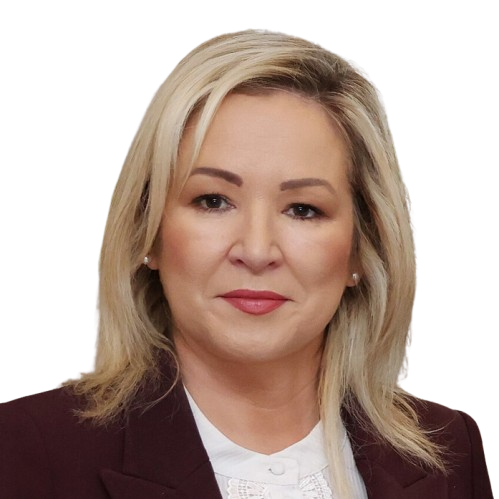
Michelle O’Neill is the vice president of Sinn Féin and currently serves as the first minister of Northern Ireland, having taken office in February 2024. This marked a historic moment as she became the first nationalist politician to hold the position.
O’Neill previously served as deputy first minister in the Northern Ireland executive between January 2020 and February 2022.
Sinn Féin became the largest party in the Northern Ireland Assembly following the May 2022 elections, which entitled O’Neill to the post of first minister. However, the assembly and executive were suspended for two years due to the Democratic Unionist Party’s (DUP) boycott in protest against post-Brexit trading arrangements (the Northern Ireland Protocol).
O’Neill assumed the office of first minister after power-sharing was restored in February 2024.
Michelle O’Neill: Sinn Féin leader
In January 2017, veteran republican Martin McGuinness resigned as deputy first minister in protest over the DUP’s handling of the Renewable Heat Incentive (RHI) scandal. McGuinness subsequently stepped back from frontline politics and died on 21 March 2017, two months after his resignation.
O’Neill was selected to succeed McGuinness as Sinn Féin’s leader in Northern Ireland.
Responding to the appointment, O’Neill said: “For me to be selected to lead our party in the north is truly the biggest honour and privilege of my life.
“I have no doubt that I am following in the footsteps of a political giant in Martin McGuinness. And it’s not just republicans that think that, as we have witnessed over the course of the last few weeks.
“Over the course of the last number of weeks, while others shouted from the sidelines it was Sinn Féin that stood up and confronted corruption. It was Sinn Féin that called a halt to the arrogance and the intolerance of the DUP.”
O’Neill’s appointment represented a generational shift for Sinn Féin in Northern Ireland. Aged 40 at the time, she became the first leader of the party in the North seen as a member of the post-conflict generation. O’Neill joined Sinn Féin after the Good Friday Agreement in 1998, aged 21.
Mary Lou McDonald succeeded Gerry Adams, Sinn Féin’s longstanding president, in February 2018. O’Neill replaced McDonald as the party’s vice president.
In September 2019, long-time Northern Ireland Assembly member John O’Dowd announced he would challenge Michelle O’Neill for the role of vice president. In the contest held at Sinn Féin’s Ard Fheis (party conference) that November, O’Neill comfortably defeated O’Dowd, receiving 493 delegate votes to his 241.
Michelle O’Neill: first minister
The Northern Ireland Assembly was suspended again from 2017 to 2020.
Following talks between the parties, the assembly resumed in January 2020 and O’Neill was appointed as deputy first minister of Northern Ireland.
As deputy first minister, O’Neill played a key role in the Northern Ireland executive’s response to the Covid-19 pandemic. As a former Northern Irish health minister (2016-2017) she was said to appear knowledgeable at press briefings. However, O’Neill was later heavily criticised for her attendance at veteran republican Bobby Storey’s funeral. The 1,800-strong mass gathering allegedly broke social distancing rules. O’Neill subsequently apologised.
In February 2022, the Democratic Unionist Party withdrew its first minister from the executive, collapsing the power-sharing institutions. This action was taken in protest against the post-Brexit trading arrangements known as the Northern Ireland Protocol, which the DUP argued undermined Northern Ireland’s place within the United Kingdom.
Under the assembly’s power-sharing framework, O’Neill automatically lost her position as deputy first minister.
The 2022 Northern Ireland Assembly election returned Sinn Féin as the largest party. It marked the first time that an Irish nationalist party won the most seats in an assembly election. Sinn Féin’s victory meant the party had the right to nominate O’Neill as first minister under the power-sharing arrangements agreed in 1998.
On 3 February 2024, devolved government in Northern Ireland was restored following a two-year political stalemate. The impasse finally broke in late January 2024 after the DUP’s party executive voted to accept a deal with the UK government. The agreement, detailed in a command paper titled Safeguarding the Union, included measures to reduce checks and paperwork on goods moving from Great Britain to Northern Ireland.
The restoration of the power-sharing arrangements resulted in Michelle O’Neill’s appointment as first minister. O’Neill of Sinn Féin became the first nationalist to hold the post since the creation of Northern Ireland in 1921. Emma Little-Pengelly of the Democratic Unionist Party (DUP) was appointed as deputy first minister.
In her first speech as first minister, O’Neill said her appointment would open “the door to a future – a shared future.”
She added: “We mark a moment of equality and a moment of progress, a new opportunity to work and to grow together, confident in the idea that, wherever we come from and whatever our aspirations, we can and must build our future together…
”As an Irish republican, I pledge cooperation and genuine honest effort with all those colleagues of the British and unionist tradition who cherish the Union. This is an assembly for all: Catholic, Protestant and dissenter.
“Despite our different outlooks and different views on the future constitutional position, the public rightly demand that we work and deliver together, and also that we build trust and confidence in our ability to collectively do that.
“That will require courage and ambition, not just from those of us who are elected but from the public. We should all invest in this. The more of us who do that, the better chance it has to succeed.”
She referred to the Good Friday Agreement as the culmination of a process of “political accommodation that provided a peaceful and democratic alternative to 30 years of conflict.”
O’Neill, who was 20 years old at the time of the agreement, recalled “the sense of hope and that real feeling of optimism.”
She said that there was no doubt that “our society has been fundamentally transformed because of our peace process.”
She continued: “I stand here, an elected first minister, proud as someone who represents that Good Friday Agreement generation and someone who will lead us into the next 25 years. I am also an Ulster woman, a Tyrone woman and a deeply proud Irish and European citizen…
”This is an historic day, and it represents a new dawn. For the very first time, a nationalist takes up the position of first minister. That such a day would come was unimaginable to my parents and grandparents’ generation, but, because of the Good Friday Agreement, that old state that they were born into is gone and a more democratic and equal society exists.
“This is now a better place for all of us. This place that we call “home” and which we all love – the North of Ireland, Northern Ireland – where you can be British, Irish, both or none, is all a changing portrait.
“Yesterday is gone. Today is a new day, and my appointment today reflects the change that is happening.”
O’Neill’s early political career
O’Neill’s first elected role was as a councillor for the Torrent area on Dungannon and South Tyrone Borough Council (2005-2011).
In 2010, she became the first female mayor of Dungannon and South Tyrone.
O’Neill was elected to the Northern Ireland Assembly in 2007 representing the Mid Ulster constituency, having previously worked as an advisor to Sinn Féin MLA Francie Molloy. She continues to represent Mid Ulster in the Assembly.
O’Neill served as minister for agriculture and rural development from 2011 to 2016 and minister of health from 2016 to 2017.
Personal life
O’Neill comes from a strong Republican background. Her father, Brendan Doris, was a former IRA prisoner who later became a Sinn Féin councillor. Her uncle, Paul Doris, headed the Noraid fundraising group in the US. Her cousin, Tony Doris, was one of three IRA members shot dead by the SAS in an ambush in Coagh, County Tyrone, in 1991.
O’Neill married Paddy O’Neill in 1995. The pair separated in 2014.
O’Neill has two children.
Michelle O’Neill has not written for Politics.co.uk.