Ulster Unionist Party founded to fight Irish Home Rule
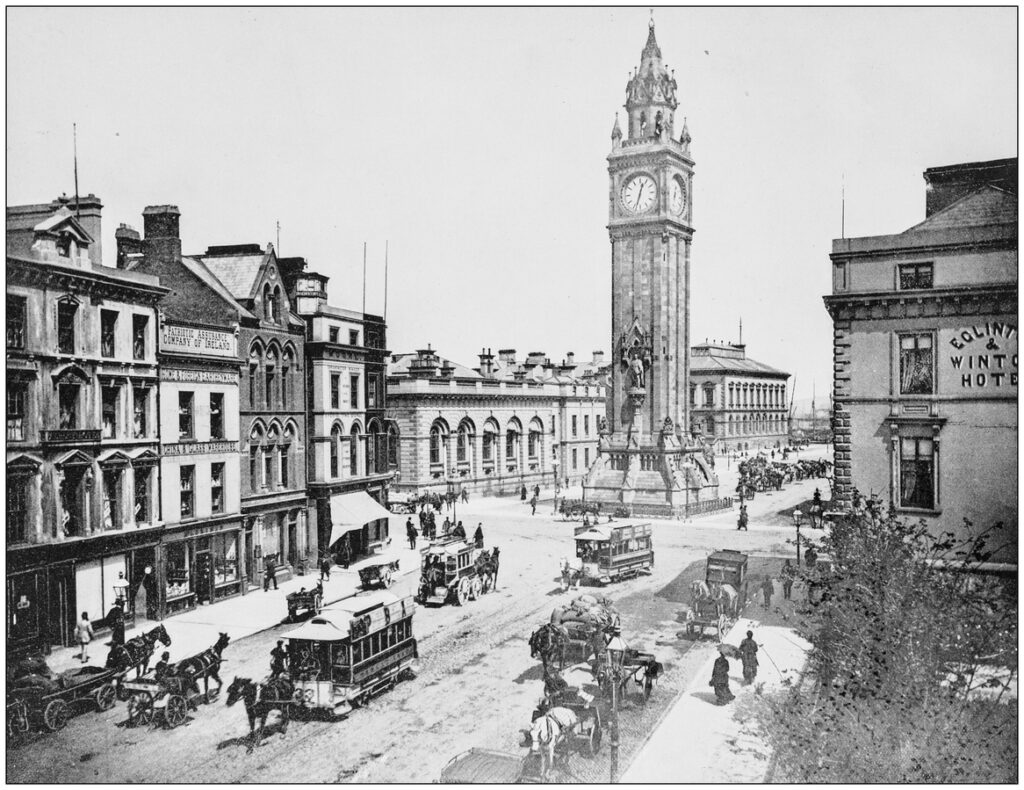
The Ulster Unionist Council (UUC) was constituted formally at a meeting in the Ulster Hall, Belfast, on 3 March 1905. This event marked the effective inauguration of the Ulster Unionist Party as a permanent organisation, separate from existing Irish unionist political bodies. The body was forged with the express purpose of organising resistance to Irish home rule.
It came as the Liberal Party, which was nominally committed to Irish home rule, looked set to return to power at the next general election. The Conservative and Unionist Party, led by Arthur Balfour as prime minister, was crippled by internal divisions.
A powerful and enduring political institution, the UUC today serves as the UUP’s ruling council.
***
The UUC’s formation was the culmination of decades of opposition to the growing movement for Irish self-government. Following the defeat of the first two Gladstonian home rule bills in 1886 and 1893, unionists – who were predominantly Protestant and concentrated in the industrialised province of Ulster – sought to create a permanent organisation to defend the constitutional union with Great Britain.
A preliminary meeting, born of this opposition to Home rule, was convened in December 1904.
Organised by North Armagh MP William Moore and Mid Armagh MP John Brownlee Lonsdale, it passed the following resolution: “That an Ulster Unionist Council be formed, and that its objects shall be to form an Ulster union for bringing into line all local Unionist associations in the Province of Ulster with a view to consistent and continuous political action, to act as a further connecting link between Ulster Unionists and their parliamentary representatives; to settle in consultation with them the parliamentary policy, and to be the medium of expressing Ulster Unionist opinion as current events may from time to time require, and generally to advance and defend the interests of Ulster Unionism in the Unionist Party.”
In line with this mandate, on 3 March 1905, the first meeting of the UUC was convened.
Formed under the presidency of James Hamilton, 2nd Duke of Abercorn, the original UUC consisted of 200 members – of which 100 were nominated by local unionist associations and 50 by the influential Orange Order. A further 50 members were co-opted as “distinguished Unionists”.
The council was served by a standing committee of 30. The leader of the UUP at Westminster nominated 10 standing committee representatives; 20 were elected by the council.
The UUC called for the “Unionists of Ireland” to “close up their ranks” in “emphatically declaring” their “determination … to oppose any scheme . . . that would place the loyal minority at the mercy of the disloyal majority”. Council members were also instructed to consider “all minor differences” subordinate “to the all important question of the maintenance of the Union”.
In this regard, the alliance incorporated the diverse elements of opposition (Conservative, Liberal Unionist, and Irish Unionist), united by their shared dread of a semi-autonomous parliament situated in Dublin. Such an institution, the unionists feared, would threaten Ulster’s traditional freedom, religion and laws.
The early leadership of Irish Unionism extended beyond what would later become Northern Ireland. Saunderson, who died in 1906, served simultaneously as leader of the MPs of the Irish Unionist Alliance and as leader of the Ulster Unionist Party in Belfast. The creation of the Ulster Unionist Council reflected the reorientation of Unionism towards Ulster, where Ireland’s protestant minority was most heavily concentrated.
***
The January 1910 and December 1910 general elections, which resulted in hung parliaments, placed home rule firmly on the political agenda. The Irish Parliamentary Party (IPP), led by John Redmond, once again held the balance of power.
The Parliament Act 1911, the controversial subject of the 1910 general elections, meant that Irish self-government was now a realisable prospect. The legislation replaced the House of Lords “veto”, which had thwarted the Second Home Rule Bill, with a power to delay bills for a maximum of two years spread over three parliamentary sessions.
H. H. Asquith’s Liberal government introduced the Third Home Rule Bill on 11 April 1912 – to predictably implacable opposition from Conservative and Unionist parliamentarians. The bill provided for limited Irish self-government by way of a Dublin-based bicameral parliament, consisting of a 164-member House of Commons and a 40-member senate. The proposed legislature would be invested with powers to deal with most national affairs, but the UK parliament would also retain authority “over all persons, matters, and things in Ireland”.
This development shifted unionist agitation into a new radical phase.
Upon its introduction, Carson rejected the proposed legislation as “absolutely unworkable and ridiculous”. He argued that the Liberal government had “sold the constitution” to the IPP in exchange for its support.
Craig declared: “I say that under no circumstances whatsoever shall we who have control of certain parts of Ulster accept this bill, or submit to it when it is passed under a shattered constitution.”
On 28 September 1912, ‘Ulster Day’, over 500,000 unionists (218,206 men and 234,046 women) signed the Ulster Covenant, vowing to use “all means which may be found necessary to defeat the present conspiracy to set up a Home Rule Parliament in Ireland”. This covenant, orchestrated by Carson, demonstrated the depth of Ulster’s opposition to a Dublin-based parliament.
Carson was the covenant’s first signatory.
During the debates on the Third Home Rule Bill, Carson proposed an amendment to exclude the province of Ulster from the scheme. This amendment secured the support Conservative Party leader Bonar Law, who argued that the difference “between Ulster and the rest of Ireland is far deeper than that between any part of the United Kingdom and Ireland taken as a whole.”
In January 1913, the Ulster Volunteer Force (UVF) was established by the UUC – providing the covenant with paramilitary support.
The government’s authority and ability to manage the Home Rule Crisis was curtailed by the “Curragh incident” of March 1914, when British army officers stationed in Ireland threatened to resign rather than move against the UVF.
In April 1914, the Larne gun-running armed the UVF with a further 25,000 rifles and 3-5 million rounds of ammunition – all smuggled from the German Empire.
The Liberal government was ultimately convinced that any home rule scheme should provide for some form of exclusion or partition.
***
Political conflict had a radicalising effect on the character of both Irish unionism and nationalism. In April 1916, the informal truce that coincided with the outbreak of war in Europe was broken by the Easter Rising, an armed insurrection against British rule began in Dublin.
The Irish War of Independence (1919-1921) resulted in the Anglo-Irish Treaty 1921 and the Irish Free State Constitution Act 1922.
Northern Ireland, defined by the Government of Ireland Act 1920 (or Fourth Home Rule Bill), had the option to opt in or out of the Free State. The new Unionist government, led by James Craig as prime minister, chose the latter option.
On 7 December 1922, the parliament of Northern Ireland agreed on the wording of the following message: “We, your Majesty’s most dutiful and loyal subjects, the Senators and Commons of Northern Ireland in Parliament assembled, having learnt of the passing of the Irish Free State Constitution Act, 1922… do, by this humble Address, pray your Majesty that the powers of the Parliament and Government of the Irish Free State shall no longer extend to Northern Ireland.”
The UUP governed Northern Ireland from 1921 until 1972. Discrimination at the expense of the Catholic minority community – notably in housing, policing, employment and electoral practices (gerrymandering) – was embedded in Northern Ireland’s governance and public life.
These practices helped sustain unionism’s near-hegemonic status, and the UUP’s position as the sole and effectively unchallenged party of government.

Politics.co.uk Newsletters
DAILY
Politics@Lunch
WEEKLY
Week in Review