Tony Blair elected as new Labour leader
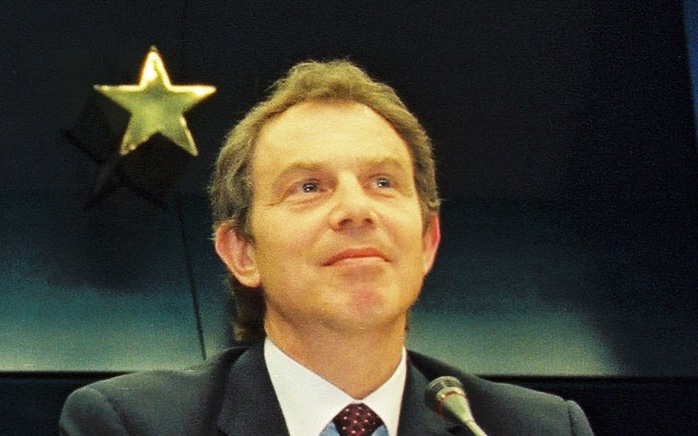
On 21 July 1994, Tony Blair was elected leader of the Labour Party in a decisive victory. The leadership contest was triggered by the sudden death of the incumbent leader, John Smith, from a heart attack on 12 May 1994.
The election was the first held under Labour’s recently reformed electoral college system, which weighted votes equally among three sections: affiliated trade unions, individual party members, and Labour MPs/MEPs.
Blair, the 41-year-old shadow home secretary, was widely seen as the race’s leading “moderniser”. His main rival for the modernising mantle, shadow chancellor Gordon Brown, did not stand against him. Brown ruled himself out of the leadership contest on 1 June.
According to Labour lore, Brown reluctantly agreed not to stand against Blair for the leadership, allowing him a clear run. This purported arrangement, finalised at the Granita restaurant in London, promised Brown unprecedented powers over economic policy as chancellor and the premiership, in time, upon Blair’s resignation as prime minister.
This dynamic – the “Granita Pact” – effectively defined the strained Blair-Brown relationship from 1997 to 2007.
***
In 1992, John Major led the Conservative Party to a surprise general election victory and a fourth consecutive term in government. The result confounded the pollsters, defying widespread expectations, and marked a devastating blow for the Labour leader, Neil Kinnock. Most opinion polls throughout the campaign had given Labour a narrow lead.
Kinnock, who had already led his party into the 1987 general election, resigned on 13 April. He was succeeded by John Smith as Labour leader in July 1992.
Smith died on the morning of 12 May 1994 after suffering a serious heart attack. On the evening of 11 May 1994, Smith delivered what was to be his final speech. He told attendees of a Labour fundraising dinner: “The opportunity to serve our country – that is all we ask.”
Smith’s sudden death at the age of 55 triggered the 1994 Labour leadership contest.
Brown’s decision not to run meant that Blair faced two opponents: the shadow employment secretary, John Prescott, seen as representing the party’s traditionalist wing and trade union base, and the acting leader, Margaret Beckett.
Beckett was the first woman ever to stand for the Labour leadership.
Blair campaigned explicitly on a platform of change. He unapologetically embraced the modernising cause, promising to go further than Smith and Kinnock.
The shadow home secretary ultimately won a commanding 57.0% of the electoral college vote, securing majorities in all three sections (52.3% among affiliates, 58.2% among constituency members, and 60.5% among MPs/MEPs). John Prescott came second with 24.1%, and Margaret Beckett third on 18.9%.
In the simultaneous deputy leadership election, Prescott defeated Beckett, creating a leadership team that balanced the party’s modernising and more traditional wings.
***
In his acceptance speech, Blair said it was an honour to be elected as leader of the Labour Party and noted the “profound sense” of the responsibility that came with it.
He added: “I joined this party through conviction, because of what I believed it would do for our country. I have not wavered in that conviction. You have put your trust in me and I vow to you I shall repay that trust with unstinting service and dedication to our party and our country.
“And I shall not rest until, once again, the destinies of our people and our party are joined together again, in victory at the next general election. Labour in its rightful place – in government again.”
https://x.com/labour_history/status/1947197760962547805
He said Labour must embrace a “mission of national renewal, a mission of hope, change and opportunity… The power of all for the good of each. That is what socialism means to me. And I will tell you how it works. Not through some dry academic theory or student Marxism.”
He told delegates: “That is why I said at the beginning of this campaign that we needed neither the politics of the old left nor new right but a new left of centre agenda for the future, one that breaks new ground, that does not put one set of dogmas in place of another, that offers genuine hope of a new politics to take us into a new millennium…
“It is the confident who can change and the doubters who hesitate. That is why we were right to change under Neil Kinnock and right to continue under John Smith.”
Blair called for a “changed Labour Party, with the vision and confidence, to lead Britain in a changing world: that is our pledge to the people of this country. And one purpose more.”
The new Labour leader concluded by quoting his predecessor, John Smith: “A chance to serve, that is all we ask”
He added: “Let it be his epitaph. And let it be our inspiration. I am ready to serve.”
Blair quickly set about rebranding his party as “New Labour”.
In 1995, Blair persuaded his party to rewrite Clause IV of its constitution – a symbolic milestone in the “modernisation” process.
***
Blair led Labour into the 1997 general election.
On 1 May 1997, the Labour Party won a landslide general election victory, ending 18 years of Conservative rule. The result was the most decisive for any party since 1945, with Labour securing a House of Commons majority of 179 seats.
Blair’s party won 418 seats, its highest ever total, while the Conservatives were reduced to just 165 seats – their worst result since 1906. The landslide represented a swing of 10.3 points from the Conservative to Labour, and saw a record 120 women voted in as MPs, up from 60 (102 of which were Labour MPs).
On 2 May, Blair was appointed as the youngest British prime minister since the early 19th century. Brown was appointed as the new chancellor, Prescott as deputy prime minister and head of a new “super-ministry”, combining parts of the environment and transport departments, and Beckett as trade secretary.
Brown, Prescott and Beckett served in cabinet for the entirety of Blair’s premiership.
Blair won two further general election victories (in 2001 and 2005), before standing down in 2007. He was succeeded as prime minister by Brown – finally fulfilling the terms of the agreement forged in 1994.

Politics.co.uk Newsletters
DAILY
Politics@Lunch
WEEKLY
Week in Review