Thatcher leads Conservative Party to landslide victory in election
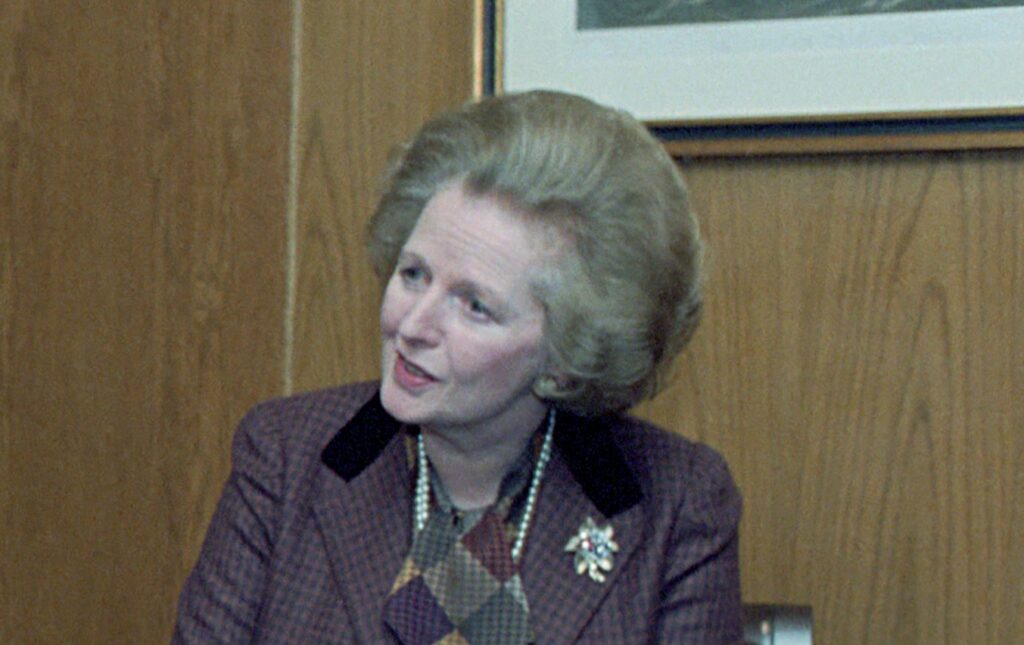
On 9 June 1983, Margaret Thatcher’s Conservative Party won a landslide general election victory, securing a parliamentary majority of 144 seats – the largest since Labour’s victory in 1945.
***
Thatcher’s victory has generally been explained by three key factors.
The first is the “Falklands factor”, specifically the surge of patriotic support for the prime minister following Britain’s victory in the Falklands War a year earlier, which forged Thatcher’s reputation as the “Iron Lady”. The 74-day war claimed the lives of 649 Argentine and 255 British servicemen, as well as three Falkland Islanders. It ended on 14 June when the commander of the Argentine garrison at Port Stanley surrendered to British troops.
Thatcher was previously regarded as one of the most unpopular prime ministers in history, having overseen rising unemployment and recession in her battle against inflation during her first years in office. The year of 1981 was the most testing of Thatcher’s premiership. Her monetarist policies, designed to curb inflation, drove unemployment towards three million. Riots in Brixton, Toxteth, and Moss Side raised the spectre of social upheaval. The prime minister’s authority to see out her hitherto unpopular economic programme was secured, in effect, by overseas developments.
The Conservative Party’s 1983 manifesto, entitled The Challenge of Our Times, stated: “In a troubled world, Britain is increasingly respected because we stand up for our own interests. But we are also respected because we stand up for the cause of freedom and the spread of prosperity throughout the world.
“We resisted unprovoked aggression in the Falkland Islands, when the loyal support of our friends throughout the world reminded us of our common heritage of freedom. We will continue to uphold the principles for which we fought.”
Thatcher called the 1983 general election some 11 months early to capitalise on her newfound popularity. At the time, the Conservative Party stood 11-points ahead of Labour.
***
The second factor concerns the state of the official opposition, led by Michael Foot.
Foot, known for his skilled performances in the House of Commons, was elected leader of the Labour Party in 1980 at the age of 67. At the time, Labour was split between moderate and maximalist tendencies. Foot, who served loyally in both Harold Wilson and Jim Callaghan’s cabinets, was well-liked by Labour MPs and seen as capable of uniting the party.
However, Labour’s divisions received significant exposition in the 1981 Labour deputy leadership election, which pitted the incumbent moderate, Denis Healey, versus Tony Benn. Healey triumphed by just 0.852% of the electoral college vote.
Foot’s bookish and sometimes dishevelled appearance also provided ample ammunition for his opponents. Conservative MP Kenneth Baker greeted Foot’s succession in 1980 with the remark: “Labour was led by Dixon of Dock Green under Jim Callaghan. Now it is led by Worzel Gummidge.” The white-haired Labour leader, a founding member of the Campaign for Nuclear Disarmament (CND), was also depicted as insufficiently patriotic.
Under Foot’s leadership, Labour campaigned on a left-wing platform that included unilateral nuclear disarmament, withdrawal from the European Economic Community (EEC), the abolition of the House of Lords, higher personal taxation for the rich, and a sweeping nationalisation programme. The party’s 1983 general election manifesto, entitled The New Hope for Britain, was famously described by one of its own MPs, Gerald Kaufman, as “the longest suicide note in history”.
Labour’s defence commitments proved especially difficult to sell to the electorate. Healey, the deputy leader, and Callaghan, the former Labour prime minister, both expressed misgivings about the party’s position. Foot was ultimately forced to modify the manifesto position, saying Labour would “move towards” a non-nuclear and the removal of nuclear bases.
During the campaign, Foot argued that another term of the “torments and evils” of Conservative rule would finish Britain as a great industrial nation.
Thatcher provided her own framing in a speech to a Scottish Conservative Party rally in Perth.
Thatcher declared: “The choice facing the nation is between two totally different ways of life. And what a prize we have to fight for: no less than the chance to banish from our land the dark, divisive clouds of Marxist socialism and bring together men and women from all walks of life who share a belief in freedom.”
In his final speech of the campaign, Foot stated: “Our philosophy is one of caring, of concern, of inviting the country to fight common problems. The Tories revere individualism and Victorian values.
“Our philosophy seeks cooperation with our allies in pursuit of peace. The Tories use a pose of national military grandeur to cover their increasing reliance on suicidal nuclear weapons.”
***
The final factor was the fragmentation of the opposition vote.
In January 1981, four senior Labour politicians, later dubbed the “gang of four”, issued the Limehouse Declaration. The document, signed by former cabinet ministers Roy Jenkins, David Owen, Shirley Williams and Bill Rodgers near Owen’s home in east London, announced the formation of a “council for social democracy”.
Jenkins, Owen, Williams and Rodgers subsequently formed the Social Democratic Party (SDP) – a new force in British politics. The development was a direct response to Labour’s shift to the left under Foot. (It was later alleged that at least four Labour MPs who were planning to form a new party deliberately voted for Foot in the 1980 leadership election. Their aim was to maximise the political space available for an emerging centrist party.)
A total of 28 Labour MPs defected to the SDP over the course of 1981. The party soon forged an alliance with the Liberal Party, led by David Steel.
For a period, the SDP was regarded as a potentially existential threat to the Conservative Party, as the government languished in unpopularity throughout 1981. In March 1981, Conservative MP Christopher Brocklebank-Fowler defected to the SDP. The party also won the Crosby by-election in November 1981, unseating the Conservatives.
The SDP-Liberal alliance secured 25.4% of the popular vote at the 1983 general election – a mere 2.2 points short of Labour. Under the first past the post electoral system, however, this yielded only 23 seats. Williams was the most prominent SDP casualty, losing her Crosby seat. Bill Rodgers lost his seat of Stockton North.
The split in the anti-Conservative vote allowed the Tories to win numerous seats on a minority vote share. Despite a slight fall in the Conservative vote share to 42.4%, therefore, Thatcher’s party gained 47 seats – finishing with a total of 397.
Labour was reduced to just 209 seats (down 60), the party’s worst result since 1935. Its share of the vote – just 27.6% – was the lowest since 1918. Notably, Tony Benn was defeated in Bristol East, a seat he had held since 1963.
The Sun newspaper referred to “Maggie’s Massacre”.
***
Michael Foot responded: “I agree with those who said the fight to win the next election starts immediately and of course I accept, to the full, my responsibilities in this election.”
Foot resigned as Labour leader. He was succeeded by Neil Kinnock in October 1983.
Healey said that the SDP had “put the people of this country at the mercy of the most reactionary, right-wing, extremist government in all of British history.”
David Steel, the Liberal Party leader, said: “I feel a real sense of outrage at the vast number of votes we picked up with so little to show for it in the way of seats.”
In the wake of the election, Thatcher exercised her authority to demote two leading “wets”, Francis Pym and William Whitelaw. Pym’s dismissal as foreign secretary followed his remark that “landslides don’t on the whole produce successful governments.”
Whitelaw, who had stood against Thatcher in the 1975 Conservative leadership election, was removed as home secretary and replaced by Leon Brittan. Whitelaw was sent to lead the House of Lords, becoming the first recipient of a hereditary peerage in 19 years.
Geoffrey Howe succeeded Pym as foreign secretary, while Nigel Lawson succeeded Howe as chancellor of the exchequer.
US president Ronald Reagan congratulated Margaret Thatcher on her victory, reportedly joking that if he were ever in need of assistance in the future, she might consider managing one of his campaigns.

Politics.co.uk Newsletters
DAILY
Politics@Lunch
WEEKLY
Week in Review
