Senior Tory David Davis tells Johnson: ‘In the name of God, go’
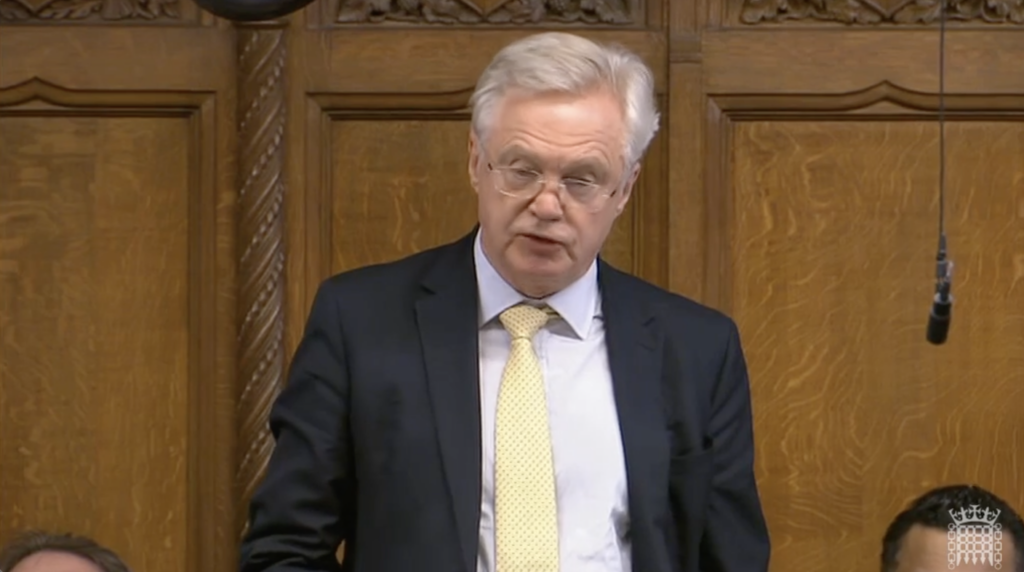
On 19 January 2022, the senior Conservative MP David Davis called for Boris Johnson to resign in a session of prime minister’s questions.
Deploying a historically-charged turn of phrase, the former Brexit secretary told Johnson: “You have sat too long here for any good you have been doing. In the name of God, go.”
Davis, a former leadership contender, had resigned from the cabinet alongside Johnson in opposition to the May government’s Brexit strategy in July 2018.
His intervention on 19 January 2022 took place minutes after Christian Wakeford, the former Conservative MP, crossed the floor to join the Labour Party. At the time, Johnson was under intense pressure over reports of gatherings in Downing Street at the height of the Covid-19 pandemic.
On the previous day, 18 January, Johnson insisted that no one had “warned me it was against the rules” for a drinks party to be hosted in Downing Street during the first lockdown. Speaking publicly for the first time in almost a week, the prime minister said he “hoped people would understand the circumstances we were operating in”.
Davis told the commons that he had spent weeks defending Johnson to “angry constituents.”
The Tory grandee stated: “I expect my leaders to shoulder the responsibility for the actions they take. Yesterday the prime minister did the opposite of that, so I will remind him of a quotation that will be altogether too familiar to him.
“Leo Amery said to Neville Chamberlain: ‘You have sat too long here for any good you have been doing… In the name of God, go.’”
Johnson responded: “I must say to my right honourable friend that I do not know what he is talking about. I do not know what quotation he is alluding to.
“What I can tell him, as I have told the House repeatedly throughout the pandemic, is that I take full responsibility for everything done in this government, and throughout the pandemic.”
It was widely noted that Johnson, a biographer of Winston Churchill, would have been all too aware of the famous quotation.
***
The phrase “In the name of God, go” has been deployed during at least two politically momentous occasions in British parliamentary history.
On 20 April 1653, Oliver Cromwell used the words to dismiss the Rump Parliament, having grown frustrated with the assembly’s refusal to pass reforming legislation. Cromwell led an armed force into the commons chamber to forcibly dissolve it.
He declared: “You have sat too long for any good you have been doing lately. Depart, I say, and let us have done with you… In the name of God, go!”
Cromwell also ordered the removal of the ceremonial mace, referring to it as a “shining bauble.”
On 7 May 1940, the Conservative MP Leo Amery repeated the words during the famous Norway Debate.
The debate followed the failure of the Allied campaign in Norway, when attempts to repel the Germans culminated in the loss of about 4,000 British troops. Across two days from 7-8 May, in what was ostensibly the adjournment debate for the Whitsun recess, MPs considered the conduct of the war in the House of Commons and turned their fire on Chamberlain.
Amery declared: “We cannot go on as we are. There must be a change. First and foremost, it must be a change in the system and structure of our governmental machine.
“This is war, not peace. The essence of peace-time democratic government is discussion, conference and agreement; the cabinet is in a sense a miniature parliament.”
He added: “I have quoted certain words of Oliver Cromwell. I will quote certain other words. I do it with great reluctance, because I am speaking of those who are old friends and associates of mine, but they are words which, I think, are applicable to the present situation.
“This is what Cromwell said to the Long Parliament when he thought it was no longer fit to conduct the affairs of the nation: ‘You have sat too long here for any good you have been doing. Depart, I say, and let us have done with you. In the name of God, go.’”
The subsequent vote saw Chamberlain’s majority plummet from over 210 to 81. Chamberlain resigned as prime minister three days later on 10 May 1940, and was succeeded by Winston Churchill.
***
The intervention of Davis, a Conservative elder statesman, shattered any illusions that the rebellion against Johnson was confined to the standard malcontents.
Davis’ choice of words – recalling the moment that ended Chamberlain’s premiership and brought Churchill to power – could only have dealt a psychological blow to Johnson, who regarded the wartime prime minister as his political hero.
Johnson initially resisted the pressure. On 6 June 2022, the prime minister survived a vote of no confidence in his leadership of the Conservative Party. Johnson won the secret ballot of Conservative MPs by 211 votes to 148 – a victory that technically secured his position under party rules for another year.
The Chris Pincher scandal and the mass walkout of ministers that followed, however, forced Johnson’s resignation on 7 July.

Politics.co.uk Newsletters
DAILY
Politics@Lunch
WEEKLY
Week in Review