Roy Jenkins resigns as Labour MP to take up European Commission presidency
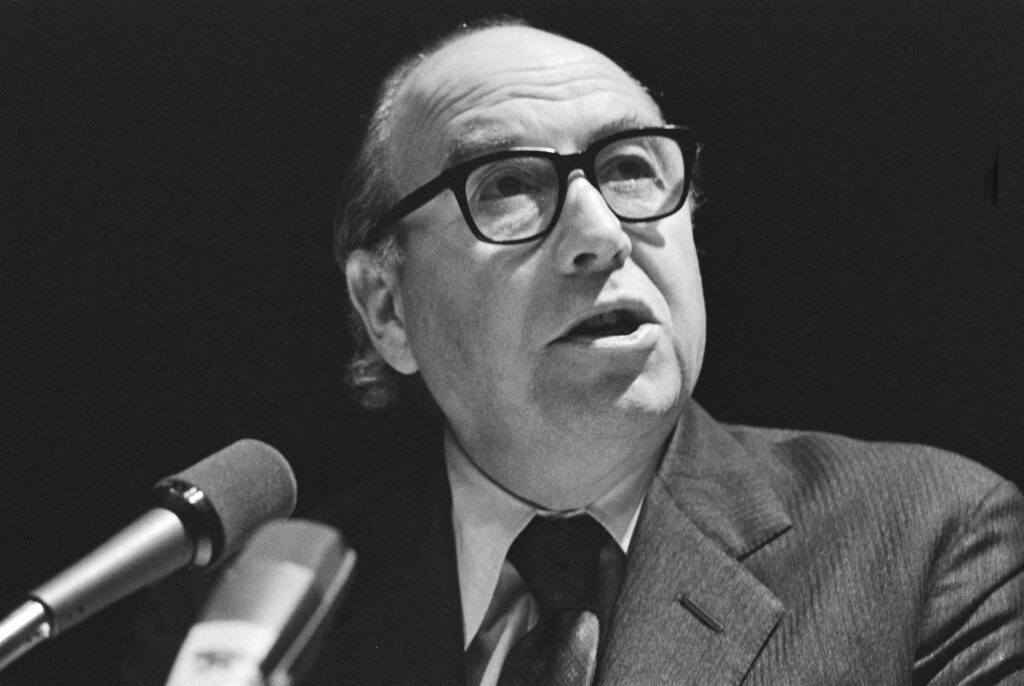
Roy Jenkins, one of the Labour Party’s most prominent figures, resigned from the House of Commons on 3 January 1977 to take up his new post as president of the European Commission, succeeding François-Xavier Ortoli.
***
Britain joined the EEC on 1 January 1973, marking the culmination of more than a decade of political negotiation and debate. For Britain’s European ambition, the 1973 accession was a case of third time lucky; previous attempts to secure entry into the EEC in 1961 and 1967 were vetoed by the French president, Charles de Gaulle.
A former chancellor of the exchequer and home secretary, Jenkins had long-established himself as among the most prominent europhiles in British politics. He had finished third in the 1976 Labour leadership election (behind James Callaghan and Michael Foot).
Jenkins became the first commission president to come from a country that had not been a signatory to the 1957 Treaty of Rome, which established the European Economic Community (EEC).
His resignation as the MP for Birmingham Stechford triggered a critical by-election. Jenkins had represented the seat since the 1950 general election, and won an 11,923-vote majority at the October 1974 election.
However, on 31 March 1977, the Conservative Party candidate, Andrew MacKay, secured Birmingham Stechford on a swing of 17.6%. The Labour prime minister, James Callaghan, was already leading a minority government, which relied on the votes of the Liberal Party (the ‘Lib-Lab pact’).
In his inaugural address to the European parliament on 11 January 1977, Jenkins referenced the 1975 referendum on Britain’s membership of the EEC – when a resounding 67.23% voted in favour of staying in.
Jenkins declared: “Britain is now decisively a part of the community… [The referendum] was indeed the most recent great popular victory won by the European cause. That should not be forgotten, either in Britain or elsewhere.”
He added: “I do not, however, intend to be a British president. I intend to be a European president.”
Jenkins said he had “devoted much of my energies, and invested most of my political capital to and in the cause of European unity.”
The former Labour MP argued that the commission “should be a political rather than a technocratic body, constantly aware of the public impact of its proposals… combining vision with practicality, efficiency with humanity.”
He called for the EEC to prove its relevance in the contemporary political climate and to young people in particular. The community, he said, cannot “live indefinitely on the triumphs of half a generation ago.”
Jenkins said: “If we do this, we shall ensure that the idea of Europe means little to the hearts of the young, and is only an evocative evening memory in the minds of the middle-aged and the old.”
He concluded: “Let us not bemoan too much. But let us at the same time be aware of the size of the stakes. The values of justice for all, individual freedom and intellectual integrity, which were the norms of a civilised society, and to which can now happily be added a sense of social fairness, are genuinely at risk.
“There are not many countries in the world which can be counted upon to sustain them. We here represent about a half of that number. If our community cannot be made to work, what can?”
Jenkins’ presidency (January 1977 to January 1981) coincided with a renewed challenge from the left-wing of the Labour Party to Britain’s membership of the EEC.
During his tenure as commission president, Jenkins emerged as a proponent of monetary union. He has been referred to as the “godfather of the euro”.
***
In April 1972, Roy Jenkins resigned from the shadow cabinet over his party’s demand for a referendum on Europe. He viewed the leadership’s shift to backing a referendum, which came during the debate over the European Communities Act, as a concession to his party’s eurosceptic wing.
In March, Labour had moved to support an amendment proposed by Conservative MP Neil Marten calling for a consultative referendum on British entry. It came after Pompidou proposed his own referendum on the enlargement of EEC. (The proposals were ultimately approved by 68.3% of French voters, on a turnout of 60.2%).
In his resignation letter to Harold Wilson, the Labour leader, Jenkins opposed what he called “government born out of opportunism.”
He declared: “I want to see that future Labour governments have a clear sense of direction. This constant shifting of the ground, I cannot accept. Save in the very short term, it will be far more damaging to the Labour Party than to the present government.”
Jenkins stated that the “official majority position of the party, which was only one of opposition to the terms of entry to the European Economic Community, has increasingly become one of opposition in principle.”
He added: “It may be argued… that the EEC referendum would be a once-for-all operation. The device would never be used again. Who can possibly say that?
“Once the principle of the referendum has been introduced into British politics, it will not rest with any one party to put a convenient limit to its use. And most history shows, as [Clement] Attlee pointed out with terse force in 1945, that it is a splendid weapon for demagogues and dictators.”
Jenkins, however, voted against the European Communities Act at its commons second reading – choosing to toe the party line on this occasion. He resolved that this course of action was the only way he could stay in the Labour Party and make the case for a pro-European policy.
On 28 October 1971, when the commons endorsed the principle of EEC accession, Jenkins was among the 69 Labour MPs who voted in favour of the government motion.
During the 1975 referendum on Britain’s membership of the EEC, Jenkins led the successful ‘Yes’ campaign. Following the referendum, Jenkins, then the home secretary, commented: “It puts the uncertainty behind us. It commits Britain to Europe; it commits us to playing an active, constructive and enthusiastic role in it.”
***
Jenkins famously returned to British politics in 1981 as a member of the “gang of four”. The establishment of the Social Democratic Party (SDP) was a direct response to the Labour Party’s shift to the left under the leadership of Michael Foot.
In 1982, Jenkins won a by-election, returning to parliament as SDP MP for Glasgow Hillhead.

Politics.co.uk Newsletters
DAILY
Politics@Lunch
WEEKLY
Week in Review