Robin Cook resigns from cabinet over Iraq war
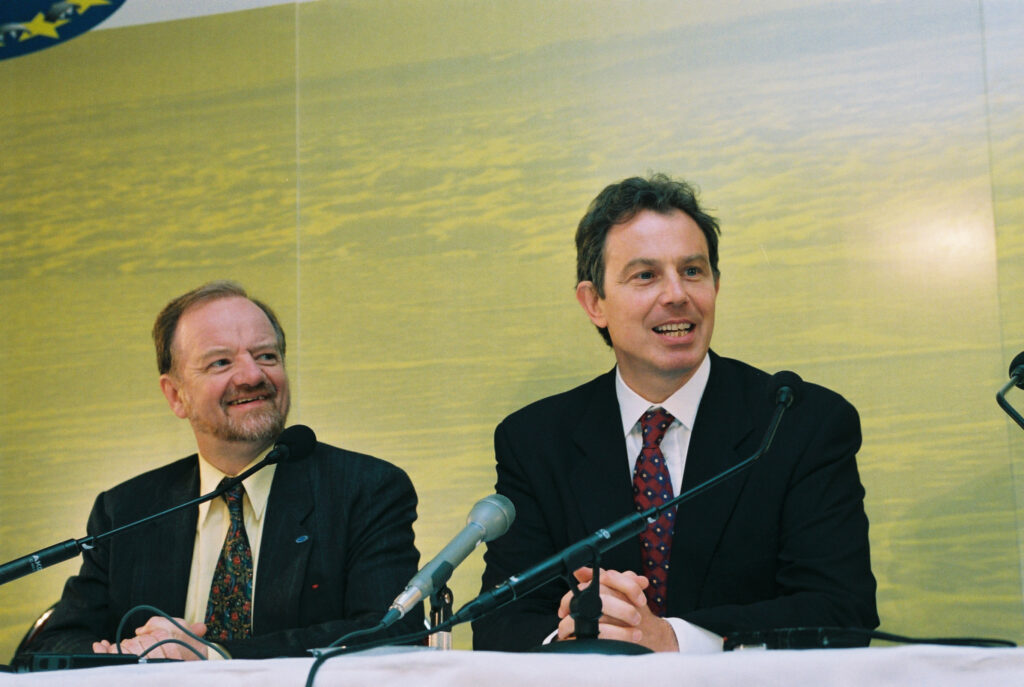
On 17 March 2003, Robin Cook, the leader of the House of Commons and a former foreign secretary, resigned from Tony Blair’s cabinet in protest at the government’s decision to commit British troops to the invasion of Iraq.
Cook’s departure marked the most high-profile protest against the conflict from within the government.
***
In November 2002, the UN Security Council unanimously passed resolution 1441 to give Iraq “a final opportunity to comply with its disarmament obligations”. From November 2002 to March 2003, however, the UN failed to find any weapons of mass destruction after 700 inspections.
Then, on 25 February 2003, the US and the UK submitted a draft resolution to the UN arguing that Iraq had missed its “final opportunity” to disarm peacefully. It declared that Iraq had “failed to take the final opportunity afforded to it in resolution 1441.” France, Germany and Russia submitted a rival proposal to the council calling for further weapons inspections as an alternative to military action.
On 10 March, France announced it would join Russia in vetoing a re-drafted UN resolution which gave Iraq until 17 March to disarm. Britain, the United States and Spain, having all promoted the proposed resolution, then abandoned it in the face of opposition. On 17 March, Britain’s Ambassador to the United Nations, Jeremy Greenstock, announced that diplomatic routes to resolve the crisis had been closed.
Greenstock stated: “Having held further discussions with council members over the weekend and in the last few hours, we have had to conclude that council consensus will not be possible in line with Resolution 1441.
“One country in particular [France] has underlined its intention to veto any ultimatum ‘no matter what the circumstances’.”
The UK and US therefore failed to secure a “second resolution”, which was seen as crucial in justifying the march to war. Just hours after Greenstock’s statement, Cook announced his resignation.
Cook’s resignation also came as the House of Commons prepared to consider a government motion authorising military action against Iraq.
***
In his letter of resignation, Cook said he could not accept “collective responsibility for the decision to commit Britain now to military action in Iraq without international agreement or domestic support.”
The former foreign secretary revealed his concerns, voiced privately during cabinet meetings, “over embarking on military action in the absence of multilateral support.”
He added: “I applaud the heroic efforts that you and Jack [Straw] have put into the attempt to secure a second resolution at the UN.
“It is not your fault that those attempts have failed. However, the evident importance that we attached to a second resolution makes it all the more difficult now to proceed without one, and without agreement in any other international forum.
“As I cannot give my support to military action in these circumstances, I write with regret to resign.”
Downing Street announced Cook’s resignation shortly after the cabinet had gathered at 4:00 pm on 17 March.
Blair responded in writing to Cook’s resignation letter in the traditional manner. The prime minister confirmed Cook had voiced his intention to resign in the event that Britain failed to “secure a new UNSCR (United Nations Security Council Resolution) that authorised military action.”
He added: “I have always tried to resolve this crisis through the UN, as you recognise in your letter. But I was always clear that the UN must be the way of dealing with the issue, not avoiding dealing with it. The government is staying true to Resolution 1441.
“Others, in the face of continuing Iraqi non-compliance, are walking away from it.”
***
Cook, who had sat on the Labour frontbench for 17 consecutive years, delivered a famous personal statement in the House of Commons later on 17 March.
Cook began by noting that it was the first time in two decades that he had spoken from the backbenches. “I must confess that I had forgotten how much better the view is from here”, he stated.
The former commons leader said he had come to the House to explain why he could not “support a war without international agreement or domestic support.”
Cook emphasised that his disagreement was not with Blair personally, whom he described as the “most successful leader of the Labour party in my lifetime.” He insisted he would “give no comfort” to those seeking to displace the prime minister.
Rather, his objection centred on the absence of international agreement for military action in Iraq.
The Labour MP stated that the “very intensity” of Britain’s efforts to secure a second resolution meant the government could not now pretend that its failure “was of no importance.” As such, Cook argued that Britain was being asked to embark on a war “without agreement in any of the international bodies of which we are a leading partner – not Nato, not the European Union and, now, not the Security Council.”
Cook warned that this risked weakening the alliances that normally underpinned British foreign policy.
He told the House: “The US can afford to go it alone, but Britain is not a superpower. Our interests are best protected not by unilateral action but by multilateral agreement and a world order governed by rules.
“Yet tonight the international partnerships most important to us are weakened: the European Union is divided; the Security Council is in stalemate. Those are heavy casualties of a war in which a shot has yet to be fired.”
Cook contrasted the situation with the multilateral support that had existed for intervention during the Kosovo War.
He was especially scathing when he addressed the military justifications for the invasion. “We cannot base our military strategy on the assumption that Saddam is weak and at the same time justify pre-emptive action on the claim that he is a threat”, he argued.
Cook also contrasted the “exhausted” patience shown toward Iraq with the “persistent refusal of Israel to comply” with UN resolutions for over 30 years. He warned of a “strong sense of injustice throughout the Muslim world” at what appeared to be “one rule for the allies of the US and another rule for the rest.”
Cook further questioned the motivations of the Bush administration. He said that the United States appeared to be “less interested in disarmament than they are in regime change in Iraq.”
He added: “What has come to trouble me most over past weeks is the suspicion that if the hanging chads in Florida had gone the other way and Al Gore had been elected [in 2000], we would not now be about to commit British troops.”
Cook concluded by appealing to the “good sense and collective wisdom of the British people.” He maintained that while the public loathed Saddam, they were not persuaded he was a “clear and present danger to Britain.”
The former foreign secretary added: “Above all, they are uneasy at Britain going out on a limb on a military adventure without a broader international coalition and against the hostility of many of our traditional allies.”
He urged MPs to thwart the “commitment of troops in a war that has neither international agreement nor domestic support.”
He declared: “I intend to join those tomorrow night who will vote against military action now. It is for that reason, and for that reason alone, and with a heavy heart, that I resign from the government.”
The speech, delivered to a packed chamber, received an unprecedented round of applause and a standing ovation from supportive MPs.
Andrew Marr, the BBC’s political editor, described Cook’s address as “without doubt one of the most effective, brilliant resignation speeches in modern British politics.” The Economist later reported that the speech received the “only standing ovation ever recorded in the commons.”
***
Cook’s resignation is remembered today as a courageous act by a politician of remarkable principle.
Two further ministers resigned in the lead up to the Iraq War, namely John Denham and Lord Hunt of Kings Heath. John Prescott, the deputy prime minister, claimed not to have heard of Lord Hunt. Bob Blizzard and Anne Campbell also resigned as parliamentary private secretaries.
Clare Short, the international development secretary, had also threatened to resign. However, Short remained in post, despite saying she was “very critical” of the way the crisis had been handled.
Announcing her decision to remain in office, Short said in a statement: “I know I will be heavily criticised for my decision and many people will feel I have let them down.
“But I am doing what I think is right in the circumstances which we are now in.”
MPs voted in favour of authorising military action on 18 March. The invasion of Iraq – Operation Iraqi Freedom – began on 20 March 2003.
In January 2004, Cook said Blair was driven to war in Iraq by a “missionary zeal” and the desire to show loyalty to Bush as US president.
He told BBC Radio 4’s Today programme that it was “rather undignified” of Blair to continue to insist he was right when “everybody could now see he was wrong.”
Cook stated: “If there was no threat from Iraq we obviously had no right to carry out a pre-emptive strike to remove that threat. And we better drop that doctrine before somebody else in the world uses it in their own back yard.”
But he defended Blair from accusations of deception, arguing that the prime minister was “behaving in a way which had a missionary zeal, an evangelical certainty.”
Cook remained an active parliamentarian for the rest of his life. He died on 6 August 2005, aged 59, after suffering a severe heart attack.

Politics.co.uk Newsletters
DAILY
Politics@Lunch
WEEKLY
Week in Review
