Peers suspended – the first since 1642 – over ‘cash for amendments’ scandal
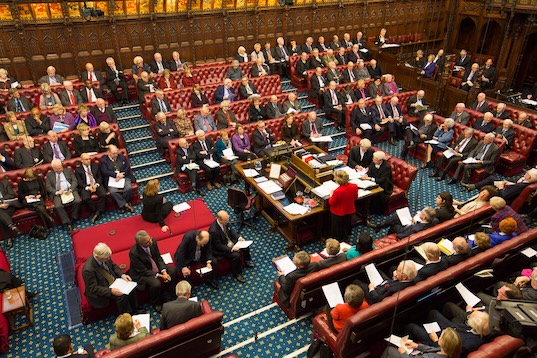
On 20 May 2009, the House of Lords voted to suspend two of its members, Labour peers Lord Taylor of Blackburn and Lord Truscott. It marked the first time in over 350 years – since 1642 – that members of the upper chamber had been suspended.
The disciplinary action followed a “sting” operation by the Sunday Times newspaper, which alleged the two peers were prepared to amend proposed legislation in return for money. The paper reported that undercover journalists, acting on behalf of a fictitious foreign retail firm, offered fees in bid to secure an exemption from business rates.
The “cash for amendments” affair, as it became known, prompted Lord Taylor’s suspension from Labour. Truscott, a former energy minister, resigned from the party, arguing he had been made a scapegoat. Both peers denied the allegations made by the Sunday Times.
Lord Truscott and Lord Taylor’s suspension came at a time in which the reputation of parliament was under historic strain over the unfolding expenses scandal. Gordon Brown, the prime minister, told the commons on 28 January that he was “deeply concerned” about the allegations. Speaking at prime minister’s questions (PMQs), Brown said the “serious allegations” needed to be dealt with.
Just one day before Truscott and Taylor’s suspension, 19 May, Michael Martin resigned as speaker of the House of Commons. Martin, who faced criticism for his handling of the expenses scandal, became the first speaker to be forced from office since 1695.
***
Following the Sunday Times report on 25 January 2009, the matter was first referred to the House of Lords sub-committee on members’ interests (a sub-committee of the Lords committee for privileges). It concluded that both Lord Taylor and Lord Truscott had breached the House of Lords code of conduct.
In the case of Lord Truscott, the sub-committee found that the evidence against the peer was “so clear and so plentiful” that it had little doubt that he was “advertising his power and willingness to influence Parliament in return for a substantial financial inducement.”
It added: “We conclude that Lord Truscott expressed willingness to breach the code of conduct’s prohibition on paid advocacy, and failed to act on his personal honour, as required by paragraphs 4(c) and 4(b) of the [House of Lords] code.”
Truscott appealed, describing the sub-committee’s work as “outrageous and slanderous”. The peer claimed that he had been treated like a “Guantanamo inmate. I was continually interrupted, with one member in particular being aggressive and descending at times into sarcasm.”
He added: “My wife, whose uncle spent time in the Gulag, can’t escape a feeling of déjà vu. 1930s Russia. Stalin is in power. Political committees decide an individual’s fate on the basis of ill-founded allegations and without any evidence of actual wrong-doing.”
The sub-committee reported to the Lords privileges body, which published its conclusions on 14 May 2009. It agreed that the peers had failed to act on their “personal honour”, breaching paragraph 4(b) of the code of conduct.
The committee concluded that Truscott’s “stated willingness to ‘smooth the way’ with other members or ‘coach’ them, and many other examples, show clearly that in order to secure a lucrative consultancy he was willing at the very least to hold out the prospect that he would be willing and able to exercise improper parliamentary influence.”
The cross-party group also dismissed Lord Taylor’s defence as “full of internal contradictions” and his sworn evidence as “inherently so implausible that we do not find ourselves able to attach much weight to it”. Taylor reportedly claimed he had worked out early on that he was the target of a sting and was stringing the journalists along to flush out the truth.
A Labour Party spokesperson responded: “Lord Taylor of Blackburn has been suspended from the Labour Party following the House of Lords privilege committee’s report and the party is now mounting a full disciplinary investigation, which will take into account any decision that the House of Lords makes on this report.
“Lord Truscott has already resigned from membership of the Labour Party in connection with this issue.”
Significantly, in a further report, the privileges committee established that the House did possess “an inherent power to discipline its members”.
Baroness Scotland of Asthal, the attorney general, gave evidence to the committee advising that the House did not have the power to suspend peers. She argued that a suspension “would interfere with the rights of a peer conferred by the crown to attend, sit and vote in parliament.”
However, the committee sided with Lord Mackay of Clashfern, a former lord chancellor, who contended that “the procedures necessary to preserve ‘order and decency’ includes a power to suspend, for a defined period within the lifetime of a parliament, a member who has been found guilty of clear and flagrant misconduct.”
The committee stated: “The duty imposed upon members, by virtue of the writs of summons [issued to peers] to attend parliament, is subject to various implied conditions, which are reflected in the many rules governing the conduct of members which have been adopted over time by the House.”
But it added: “The House has no power… to require that the writ of summons be withheld from a member otherwise entitled to receive it; as a result, it is not within the power of the House by resolution to expel a member permanently.”
In light of these findings, the privileges committee invited the House to agree two resolutions recommending that Truscott and Taylor “be suspended from the service of the House until the end of the current session of parliament.”
The Sunday Times also made allegations against two further Labour Lords, Snape and Moonie.
While Snape and Moonie were ultimately cleared of wrongdoing by the privileges committee, the peers were both invited to deliver personal statements of apology to the House having demonstrated an “inappropriate attitude to the rules” governing the conduct of members.
***
On 20 May, the House of Lords considered the two main privileges committee reports, relating to the power of the House to suspend members and the conduct of Truscott, Taylor, Snape and Moonie.
In her contribution to the debate, Lord Brabazon of Tara, chair of the Lords privileges committee, urged peers to back the suspensions as they had “failed to act on their personal honour”.
He added: “This episode has done serious damage to the reputation of the House. We all have responsibility, individually and collectively, to uphold that reputation.
“That is why personal honour remains the cornerstone of the House’s code of conduct. The noble Lords, Lord Truscott and Lord Taylor of Blackburn, have not, we believe, acted on their personal honour.”
Lord McNally, the Liberal Democrat leader in the Lords, argued that the Sunday Times had been guilty of “entrapment”.
He said: “It is important for the public to understand that the Sunday Times, with all the resources of its insight team, could not find a single example of a peer who was actually paid for getting an amendment passed. The reason for that is very clear.”
The attorney general, Baroness Scotland, reminded the House of the “constitutional enormity of what it is about to do; in all its history it has never suspended a member. It is open to the House to do so but it has to consider whether these changed times entitle and oblige it to act differently.”
In the end, the House unanimously approved (without a division) the suspensions of peers Truscott and Taylor until the end of the parliamentary session on 20 May. This suspension amounted to six months.
The suspensions marked the first time since 1642 any peer had been compelled to withdraw from the House of Lords. Some 300 years previously in the early years of the English Civil War, Thomas Savile was barred for acting against parliament on behalf of King Charles I.
After Truscott and Taylorr, Westminster did not need to wait three centuries for the next instance of noble suspension. Just one year later, in October 2010, Baroness Uddin, Lord Paul and Lord Bhatia were suspended from the House as part of the expenses scandal. These suspensions were described as the “toughest since 1643”.

Politics.co.uk Newsletters
DAILY
Politics@Lunch
WEEKLY
Week in Review
