Missing MP John Stonehouse arrested in Australia on Christmas Eve

On 24 December 1974, the Labour MP and former cabinet minister John Stonehouse was arrested in Melbourne, Australia, more than a month after disappearing while on a business trip.
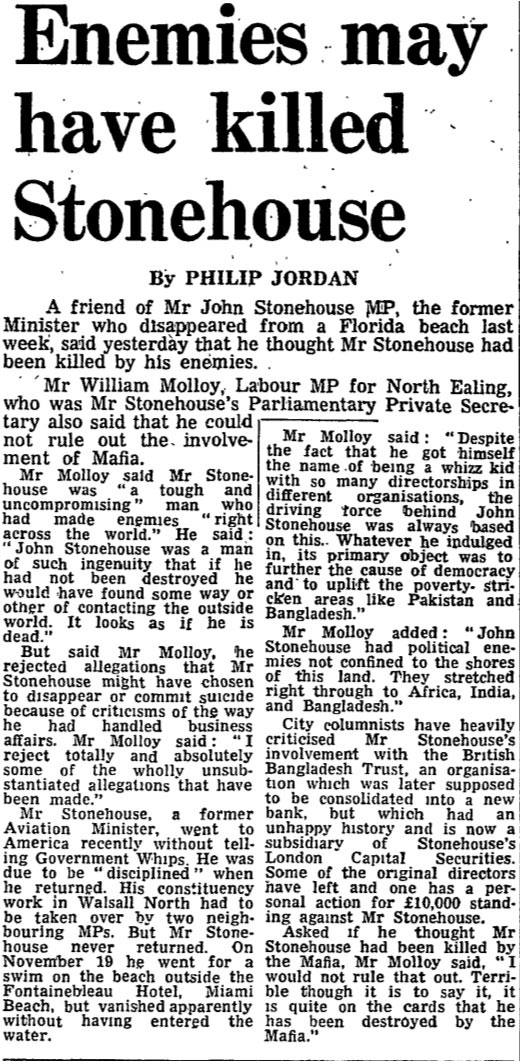
Stonehouse, 49, had been presumed dead since 20 November 1974, when a pile of his clothes was found on a beach in Miami, Florida. Obituaries had been published; his wife, Barbara, had publicly accepted he had drowned.
Barbara Stonehouse told BBC News: “I’ve heard some extraordinary rumours and they’re all so much out of character with my husband’s personality that they’re just not worth answering or worth thinking about.
“I’m convinced in my mind that it was a drowning accident. All the evidence that we’ve had points to the fact that he was drowned.”
Some contemporaneous rumours suggested the possible involvement of the mafia. In reality, the MP for Walsall North had faked his own death to escape financial ruin, elude inquiries about his business interests and start a new life with his 28-year-old secretary and secret girlfriend, Sheila Buckley.
***
At the time of Stonehouse’s discovery, Australian police were on high alert for the fugitive peer Lord Lucan, who had also vanished in November; he was suspected of killing his children’s nanny, Sandra Rivett, and attempting to murder his wife. A bank teller at the Bank of New Zealand in Melbourne became suspicious of an Englishman depositing large sums of cash under the name “Clive Mildoon” and alerted authorities.
Stonehouse, who served as postmaster general from 1968 to 1969, spent much of his time in Australia transferring large sums of money between banks under various aliases.
When arrested on Christmas Eve, police officers ordered Stonehouse to pull down his trousers. They were checking for a six-inch scar on the inside of the right thigh – a distinguishing mark of Lord Lucan.
Stonehouse subsequently confessed.
The Victoria State assistant commissioner for crime, Chief Superintendent Mick Patterson, told a news conference that Stonehouse would be detained on charges of entering Australia with false passport.
Describing Stonehouse’s arrest, Patterson said: “About 11:15 am today, a gentleman whom the Criminal Investigation Bureau suspected of being an illegal immigrant with a false passport was interviewed.
“He has now admitted he is the missing member of parliament from England, Mr Stonehouse, who was reported as missing from Miami in Florida. He admits that he entered Australia with a false passport.”
Stonehouse was permitted to call his wife in the UK. In a conversation taped by police, he told her: “Hello darling. Well, they picked up the false identity here. You would realise from all this that I have been deceiving you. I’m sorry about that, but in a sense I’m glad it’s all over.”
In a message to Harold Wilson, the prime minister, Stonehouse reportedly cited “incredible pressures” in business and “various attempts at blackmail” to explain his actions. He said he had tried to “create a new identity and attempt to live a new life.”
Stonehouse added: “I suppose this can be summed up as a brainstorm or a mental breakdown. I can only apologise to you and all the others who have been troubled by this business.”
Wilson had defended Stonehouse in the House of Commons just one week earlier.
On 17 December 1974, Wilson addressed press reports that Stonehouse had been a spy for the Czechoslovak intelligence service. Addressing MPs, Wilson said he had been advised “that there was no evidence to support the allegations”.
Wilson told the House: “There is no truth whatever in reports that my right honourable friend was being kept under investigation or surveillance by the security service at the time of his disappearance.”
Questioned by Edward Heath, the leader of the Conservative Party, Wilson dismissed what he described as a “serious press campaign”. The prime minister said he had “no information whatsoever” about Stonehouse’s disappearance.
Wilson reportedly first confronted Stonehouse about such spying allegations in 1969, when Czech defector Josef Frolik claimed the MP had been recruited as an informer. Frolik’s claim was not made public, but it badly damaged Stonehouse’s promising political career.
***
Following his arrest, Stonehouse refused to resign as an MP. He initially sought to stay in Australia, but was extradited to the UK in July 1975.
Labour did not suspend Stonehouse, due to the government’s razor thin majority after the October 1974 general election.
Having penned a series of written questions since May 1975, Stonehouse made a personal statement in the commons on 20 October 1975.
In a surreal speech, his first parliamentary oration since his attempted disappearance, Stonehouse repeatedly referred to himself in the third person and to “the original man”. He opened his remarks by categorically denying allegations that he had acted as an agent for the CIA or a spy for the Czech government.
He attributed his actions to a “complete mental breakdown” described by a psychiatrist as “psychiatric suicide”.
He claimed his breakdown represented the “repudiation of the life of Stonehouse because that life had become absolutely intolerable to him.”
He told the House: “A new parallel personality took over – separate and apart from the original man, who was resented and despised by the parallel personality for the ugly humbug and sham of the recent years of his public life.
“The parallel personality was uncluttered by the awesome tensions and stresses suffered by the original man, and he felt, as an ordinary person, a tremendous relief in not carrying the load of anguish which had burdened the public figure.”
Stonehouse said his psychological collapse followed the “death of an idealist”.
Finally, he thanked some fellow MPs who had “extended understanding in my turmoil”. Among those thanked were Ulster Unionist Party (UUP) MP Enoch Powell, as well as Conservative MPs Peter Tapsell and Peter Walker.
In April 1976, Stonehouse defected to the short-lived English National Party (ENP), which advocated the establishment of an English parliament. He was convicted of fraud in August 1976 and sentenced to seven years in prison. He subsequently resigned from the privy council – one of only three people to do so in the 20th century.
On 27 August 1976, Stonehouse finally resigned his commons seat.
The Walsall North by-election that followed was suitably eventful. The Conservative candidate, Robin Hodgson, was elected with 16,212 votes (43.4%). He secured a 4,379-vote majority over the Labour candidate, David Winnick, on a swing of 22.5 points.
Independent candidate Sidney Wright placed third with 4,374 votes (11.7%). The Liberal Party finished fifth behind the National Front candidate, who won 2,724 votes (7.3%). It also marked the Ecology Party’s first foray into national electoral politics. Jonathan Tyler, the party’s candidate, secured 181 votes (0.5%).
During his time in HM Prison Wormwood Scrubs, Stonehouse played chess with Moors murderer Ian Brady.
Stonehouse’s wife divorced him in 1978. Three years later, in January 1981, he married Buckley. He was released from prison in August 1979 having suffered three heart attacks, and subsequently joined the Social Democratic Party (SDP).
Stonehouse died from a fourth heart attack on 14 April 1988, aged 62.
***
An authorised history of MI5, published in 2009, stated that Stonehouse had been a paid agent for Czechoslovakia since 1962. Historian Christopher Andrew had been given access to Stonehouse’s MI5 file.
In October 1980, Margaret Thatcher as prime minister was presented with new information regarding Stonehouse’s rumoured espionage.
A confidential minute from the cabinet secretary, Sir Robert Armstrong, recorded claims by a Czech defector who said he had acted as John Stonehouse’s controller in the late 1960s. According to the defector, Stonehouse had been a “conscious paid agent from about 1962” and, after entering office in 1964, had “provided information about government plans and policies and about technological subjects including aircraft, and had been paid over the years about £5,000 in all”.
Thatcher decided that the former Labour MP should not be prosecuted.

Politics.co.uk Newsletters
DAILY
Politics@Lunch
WEEKLY
Week in Review