Margaret Thatcher declares ‘The lady’s not for turning’
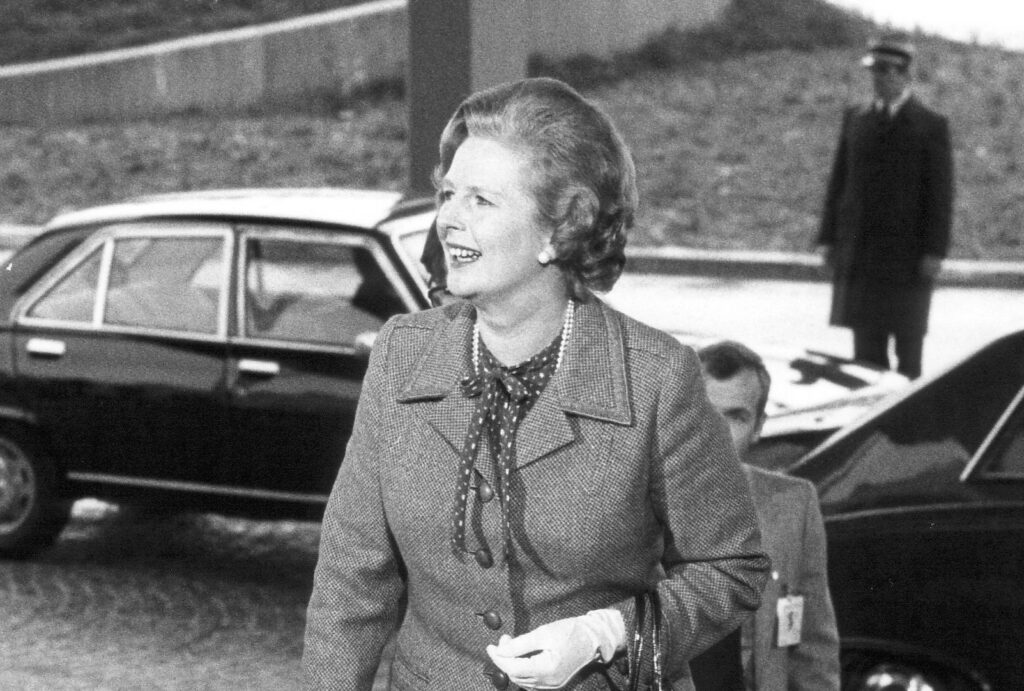
On 10 October 1980, prime minister Margaret Thatcher told the Conservative Party conference that she would not reverse her government’s controversial monetarist economic policies. Addressing Tory delegates in Brighton, she delivered the famous line: “You turn if you want to. The lady’s not for turning!”
The speech marked a defining moment in the development of Thatcher’s government.
***
Tory MPs and delegates journeyed to Brighton with the Thatcher government facing a series of crises. The country was suffering a severe recession, with the monetarist policy advocated by Thatcher blamed. By late 1980, unemployment was rising rapidly towards 2.5 million and manufacturing output had fallen starkly; meanwhile, riots had broken out in cities like Bristol.
Thatcher, with the government increasingly unpopular, was under significant political pressure – including from within her own party – to adopt a more moderate approach.
Senior “wet” cabinet ministers – those from the one nation wing of the party – urged the prime minister to moderate her economic agenda and abandon her most radical free-market policies. These figures are generally said to have included Ian Gilmour and James Prior.
Heading into conference season, there was some expectation that Thatcher would be forced to bow to the pressure.
But in her keynote address, Thatcher directly refused to change course. She referenced her first conference speech as prime minister, in which she defined the government’s mission as changing the “national attitude of mind”. She described this as the “most challenging to face any British administration since the war”.
Thatcher added: “Challenge is exhilarating. This week we Conservatives have been taking stock, discussing the achievements, the set-backs and the work that lies ahead as we enter our second parliamentary year.”
Reviewing her first seventeen months in office, Thatcher argued the government had “laid the foundations for recovery”.
But the prime minister maintained that her view as to the government’s achievements would “avail us little unless we achieve our prime economic objective – the defeat of inflation”.
She characterised inflation as “the parent of unemployment” and the “unseen robber of those who have saved”.
She stated: “No policy which puts at risk the defeat of inflation – however great its short-term attraction – can be right. Our policy for the defeat of inflation is, in fact, traditional.
“It existed long before… ‘monetarism’ became a convenient term of political invective.”
Thatcher conceded that the government was “not heedless of the hardships and worries that accompany the conquest of inflation.”
She added: “Foremost among these is unemployment. Today our country has more than 2 million unemployed.”
Thatcher described the 2 million figure as a “human tragedy” that undermined “human dignity and self respect”. But she rejected the idea that there was any “obscure economic religion which demands this unemployment as part of its ritual”.
She told delegates: “If I could press a button and genuinely solve the unemployment problem, do you think that I would not press that button this instant?”
She insisted that the government would not spend “money like water”, declaring: “If ever a nation has spent, spent, spent and spent again, ours has. Today that dream is over.”
She argued that “higher public spending, far from curing unemployment, can be the very vehicle that loses jobs”.
Thatcher outlined her philosophy regarding the role of the state, arguing that “it is not the State that creates a healthy society”. She argued that when the state grows too powerful, it “drains society, not only of its wealth but of initiative, of energy, the will to improve”.
Thatcher’s speech, written by her playwright speechwriter Ronald Millar, famously featured a direct attack on her critics and a reference to the 1948 play, The Lady’s Not for Burning.
Directly addressing the calls to change course, she declared: “To those waiting with bated breath for that favourite media catchphrase, the ‘U turn’, I have only one thing to say: ‘You turn if you want to. The lady’s not for turning.’
“I say that not only to you but to our friends overseas and also to those who are not our friends.”
The proclamation, which concluded Thatcher’s remarks on economic policy, was reportedly met with a five-minute standing ovation in the conference hall.
Thatcher, styling herself as a conviction politician, thereby confirmed that the government would continue to pursue its monetarist economic strategy.
She concluded: “We close our conference in the aftermath of that sinister utopia unveiled at Blackpool. Let Labour’s Orwellian nightmare of the left be the spur for us to dedicate with a new urgency our every ounce of energy and moral strength to rebuild the fortunes of this free nation.”
***
The speech and its reception helped reassert Thatcher’s authority over her party.
Unemployment peaked at three million in January 1982. But Thatcher, having recently conducted a ruthless reorganisation of her critics (the “purge of the wets” reshuffle), remained committed to her monetarist course.
The intervention of the Falklands War in April 1982 revolutionised Thatcher’s standing in the country. Britain’s decisive victory forged Thatcher’s reputation as the ‘Iron Lady’, and proved a significant factor in the Conservative Party’s landslide victory at the 1983 general election.

Politics.co.uk Newsletters
DAILY
Politics@Lunch
WEEKLY
Week in Review