Major leads Conservative Party to surprise victory in general election
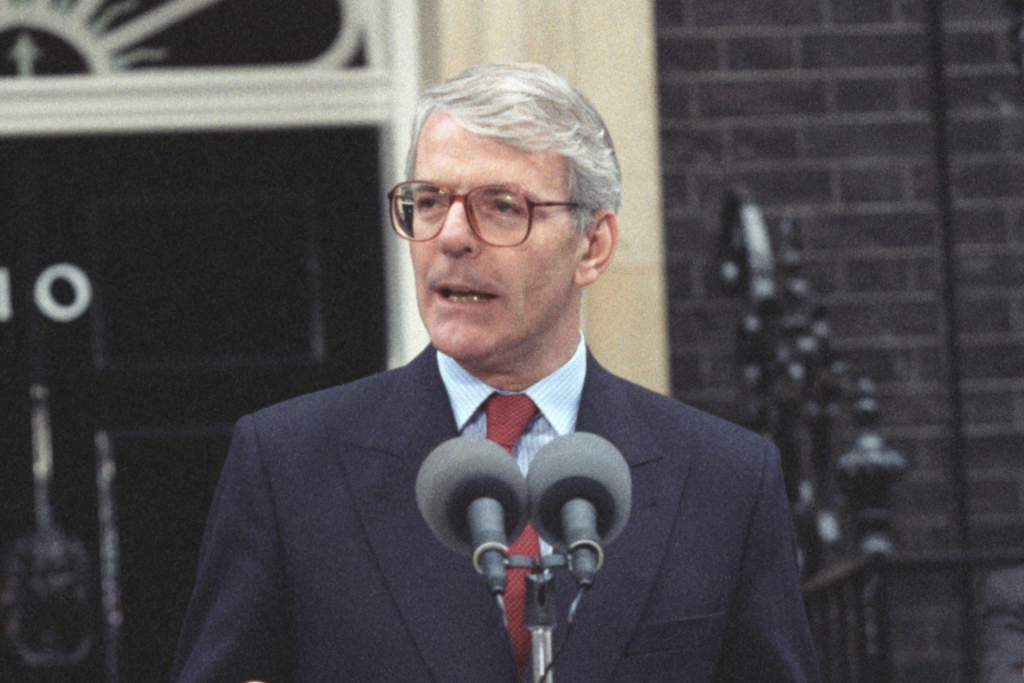
On 9 April 1992, John Major led the Conservative Party to a surprise general election victory and a fourth consecutive term in government. The result confounded the pollsters, defying widespread expectations, and marked a devastating blow for the Labour leader, Neil Kinnock. Most opinion polls throughout the campaign had given Labour a narrow lead.
***
Major assumed office as prime minister in November 1990, following the dramatic resignation of Margaret Thatcher. Major’s predecessor resigned in the face of immense opposition to the Community Charge, known universally as the “poll tax”, and internal splits over government policy on European integration.
Major’s initial period in office was marked by a restoration of cabinet government and rising public support – bolstered by the successful conclusion of the Gulf War in 1991 and the negotiation of the Maastricht Treaty.
The Conservative campaign in the 1992 general election focused relentlessly on the economy.
On 6 January, the party unveiled its “Labour’s Tax Bombshell” campaign with a famous poster. The attack claimed Labour’s plans would mean tax increases of more than £1,000 for the average voter.
Labour responded by producing its tax and spending plans in detail by way of a “shadow budget”. The party proposed an increase in the top rate of tax from 40% to 50%, and removal of the exemption from 9% national insurance contributions on high earners. John Smith, the shadow chancellor, boasted that eight out of 10 taxpayers would feel better off as a result of the plans. But these figures were ammunition for the Conservative campaign which produced a series of uncharitable costings. One poster named “The price of Labour” as “£1,250 a year for every family”
The Conservative Party’s “Double Whammy” poster warned of “more taxes” and “higher prices” via two bright red boxing gloves. This material was curated by Saatchi and Saatchi, an advertising company that had worked with the Conservative Party since 1978. Saatchi and Saatchi, Thatcher’s favourite ad agency, produced the iconic “Labour Isn’t Working” during the 1979 general election campaign.
Major also adopted a more sober style of street-level campaigning.
The prime minister, who remained a popular figure, was placed at the centre of the Conservative campaign. Initially, a series of “Meet John Major” events saw the prime minister field questions from an invited audience of 200-300 people. Thatcher, however – an irrepressible back-seat driver – complained that the Conservative campaign lacked “oomph and steam”.
Major moved beyond his initial stage-managed strategy on 28 March, when he produced his soapbox. From this portable perch, Major preached the perceived virtues of Conservative policy to crowds of Britons.
***
Major also benefited from blunders committed by the Labour campaign.
On 24 March, a Labour Party election broadcast told the story of two girls with an ear problem: one of the girls was treated privately and without delay, while the other waited for NHS treatment. The broadcast blamed this discrepancy on NHS underfunding.
Subsequent reports, however, questioned the authenticity of the story the broadcast was based on. “If Kinnock will tell lies about a sick little girl”, the Sun queried, “will he ever tell the truth about anything?”
Labour was forced to confirm the veracity of the case and inadvertently revealed the name of one of the subjects, Jennifer. The saga, known as “The war of Jennifer’s ear”, was a coup for the Conservative Party and its allies in the media.
Nevertheless, opinion polls on 1 April – dubbed “Red Wednesday” – suggested Labour had established a strong 4-7 point lead over the Conservatives. That evening, just eight days before the general election, Kinnock held a high-profile rally at the Sheffield Arena.
The event itself was a carefully choreographed, American-style political rally, featuring celebrity endorsements and a spectacular stage entrance for Kinnock. Images of the Labour leader landing in a helicopter were projected into the auditorium via a large screen. According to subsequent reports, Labour’s strategists had been working on the rally for over 18 months.
Kinnock, upon arriving in the auditorium, delivered an infamously animated performance. Having just journeyed to the stage through the 10,000-strong audience of party activists, Kinnock euphorically proclaimed: “We’re alright!”
Kinnock’s evangelical display was widely perceived by commentators as premature. Moreover, his showing appeared to contradict the quasi-presidential spirit of the Labour campaign. This was no statesman, the Conservative-supporting press contended. The Sun newspaper dedicated eight pages to the Sheffield rally under the headline “Nightmare on Kinnock Street”.
Throughout the campaign, the tabloids – and the Sun in particular – slated Labour and its leadership under Kinnock. On polling day, the Sun depicted Kinnock’s head inside a lightbulb. The savage splash added: “If Kinnock wins today will the last person in Britain please turn out the lights”.
***
In the end, the Conservative Party won 336 seats and a working majority of 21. Major secured over 14 million votes – the highest popular vote ever recorded by any party in a British general election.
Labour won 271 seats, up 42, on a turnout of 77.7% – the highest since February 1974.
Kinnock, who had already led his party into the 1987 general election, resigned on 13 April. Labour’s deputy leader, Roy Hattersley, also stood down.
Kinnock was succeeded by John Smith as Labour leader in July 1992.
In his resignation statement, Kinnock pinned Labour’s underperformance on those newspapers sympathetic to the Conservatives. “This was how the election was won and if the politicians, elated in their hour of victory, are tempted to believe otherwise, they are in very real trouble next time”, he declared.
The outgoing Labour leader added: “My sorrow is that millions… will suffer because of the election of another Conservative government.”
Lord McAlpine, the former treasurer of the Conservative Party, agreed with Kinnock’s interpretation. “The heroes of this campaign were Sir David English, Sir Nicholas Lloyd, Kelvin MacKenzie and the other editors of the grand Tory press”, he said.
In the wake of the election – with Major’s victory confirmed – one notable headline gloated: “It’s The Sun Wot Won It”.
***
The 1992 contest also marked the first general election contested by the Liberal Democrats.
The Social and Liberal Democrats Party (SLD) was formally constituted on 3 March 1988, marking the official merger of the historic Liberal Party and the Social Democratic Party (SDP). The move, which followed years of electoral cooperation, created a unified “third force” in British politics.
The Liberal-SDP merger negotiations proved protracted and acrimonious. A new name for the party was a conspicuous sticking point. The SDP preferred to maintain the “social democratic” label, while the Liberals wanted to keep the word “liberal”.
Paddy Ashdown, a former Royal Marine, was elected as the first leader of the Social and Liberal Democrats on 28 July 1988. Ashdown suffered a symbolic setback in the 1989 Richmond by-election. The continuity SDP, led by David Owen – a member of the original “Gang of Four” that founded the party – won 32.2% of the vote, narrowly behind the Conservative candidate, William Hague, on 37.2%. The SLD placed third with 22.1% of the vote.
In October 1989, the party was renamed the Liberal Democrats – the unwieldy “Social and Liberal Democrats” had been cruelly reduced to “Salads” by its critics.
The Liberal Democrats under Ashdown won 17.8% of the vote and 20 seats at the 1992 general election.
In the 1992-1997 parliament, Ashdown signalled the end of his party’s “equidistance” between the two main parties, placing the Lib Dems explicitly on the left of British politics and indicating that he would be prepared to work with Labour to defeat the Conservatives.
***
The 1992 election provided Major with his own mandate.
But the Conservative Party’s 21-seat majority was shallow compared to previous returns in 1983 and 1987. The arithmetic left Major vulnerable to the deep divisions within his party – including over Europe, which would plague the rest of his premiership.
By the time Major called a general election in 1997, the Conservative majority had been eroded to zero by deaths and defections.
John Smith’s death in 1994 meant it was Tony Blair who led Labour into the 1997 general election.

Politics.co.uk Newsletters
DAILY
Politics@Lunch
WEEKLY
Week in Review
