Macmillan delivers ‘wind of change’ speech to South African Parliament
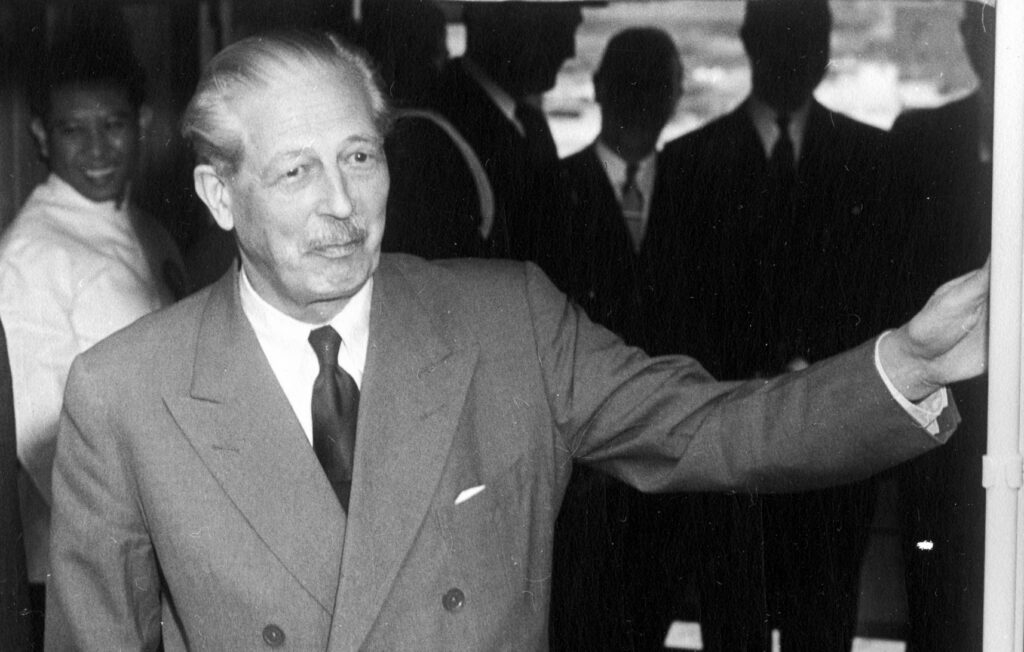
On 3 February 1960, Harold Macmillan delivered a landmark address to the all-white South African parliament in Cape Town, in which he spoke of a “wind of change” blowing through the continent.
The speech, and Macmillan’s “wind of change” line in particular, represented a seminal contribution to the discourse of decolonisation, signalling an acceptance on the part of the British government that the era of colonial rule was ending.
***
The address came at the end of a 17,000-mile, six-week tour of Africa that began on 5 January in Ghana. Macmillan also visited Nigeria, Rhodesia and Nyasaland.
Macmillan’s speech, which lasted 40 minutes, was delivered in the dining room of the House of Assembly; among those in the audience was Dr Hendrik Verwoerd, the South African prime minister. Macmillan deliberately withheld a full advance copy of the text from Verwoerd, merely summarising the main content.
In the speech’s central passage, Macmillan identified the emergence of national consciousness across Africa as a “political fact.”
Macmillan stated: “The wind of change is blowing through this continent, and whether we like it or not, this growth of national consciousness is a political fact. We must all accept it as a fact, and our national policies must take account of it.
“I sincerely believe that if we cannot do so we may imperil the precarious balance between the East and West on which the peace of the world depends.”
Macmillan said that the “great issue” in the second half of the 20th century was whether “the uncommitted peoples of Asia and Africa will swing to the East or to the West.”
He added: “Will they be drawn into the Communist camp?
“Or will the great experiments in self-government that are now being made in Asia and Africa, especially within the Commonwealth, prove so successful, and by their example so compelling, that the balance will come down in favour of freedom and order and justice?”
He delivered an unmistakable critique of South Africa’s apartheid policy.
He stated that the UK government’s aim was to create a society where “individual merit, and individual merit alone, is the criterion for a man’s advancement, whether political or economic.”
Macmillan added: “As a fellow member of the Commonwealth it is our earnest desire to give South Africa our support and encouragement, but I hope you won’t mind my saying frankly that there are some aspects of your policies which make it impossible for us to do this without being false to our own deep convictions about the political destinies of free men to which in our own territories we are trying to give effect.
“I think we ought, as friends, to face together, without seeking to apportion credit or blame, the fact that in the world of today this difference of outlook lies between us.”
***
Macmillan’s address was reportedly heard in “almost complete silence”. There were mere murmurs of “Hear, hear!” when Macmillan said he was opposed to a threatened boycott of South African goods. Upon the speech’s conclusion, there were approximately 30 seconds of applause.
Verwoerd delivered an impromptu response to Macmillan’s address.
He countered: “The tendency in Africa for nations to become independent and, at the same time, the need to do justice to all, does not only mean being just to the black man of Africa but also being just to the white man of Africa.
“They are the people, not only in the Union but throughout major portions of Africa, who brought civilisation here, who made possible the present development of black nationalism by bringing the natives education, by showing them the Western way of life, by bringing to Africa industry and development, by inspiring them with the ideals which Western civilisation has developed for itself.”
In the wake of Macmillan’s speech, the colonial secretary, Iain Macleod, moved to decrease the timetable for independence in East Africa by a decade – granting independence to Tanganyika (1961), Uganda (1962) and Kenya (1963). Within a decade of Macmillan’s address, 27 former colonies in Asia, Africa and the Caribbean gained independence.
The speech led to the formation of the Conservative Monday Club, a pressure group dedicated to opposing decolonisation and supporting white minority rule in the remaining colonies, particularly Rhodesia.
The Monday Club title was a reference to “black Monday”, the day Macmillan spoke in Cape Town.
In May 1961, following a whites-only referendum held in October 1960, South Africa became a republic and withdrew from the Commonwealth. The decision was seen as a response to the political rupture precipitated by Macmillan’s “wind of change” speech.
In March 1960, Verwoerd argued that Macmillan’s famous address strengthened the case for establishing a republic.
He said: “It was not the Republic of South Africa that was told, ‘We are not going to support you in this respect.’ Those words were addressed to the monarchy of South Africa, and yet we have the same monarch as this person from Britain who addressed these words to us.
“It was a warning given to all of us, English-speaking and Afrikaans-speaking, republican and anti-republican. It was clear to all of us that as far as these matters are concerned, we shall have to stand on our own feet.”
When South Africa left the Commonwealth, Macmillan remarked ruefully: “The wind of change has blown us away.”
Macmillan later titled the first volume of his memoirs Winds of Change (1966) – adopting the plural form commonly used by the press.

Politics.co.uk Newsletters
DAILY
Politics@Lunch
WEEKLY
Week in Review