Labour Party votes to leave the EEC in blow to Harold Wilson
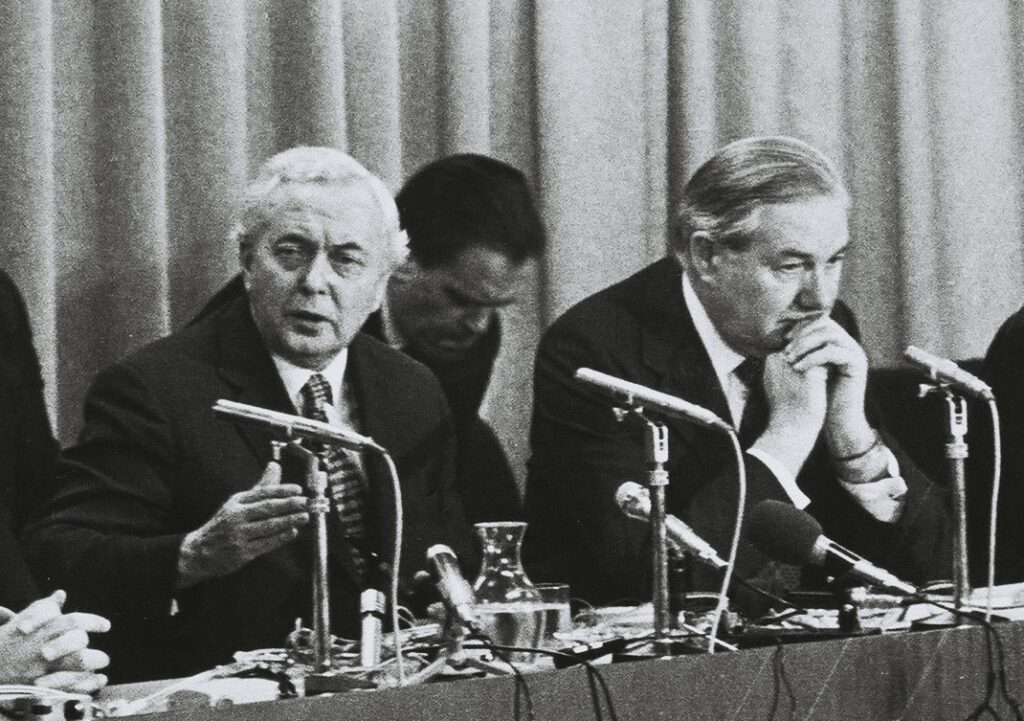
On 26 April 1975, a special one-day conference of the Labour Party voted decisively for the United Kingdom’s withdrawal from the European Economic Community (EEC). The position was carried by 3,724,000 votes to 1,986,000 – almost a 2:1 margin.
The result was a blow to Harold Wilson, the pro-EEC prime minister. It exposed divisions within his party just weeks before the country’s first-ever national referendum on the issue.
The outcome meant that every major organ of the Labour Party was now pitted against the government’s policy: in March, the national executive committee (NEC) resolved in favour of withdrawal from the EEC; earlier in April, more Labour MPs voted against continued membership of EEC than voted in favour (by 11).
This latter development came during a debate on a commons motion approving “the recommendation of Her Majesty’s Government to continue Britain’s membership of the community.” The motion was passed by 396 votes to 170 – a majority of 226 – because of the overwhelming support of Conservative and Liberal MPs. Eric Heffer, the minister of state for industry, was forced to resign after he forcefully spoke against the motion from the government dispatch box.
***
The special Labour conference exhibited the party’s divides over Europe – which the referendum policy was designed to manage.
Wilson committed to a referendum on Britain’s continued membership of the EEC in 1972.
In April 1972, during the European Communities Act’s committee stage, the Labour leadership voted to support an amendment proposed by anti-EEC Conservative MP Neil Marten calling for a referendum on British entry. This decision precipitated the resignation of Roy Jenkins as deputy leader of the Labour Party. In his resignation letter, Jenkins opposed what he called “government born out of opportunism.”
The Labour manifestos for the February 1974 and October 1974 general elections featured referendum commitments.
The October manifesto stated: “The Labour government pledges that within 12 months of this election we will give the British people the final say, which will be binding on the government – through the ballot box – on whether we accept the terms and stay in or reject the terms and come out.”
Speaking in the House of Commons in January 1975, Wilson said cabinet ministers would be “free to support and speak in favour of a different conclusion in the referendum campaign”. However, this freedom did not extend to parliamentary proceedings – hence Heffer’s sacking. In total, of the 23 members of Wilson’s cabinet, seven did not support the government’s pro-EEC position.
Michael Foot, the employment secretary, and Tony Benn, the industry secretary, were among the most prominent supporters of withdrawal. They spoke at the special conference to this effect.
Foot suggested that high unemployment figures were the fault of the EEC. “I read these figures with horror and with shame”, he said. “These are figures we have to have before us every day of our political lives.”
He added: “I want to see every instrument available at our command for dealing with unemployment here and now.”
Foot received a standing ovation.
Wilson, addressing delegates, argued in favour of the new terms of Britain’s membership, which were negotiated across two summits in 1974 and 1975.
The prime minister told the conference floor: “My judgement is that it is now best for the future of Britain, best for the Commonwealth, best for the developing world, best for the wider world, that we remain in the community.”
Wilson conceded that he had never been “emotionally a Europe man” but declared that he saw no other course.
The speech of James Callaghan, the foreign secretary, was interrupted by shouts of “Rubbish!”
***
Speaking after the vote, Benn commented: “We have had a conference and the decision is clear… It is very clear that there now must be a move for the Labour Party to campaign.”
Shirley Williams, the prices and consumer protection secretary who spoke in favour of the EEC, said: “[The result is] much better than we had feared, but not quite as good as we had hoped.”
One party official reportedly remarked: “The party is now against its own government. And now the people will be against the party. We could have done without this meeting.”
Despite the anti-EEC majority in the wider Labour Party and movement, Wilson is said to have been confident that the public would vote to stay in.
On 5 June, the United Kingdom voted decisively to remain a member of the European Economic Community. A resounding 67.23% voted in favour of staying in, versus 32.77% who supported withdrawal.
Peter Kellner, a political analyst and pollster, has argued that the decision to hold the 1975 referendum “was a constitutional outrage” in that “it was wholly to do with holding the Labour Party together”.
Wilson hailed the result as a “historic decision”.
Speaking outside 10 Downing Street on the evening of 6 June, the prime minister stated: “The British people in clear and unmistakable terms have made their historic decision that Britain shall remain a member of the European Community.
“They have overwhelmingly supported the government’s recommendation.
“Their verdict has been given by a vote and by a majority bigger than that achieved by any government in any general election in the history of our democracy. No one in Britain, in Europe, or the wider world should have any doubts about its meaning.”

Politics.co.uk Newsletters
DAILY
Politics@Lunch
WEEKLY
Week in Review