Hugh Dalton resigns as chancellor after budget leak
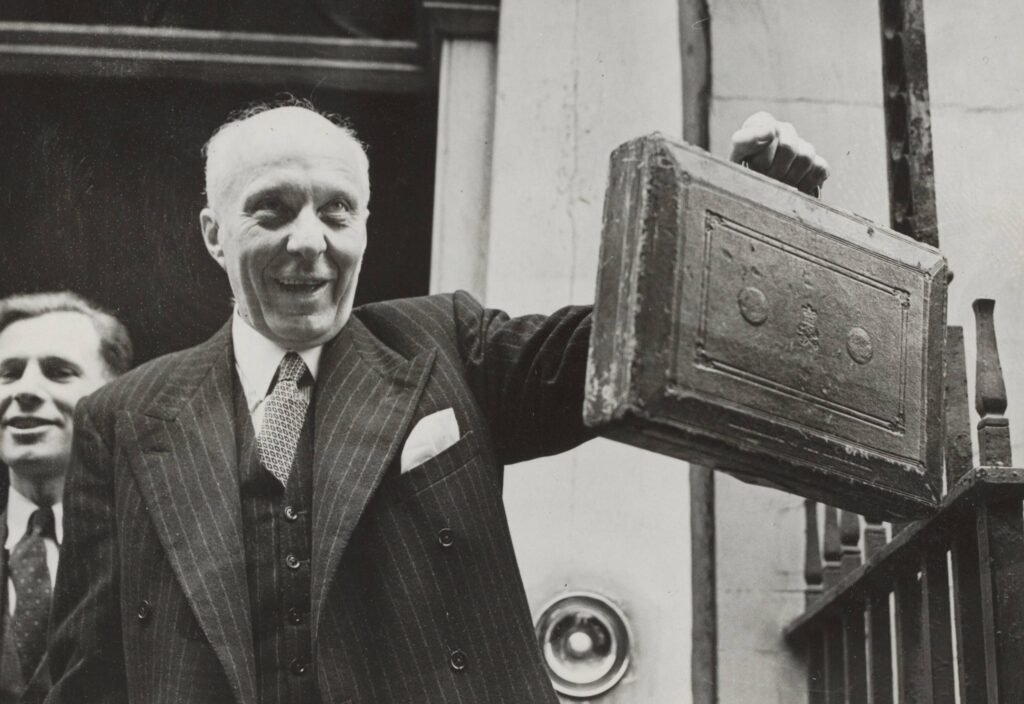
On 13 November 1947, Hugh Dalton resigned as chancellor of the exchequer in Clement Attlee’s Labour government. It came after he leaked details of the budget to a journalist mere moments before he was due to deliver his statement to MPs.
Dalton’s departure stands as the most infamous – but far from the most wide-ranging – budget leak in British political history
***
The leak occurred as Dalton was walking to the House of Lords chamber, the temporary residence of MPs with the commons chamber undergoing reconstruction after wartime bombing. Dalton was accosted by John Carvel, the political correspondent for the London evening newspaper, the Star.
The garrulous chancellor then volunteered several key proposals to Carvel.
He is reported to have said: “John, your whisky is going to cost you a bit more from now on. You’ll have to pay a penny more for your beer, too.”
At 3:45 pm, shortly before Dalton began reading his budget speech, the Star produced headlines reading: “Penny on beer” and “Tax on pools and dogs likely.”
Dalton’s political aide, Douglas Jay, who normally would have shielded him from journalistic advances, had been sent ahead to ensure a glass of water was at the dispatch box. Dalton was left unguarded.
Critically, the information he divulged found its way into the public domain while the stock market was still open.
The following day, the leak was raised in the commons by Conservative MP Henry Raikes.
Dalton offered his deep apologies to the House, declaring: “I very much regret to tell the House that the publication… arose out of an incident which occurred as I was entering the chamber to make my speech yesterday.”
He told MPs: “In reply to questions put to me by the lobby correspondent of the Star newspaper, I indicated to him the subject matter contained in the publication in question. I appreciate that this was a grave indiscretion on my part, for which I offer my deep apologies to the House.”
Winston Churchill, the then leader of the opposition, was initially sympathetic. He commended Dalton’s “very frank manner” and suggested that Carvel, rather than the chancellor, was most at fault.
Churchill condemned the “misuse of his confidence which has occurred”.
Dalton, however, said he took the “blame for having committed an indiscretion in my relationship with this lobby correspondent whom I have known… over a period of years”.
He added: “I have apologised for my part in the matter, and I would prefer to leave it there.”
Attlee, a famously taciturn figure, is said to have been astounded by the incident. When his adviser Francis Williams explained the situation to him, the prime minister responded: “Talked to the press? Why on Earth did he want to talk to the press?”
***
The prime minister, upon conferring with colleagues, then accepted Dalton’s resignation; his relationship with Dalton is said to have been tense at this stage.
In his letter of resignation, Dalton wrote that “in view of the incident which was raised today in the House, I think it my duty to offer you my resignation.”
In his response, Attlee acknowledged that the indiscretion “in itself did not result in any action detrimental to the state”.
But the prime minister added: “The principle of the inviolability of the budget is of the highest importance, and the discretion of the chancellor of the exchequer who necessarily receives many confidential communications must be beyond doubt.”
Dalton was succeeded as chancellor by Stafford Cripps.
Carvel, the Star political correspondent, was also reported to have lost his position over his budget scoop.
Dalton’s resignation came as Churchill faced pressure from Conservative MPs to step up his criticism. The Tory leader had prepared a letter requesting a select committee inquiry.
Churchill wrote: “I have now seen the very precise and comprehensive form of your announcement. I am also told that no obligation of secrecy was imposed upon the journalist, though that certainly seems to me to have been implicit.”
He added: “In the circumstances, while I acknowledge the frankness of your apology to the House and my sympathy with you in any breach of confidence which may have been committed, I feel it is necessary that the incident should be the subject of an inquiry by a select committee.”
Churchill raised the matter again in the commons on 17 November, tabling a formal motion “on the subject of a select committee to inquire into the circumstances of the disclosure of budget information”.
Attlee responded that Dalton had paid a “very heavy penalty for his indiscretion” and referenced the “sympathy of members in the misfortune which has come upon him”.
He said that neither Dalton nor the government would “oppose further inquiry – because there is nothing whatever to conceal in the matter – if it was thought necessary.”
Conservative MP Arthur Baxter said that MPs had been contacted by newspapers in the United States and in Canada looking for further information “in the belief that there is something sinister” at hand.
The parliamentary inquiry ultimately concluded that Dalton’s leak did not come with economic consequences.
Attlee later summed up Dalton’s downfall with the remark: “Perfect ass. His trouble was that he would talk. He always liked to have a secret to confide to somebody else to please him. He did it once too often.”
Dalton returned to the cabinet less than seven months later as chancellor of the Duchy of Lancaster. He served in this post until February 1950, when he was appointed as minister of town and country planning.
Dalton retired from the shadow cabinet in 1955 after 30 years as a frontbencher.
He subsequently stood down from parliament at the 1959 general election, and was elevated to the Lords as Baron Dalton shortly thereafter.
Dalton died on 13 February 1962, aged 74.
***
Dalton’s famous resignation in 1947 can be attributed to the bluntness and indiscretion of his leak. That said, several of his successors as chancellor have remained in office despite their budgets suffering from significantly more extensive – and market-sensitive – disclosures.
In 1996, the Daily Mirror handed back Kenneth Clarke’s final budget as chancellor when it was leaked to the paper. Anthony Harwood, the reporter who was sent the relevant details, hand-delivered the papers to a Downing Street press officer, saying: “Tell the chancellor he’ll be needing these tomorrow.”
John Major, the prime minister, ordered a leak inquiry and the Metropolitan Police investigated. No one was arrested.
Writing some years later, Jill Rutter, a former press secretary at HM Treasury, said the government considered whether “the chancellor should go down to the House and deliver a midnight budget”.
But she added: “We looked at the content, concluded there was nothing market moving, and Ken Clarke decided to go out for a curry with his private office.”
In 2013, George Osborne’s budget was leaked after the Evening Standard posted an image of its forthcoming front page to Twitter (now X). The post set out the main announcements prior to Osborne’s statement to parliament.
Ed Miliband, the leader of the opposition, told MPs: “The chancellor almost need not have bothered coming to the House, because the whole budget, including the market-sensitive fiscal forecasts, was in the Standard before he rose to his feet.”
MPs called on Osborne to follow Dalton’s example and “Resign!”
Joe Murphy, the Standard‘s political editor, issued a swift apology, saying: “We are so sorry to the House of Commons, to the Speaker and to the chancellor for what happened.”
The junior journalist who used the Standard’s social media account to post the picture of Wednesday’s front page was suspended while the paper conducted an investigation.
Charlie Whelan, Gordon Brown’s former spokesman, responded: “Don’t worry [Joe Murphy] they won’t lock you in the tower for leaking budget. I used to do it all the time!”
Osborne ordered the permanent secretary of the Treasury to review how sensitive budget information is pre-released to the press.
The Treasury said: “The chancellor has asked the permanent secretary to conduct a review into the practice of the proactive pre-releasing of budget information under embargo on budget day which has operated in recent years.
“He has asked that this review report on the appropriateness of these arrangements.”
Budget leaks, kites and trails are now a staple of the budget process.
https://x.com/Gilesyb/status/1765335994268536959
The 2025 autumn budget process played out across the media courtesy of reports by well-briefed journalists. A plan to raise income tax, which would have breached Labour’s 2024 election manifesto, was briefed and then farcically un-briefed by the time Rachel Reeves delivered her budget statement.
However, 45 minutes before Reeves stood up to address MPs on 26 November, the Office for Budget Responsibility (OBR) disclosed the contents of the budget in what it later called a “technical error”.
Politics.co.uk Newsletters
DAILY
Politics@Lunch
WEEKLY
Week in Review