Harold Macmillan launches attack on Thatcherism in Lords maiden speech
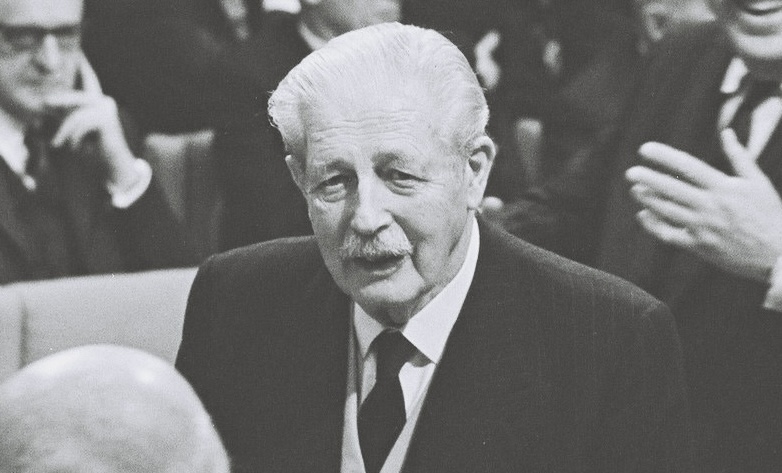
On 13 November 1984, Harold Macmillan, who had been created Earl of Stockton earlier that year, delivered his maiden speech in the House of Lords. Macmillan, aged 90, used the occasion to issue a series of devastating criticisms of Margaret Thatcher’s Conservative government, particularly over handling of the ongoing Miners’ Strike.
Macmillan resigned as prime minister in October 1963 following a period of ill-health. His premiership had been looking increasingly embattled after the Profumo affair, a ruthless reshuffle – dubbed the “night of the long knives”, and the French veto of Britain’s accession into the European Economic Community (EEC).
Macmillan stood down as an MP at the 1964 general election and initially refused a peerage.
***
Upon accepting an earldom 20 years later, Macmillan became the last non-royal recipient of a hereditary peerage. In his landmark maiden speech, delivered to a packed chamber, ‘Supermac’ framed his parliamentary comeback as that of a “political Rip van Winkle”.
He harked back to his time as prime minister, recalling the charge levelled by his opponents that the Conservative Party’s tenure in office amounted to “thirteen years of Tory misrule”.
He countered by invoking his famous declaration during the 1959 general election campaign, wryly citing “some enthusiast – I cannot remember his name now – who invented some slogan about, ‘You’ve never had it so good!’ or something like that.”
Macmillan’s speech represented an impassioned restatement of the one nation conservatism that defined his premiership – and an evisceration of Thatcher’s doctrinaire policy. He defended the Keynesian, consensus-era economics of his own time, condemning the ideological rupture that Thatcherism represented.
Some 60 years after his first appearance in the commons, he recalled the job of juggling four or five economic balls at once, including the preservation of “full employment.”
He offered only caveated praise for Thatcher and her colleagues, stating they had tackled the “terrible situation” of 1970s inflation “with courage, determination and persistence and they must be admired by all reasonable men and women.”
But he added: “What do we do now? We have done this – we have got some control over the machine which was completely out of control. What do we do now? As to that, it is very difficult to answer.”
The unflappable former prime minister questioned where monetarist theories had really come from. “Was it America?”, he inquired, “Or was it Tibet?”.
He segued into a scathing analogy, telling peers: “Many of your Lordships will remember that it operated in the nursery. One nanny said, ‘Feed a cold’ – she was a neo-Keynesian. The other said, ‘Starve a cold’ – she was a monetarist.”
He judged laissez-faire economics to be “just as bad as collectivism.”
He said: “Good men, good Christian men, like [anti-corn law free traders Richard] Cobden and [John] Bright, closed their eyes to factories working appalling hours, employing children under 12—and not only hours in the factory, but underground, too.”
He added: “[But] no, the government could not interfere; it was against the doctrine of laissez-faire.
“Once you get a doctrine, that is the end of you. Pragmatic politics are the only good ones.”
Macmillan, who was prime minister when Thatcher was first elected to the commons in 1959, expressed concern over the government’s approach to the Miners’ Strike, which had been running for almost nine months at the time of his speech.
The former prime minister said it broke his heart “to see what is happening in our country today”
He referred to a “terrible strike” was being carried out “by the best men in the world”, adding: “They beat the Kaiser’s army and they beat Hitler’s army. They never gave in. The strike is pointless and endless. We cannot afford action of this kind.”
It was a thinly veiled criticism of Thatcher’s view of the strikers as the “enemy within”.
Macmillan then appealed directly to the central doctrine of one nation conservatism.
He warned of the “growing division of comparative prosperity in the south and an ailing north and midlands” and described as “wicked the hatred that has been introduced”.
He concluded with a plea for reconciliation based on “faith, hope and charity.”
***
These remarks suggested ‘Mac the knife’, so-called after his brutal 1962 reshuffle, retained his ruthless streak. The speech roused an unprecedented standing ovation.
Macmillan later reinforced his criticism of Thatcherism, famously comparing the privatisation of public assets to “selling the family silver.” But he had also offered his counsel to Thatcher at the outbreak of the Falklands war, advising his successor to create a war cabinet of “just four or five and not more so you can meet regularly”.
Thatcher paid a generous tribute to Macmillan upon his death two years later on 29 December 1986.
She compared his passing to the collapse of “one of the great oaks in the forest”.
Thatcher added: “It does feel like that because although we knew he was getting on but somehow, well, we hoped there’d be miracles and he would live.”
She said that Macmillan’s criticism had never come between them.
The prime minister remarked: “People are free to say just exactly what they wish. That didn’t come between us at all. Sometimes I was critical of some of the things he said or did. So what, we were in politics, we were friends and colleagues.
“That doesn’t mean you have to say identical things the whole of the time.”
Thatcher was asked whether Macmillan’s “going marks in any way the end of that old-fashioned Disraeli tradition of the Tory party”.
She responded: “No, I don’t. It’s strange you should mention Disraeli.
“I remember Harold Macmillan very well when I was a junior minister, he made me a junior minister at the Ministry of Pensions and National Insurance, and I remember him telling us many times, ‘Look, read Trollope and read Disraeli.’
“And of course we all did.”
Macmillan’s 1984 maiden speech, delivered at the end of a political career spanning decades, was a remarkable moment in itself. But it also reflected the growing ideological chasm between the monetarist thinking of Thatcher, and the post-war economic consensus her reforms shattered.
Watching on in the Lords gallery was a young David Cameron, who, upon his elevation to the Lords as Baron Cameron of Chipping Norton, reflected on Stockton’s remarks in his own maiden speech.
The former prime minister’s political instincts were probably more in tune with Supermac than those of the Iron Lady.
Cameron said: “I set foot in this place as a teenager in the 1980s when I worked briefly as a parliamentary researcher. I watched from I think just up there [gestures to gallery] as the late Lord Macmillan [sic], aged 90, leaning elegantly on a stick, delivered his maiden speech.
“It was a thoughtful, measured evisceration of the late lady Thatcher’s government and its handling of the miners’ strike.”
https://x.com/LeeDavidEvansUK/status/1727012586657645052

Politics.co.uk Newsletters
DAILY
Politics@Lunch
WEEKLY
Week in Review