‘Gang of Four’ break from Labour with Limehouse Declaration
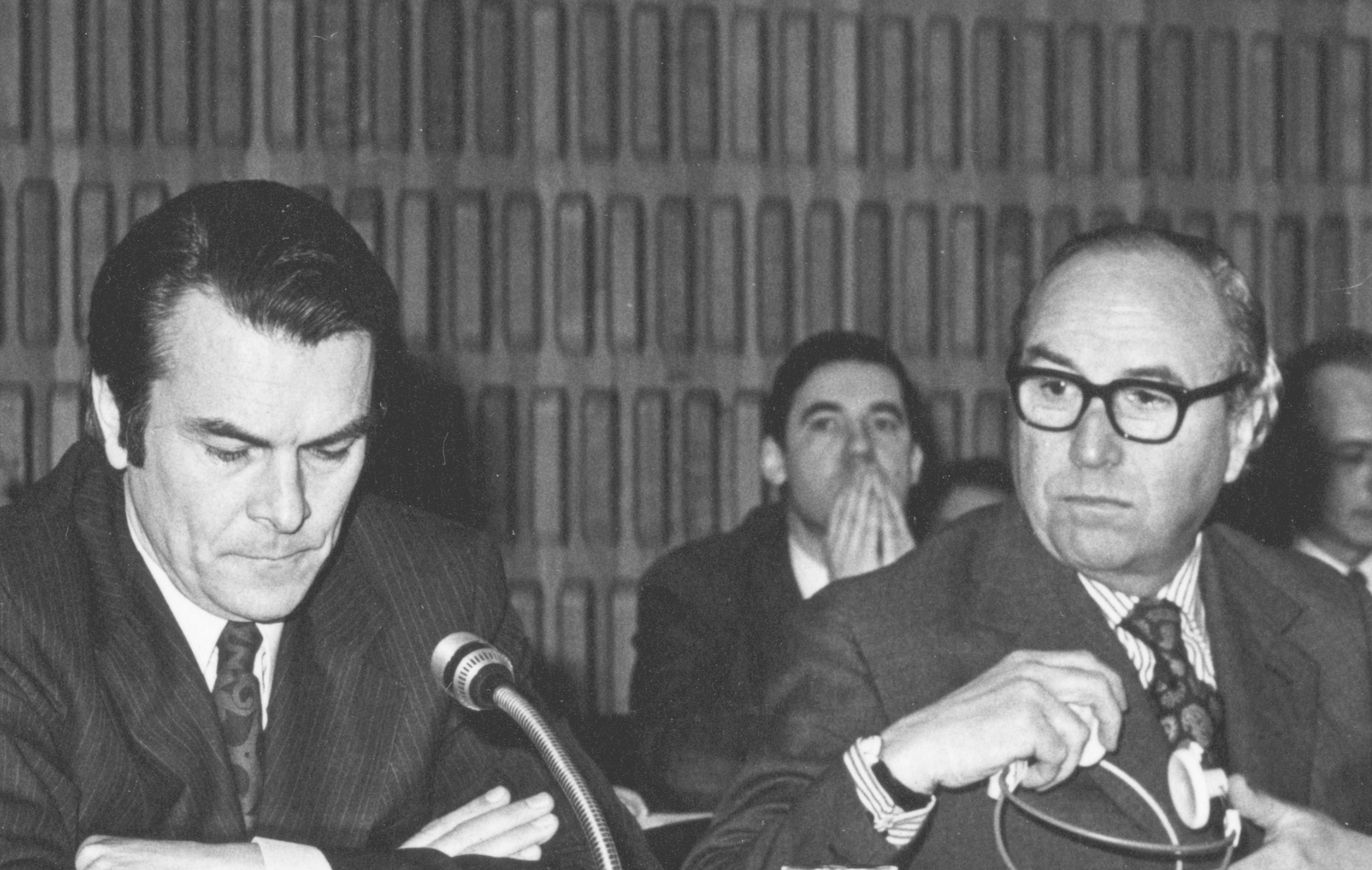
On 25 January 1981, four senior Labour politicians, later dubbed the “gang of four”, issued the Limehouse Declaration. The document, signed by former cabinet ministers Roy Jenkins, David Owen, Shirley Williams and Bill Rodgers near Owen’s home in east London, announced the formation of a “council for social democracy”.
It marked the first public step towards the creation of the Social Democratic Party (SDP).
The declaration was a direct response to the Labour Party’s perceived shift to the left under the leadership of Michael Foot, the white-haired socialist elder statesman. Foot defeated Dennis Healey, seen as a standard-bearer of the party’s social democratic tradition, in the 1980 Labour leadership contest.
It was later suggested that at least four Labour MPs, who were already considering the creation of a new party, had deliberately backed Foot in that election, calculating that his leadership would maximise the political space available for a centrist alternative.
***
The immediate catalyst for the Limehouse Declaration was the procedural change agreed at Labour’s dramatic special conference at Wembley earlier in January 1981. Party delegates voted to establish an electoral college for future leadership elections.
Under the new system, voting power was divided between three blocs: the trade unions/affiliates (40%), the constituency parties (30%), and the parliamentary Labour Party (PLP) (30%). Previously, the choice of leader had rested exclusively with MPs.
The opening paragraph of the Limehouse Declaration stated: “The calamitous outcome of the Labour Party Wembley conference demands a new start in British politics. A handful of trade union leaders can now dictate the choice of a future prime minister.
“The conference disaster is the culmination of a long process by which the Labour Party has moved steadily away from its roots in the people of this country and its commitment to parliamentary government.”
The declaration added: “We do not believe in the politics of an inert centre merely representing the lowest common denominator between two extremes.
“We want more, not less, radical change in our society, but with a greater stability of direction.”
The “gang of four” also highlighted their opposition to key policies promoted by the Labour left, including withdrawal from the European Economic Community (EEC), unilateral nuclear disarmament, and the abandonment of the mixed economy.
The document stated: “Our economy needs a healthy public sector and a healthy private sector without frequent frontier changes…
“We want Britain to play a full and constructive role within the framework of the European Community, Nato, the United Nations and the Commonwealth.
“It is only within such a multi-lateral framework that we can hope to negotiate international agreements covering arms control and disarmament and to grapple effectively with the poverty of the Third World.”
The declaration called for a “realignment” of British politics.
It concluded: “We recognise that for those people who have given much of their lives to the Labour Party, the choice that lies ahead will be deeply painful. But we believe that the need for a realignment of British politics must now be faced.”
In an interview on the BBC’s Panorama programme marking the declaration, Williams outlined the rationale behind the document.
Williams stated: “We have to say now we think the character of the party has changed so far it will take something very exceptional, something really out of the ordinary line to make us be convinced there’s a chance of winning back the party.
“We would like to do so. We would like to think there could be a miracle of that sort but I have to say that we are very pessimistic at the present time…
“If the Labour party goes back to reasserting its socialist and democratic beliefs, that’s where I belong.”
On 5 February 1981, an advertisement placed by the Council for Social Democracy appeared in the Guardian newspaper; it claimed the backing of 8,000 individual supporters. The notice named 100 signatories – including 13 former Labour MPs, four of whom had served as cabinet ministers. Among these senior figures was Baron George-Brown, the deputy leader of the Labour Party from November 1960 to June 1970.
***
The Limehouse Declaration directly precipitated the launch of the SDP two months later on 26 March.
The official launch came at a slick press conference attended by the gang of four.
Addressing a packed room of journalists and the party’s new MPs, Jenkins described the formation of the SDP as “the biggest break in the pattern of British politics for at least 60 years and two generations.”
Williams stated: “I’ve always been struck whenever I’ve been in Britain, by the extent to which we shackle ourselves, by the extent of our class system in Britain, and by the extent of the divisions that we live with in this country.”
Owen said: “Our country is in real trouble, and I think everybody knows it. They can see unemployment rising, and they can sense that we will not recover our economic strength.”
Dennis Healey, the deputy leader of the Labour Party, said he did not think a party could “start from scratch” as the SDP was attempting.
Healey said: “[Oswald] Mosley tried to do this exactly 50 years ago when he broke away from the Labour Party, and as you know, nothing came of it. So he formed the fascist party.”
The remark was a reference to the New Party, founded by Mosley in 1931.
Healey added: “It’s very easy to appeal to the wonderful dream, a world in which there’s peace, motherhood and all that. But when you start getting down to how you achieve it in practice, how you build up your strength from the grassroots, this, I think, is when the problems will appear.”
The Labour deputy leader dismissed suggestions he would join the SDP.
Healey also denied that Labour would have stayed together if he had won the 1980 leadership election. However, he argued that “if the Wembley conference had gone differently, the split would not have taken place.”
The SDP soon forged an alliance with the Liberal Party, led by David Steel.
A total of 28 Labour MPs defected to the SDP over the course of 1981.
***
Through the 1979 to 1983 parliament, Labour remained split between an insurgent, increasingly influential grassroots movement, often associated with Tony Benn, and the social democratic tradition.
Benn had been a prominent supporter of the reforms adopted at the Wembley conference, even criticising those who chose to stand in the 1980 leadership election. The contest came before delegates had considered the proposed procedural changes.
In 1981, Benn challenged Healey, the incumbent deputy leader, under the party’s new procedures. Benn secured an overwhelming majority of the constituency party vote (81.1%). Healey, however, won a commanding majority of the PLP (65.9%) and the heavily weighted trade union/affiliated bloc (62.5%).
Overall, Healey prevailed by just 50.4% to 49.6% in the second ballot. It has been widely argued that a Benn victory would have strengthened the SDP’s case for a fundamental political realignment.
The SDP also posed a major threat to the Conservative Party under Margaret Thatcher’s leadership.
The year of 1981 was the most testing of Thatcher’s premiership. Her monetarist policies, designed to curb inflation, were driving unemployment towards three million. Riots in Brixton, Toxteth, and Moss Side raised the spectre of social upheaval. In these circumstances, the new SDP-Liberal Alliance was seen as a potentially existential threat to the deeply unpopular Conservative Party.
Conservative MP Christopher Brocklebank-Fowler was among the first defectors to the SDP.
Brocklebank-Fowler announced his intention “to join the Council for Social Democracy” during a commons debate on the 1981 spring budget. He stated his support for a “programme for stability, national unity and national renewal”.
Brocklebank-Fowler declared: “The country, industry and the public at large want and deserve a new deal.”
On 22 October, Bill Pitt – the SDP-endorsed Liberal candidate – won the Croydon North West by-election on a swing of 24.2 points.
In November, Shirley Williams won the Crosby by-election – the first time an SDP candidate had won a parliamentary seat. The contest was triggered by the death of the incumbent Conservative MP, Sir Graham Page, who had held the Merseyside seat since 1953. Page had won a majority of 19,272 votes at the 1979 general election.
In her victory speech, Williams quoted the 17th century poet John Dryden: “’Tis well an old age is out, and time to begin anew.”
She declared that “the mould of British politics has been totally shattered.”
Jenkins remarked that the SDP had “broken through across the whole front of British politics.”
In March 1982, Jenkins won the Glasgow Hillhead by-election. The “gang of four” were now all serving MPs.
The SDP, however, was unable to sustain a dominant position heading into the 1983 general election. In the final years of the 1979-1983 parliament, Thatcher’s standing strengthened significantly, bolstered by the surge of support following the Falklands War.
The SDP-Liberal alliance secured 25.4% of the popular vote at the 1983 general election – a mere 2.2 points short of Labour. Under the first past the post electoral system, this yielded only 23 seats. Williams was the most prominent SDP casualty, losing her Crosby seat. Bill Rodgers lost his seat of Stockton North.
Labour won 209 seats (down 60 on the 1979 general election).
The SDP-Liberal alliance failed to improve its standing at the 1987 general election. The alliance, now led by David Owen and Steel, won 22.6% of the popular vote and 22 seats – a net loss of one.
Roy Jenkins lost his seat. Williams and Rodgers, both seeking a parliamentary comeback, were defeated. Owen became the last member of the original ‘gang of four’ standing.
***
The alliance’s second successive failure to “break the mould” of British politics prompted a strategic rethink. After years of electoral cooperation, the Social Democratic and Liberal parties agreed to an official merger.
The Social and Liberal Democrats (SLD) party was formally created on 3 March 1988.
The merger process was fraught with political difficulties. The formal coalescence was vehemently opposed by David Owen, who refused to lead his party into the merger. Owen dismissed the new entity as a “ghastly mess, a disaster and a shambles”.
In his resignation statement, delivered after 57.4% of the party, 25,897 members, voted for a full merger, Owen said: “We [the SDP] are now deeply and predictably split”. Jenkins, Rodgers and Williams all supported the proposed merger.
Owen subsequently led a small breakaway group which continued for a short time under the SDP name.
Paddy Ashdown was elected as the first leader of the Social and Liberal Democrats (SLD) on 28 July 1988. In October 1989, the party was renamed the Liberal Democrats – the unwieldy “Social and Liberal Democrats” had been cruelly reduced to “Salads” by its critics.
In May 1990, Owen formally wound up his lingering SDP outfit after the Bootle by-election. His party had finished seventh on 155 votes, behind the Monster Raving Loony.
The Liberal Democrats won 17.8% of the vote and 20 seats at the 1992 general election.

Politics.co.uk Newsletters
DAILY
Politics@Lunch
WEEKLY
Week in Review