Democratic Unionist Party founded by Ian Paisley
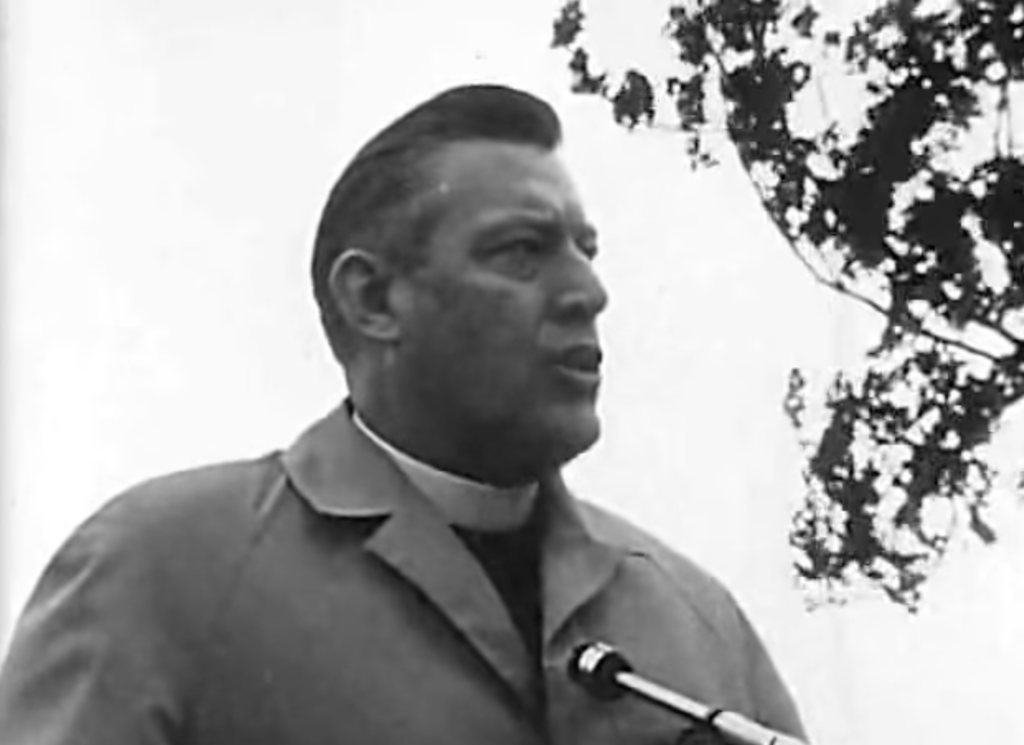
On 30 September 1971, Reverend Ian Paisley co-founded the Democratic Unionist Party (DUP).
The party, formed against the backdrop of escalating violence in Northern Ireland, was created in reaction to the perceived moderation of the established, or ‘official’, Ulster Unionist Party (UUP), particularly following Terence O’Neill’s tenure as prime minister of Northern Ireland. The DUP provided an institutional platform for a more resistant or hardline unionism – loyalism – rooted in a not-an-inch, never surrender ethos.
Paisley formed the party alongside Desmond Boal, who defected from the UUP. The official unionist party had dominated Northern Ireland’s political institutions since their creation in the 1920s, enjoying an unchallenged hegemony at Stormont and among the majority (Protestant/unionist) community.
***
In April 1970, Paisley was elected to the Northern Ireland parliament.
Paisley was elected as the MP for North Antrim in the 1970 United Kingdom general election on a Protestant Unionist Party platform, defeating UUP incumbent Henry Clark.
The DUP evolved from the Protestant Unionist Party (PUP), which itself had emerged from the Ulster Protestant Action movement. Its development owed much to the street disturbances of the 1960s, and loyalist opposition to the civil rights movement – which Paisley was instrumental in organising. As such, the party exhibited a more class-based and populist image than the predominant UUP.
Boal described the party as “right wing in the sense of being strong on the constitution” but “to the left on social policies”.
The DUP’s profile as a socially conservative and fundamentalist political party drew from Paisley’s Free Presbyterian Church.
The DUP initially campaigned for the immediate restoration of Northern Ireland self-government after the imposition of direct rule in March 1972. Its first main electoral test came with the 1973 Sunningdale Agreement. The Sunningdale scheme proposed a power-sharing executive between nationalists, represented by the Social Democratic and Labour Party (SDLP), and unionists, primarily represented by the UUP.
Central to the agreement was a cross-border Council of Ireland, which would have provided for North-South co-operation. The agreement was championed by pro-agreement unionists in the UUP, including its leader, Brian Faulkner, as well as the SDLP.
The DUP was bitterly opposed to the scheme – a stance which exerted significant centrifugal pressure on the official Unionist position.
At the February 1974 general election, the DUP and UUP – now vehemently anti-Sunningdale – joined forces within the United Ulster Unionist Council (UUUC). The electoral pact secured 11 out of 12 of Northern Ireland’s parliamentary seats. The UUUC won 58.3% of the vote.
In the 1980s, Paisley was involved in efforts to establish a paramilitary-style movement, notably the Third Force and later Ulster Resistance.
Paisley’s pre-eminence in founding a church, a political party and the Ulster Resistance paramilitary movement reflects his extraordinary place in British and European history.
Paisley was also a member of several parliaments: the Northern Ireland parliament, the Westminster parliament (both as an MP and peer), the European parliament and the Northern Ireland Assembly.
***
For decades, the DUP remained the primary political vehicle for unionists opposed to power-sharing – including the arrangements set out in the 1998 Good Friday Agreement. In the years following the Belfast Agreement, the DUP steadily eroded the UUP’s dominance, emerging as the largest unionist party in the 2003 Northern Ireland Assembly election.
In 2003, Sinn Féin simultaneously supplanted the SDLP as the predominant representative of nationalism in Northern Ireland.
In March 2007 – in a moment that would have once been unthinkable – Paisley and Sinn Féin’s Gerry Adams publicly announced an agreement to form a power-sharing government. The private negotiations that preceded the announcement were the first time the two parties had ever held direct talks.
Paisley became first minister, with Sinn Féin’s Martin McGuinness deputy first minister, marking the DUP’s transition from a protest party to a party of government.
The St Andrews Agreement saw Paisley enter Stormont’s power-sharing executive as first minister of Northern Ireland, alongside Sinn Féin’s Martin McGuinness as deputy first minister.
This move cemented the DUP’s transition from a party of protest to a party of government.
The DUP’s influence peaked at Westminster a decade later, when its 10 MPs entered a confidence and supply agreement with Theresa May’s Conservative government after the 2017 general election.
Paisley held his North Antrim seat in the House of Commons for 40 years, until his retirement in 2010.
Paisley died on 12 September 2014, aged 88.

Politics.co.uk Newsletters
DAILY
Politics@Lunch
WEEKLY
Week in Review