David Cameron recalls parliament to debate England riots
On 11 August 2011, parliament was recalled from summer recess for an emergency session to debate the wave of rioting that had swept across London and other English cities over the preceding five days.
The riots had begun in Tottenham, north London, on 6 August following an initially peaceful demonstration over the fatal shooting of Mark Duggan by police. The disorder rapidly escalated and spread, initially across London, and then to cities including Birmingham, Manchester, Liverpool, and Nottingham.
In response, David Cameron, the prime minister, cut short his holiday and chaired meetings of the Cobra emergency committee.
***
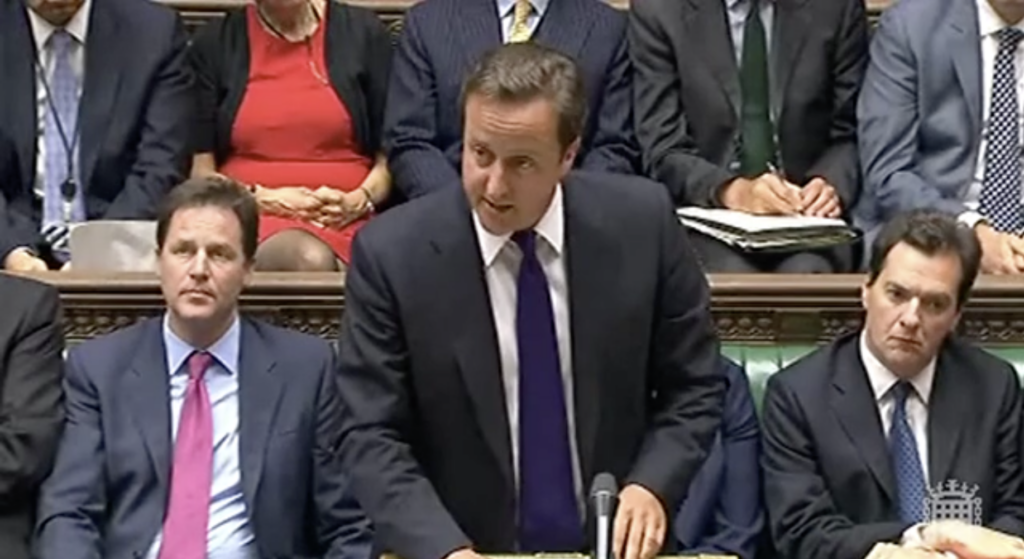
The session on 11 August began with a statement from Cameron, outlining the nature of the government’s response and principles that underpinned it. He condemned the violence as “completely unacceptable” and “criminality, pure and simple”.
Cameron told the House: “We have seen houses, offices and shops raided and torched, police officers assaulted and fire crews attacked as they try to put out fires.
“We have seen people robbing others while they lie injured and bleeding in the street, and even three innocent people deliberately run over and killed in Birmingham.”
The prime minister vowed to do “whatever it takes to restore law and order” and rejected any link between the disturbances and the death of Mark Duggan, which he called “preposterous.”
He added: “Young people stealing flat-screen televisions and burning shops – that was not about politics or protest, it was about theft.”
However, Cameron also admitted to initial policing failures, stating that there were “simply far too few police deployed on to our streets, and the tactics that they were using were not working.”
He said the police had initially treated the situation as a “public order issue, rather than essentially one of crime.”
In his statement, Cameron outlined a three-part response: restoring order, supporting victims, and tackling the “deeper problem.”
For the first part, Cameron pointed to the increase in police deployment from 6,000 “to almost 16,000 officers” and the cancellation of police leave. He stated that over 1,200 people had been arrested, with courts sitting “through the night” to process cases.
He pledged that “no phoney human rights concerns” would prevent the police from publishing CCTV images to identify perpetrators.
Cameron also revealed that the government, police and intelligence services were currently looking at whether there should be limits on the use of social media sites, which he said were being used to spread organised disorder.
The government, he said, was “working with the police, the intelligence services and industry” to review “whether it would be right to stop people communicating via these websites and services when we know they are plotting violence, disorder and criminality.”
Turning to the government’s plan to support victims, Cameron pledged a £20 million high street support scheme to help shops get “back up and running quickly”, and a £10 million recovery scheme was established to help councils with clean-up costs.
Cameron then turned to the “deeper problem”, arguing that while “responsibility for crime always lies with the criminal”, society must also consider the “context”.
He stated there was a “major problem in our society with children growing up not knowing the difference between right and wrong.”
Cameron declared: “This is not about poverty; it is about culture – a culture that glorifies violence, shows disrespect to authority and says everything about rights but nothing about responsibilities.”
He added: “At the heart of all the violence sits the issue of street gangs, territorial, hierarchical and incredibly violent, they are mostly composed of young boys, mainly from dysfunctional homes”.
Cameron announced a “cross-government programme of action to deal with this gang culture”, referencing anti-gang tactics used by Bill Bratton, former commissioner of police in New York and Los Angeles. On 13 August, Bratton was announced as Cameron’s new crime adviser.
The prime minister concluded: “To the law-abiding people who play by the rules and who are the overwhelming majority in this country, I say: the fight back has begun. We will protect you. If you have had your livelihood and property damaged, we will compensate you.
“We are on your side. To the lawless minority, the criminals who have taken what they can get, I say: we will track you down, we will find you, we will charge you, we will punish you. You will pay for what you have done.”
***
Cameron’s statement was followed by questions from 160 MPs, including Labour leader Ed Miliband, across a session that lasted for over 165 minutes. The prime minister took to his feet at 11:00 am to deliver his initial statement, and sat down for the final time at around 1:45 pm.
Questions from MPs focused on the immediate policing response, the potential use of measures like water cannons or curfews, the role of social media and deeper societal issues including deprivation, youth unemployment and parental responsibility.
David Lammy, the Labour MP for Tottenham, relayed the anger of his constituents, 45 of whom “lost their homes, which were burnt to the ground.”
Echoing Miliband, he called on Cameron to “commit to a public inquiry” to investigate how “initial skirmishes were allowed to lead to a situation in which the great Roman road, Tottenham high road, now lies in cinders”.
Following the prime minister’s statement, the House of Commons held a debate on the outbreak of public disorder. Theresa May, the home secretary, led the debate for the government.
May reinforced Cameron’s position, telling MPs: “The violence of the last five days raises many searching questions, and the answers may be painful to hear and difficult to put right. Why is it that so many people are prepared to behave in this way?
“Why does a violent gang culture exist in so many of our towns and cities? Why did the police find it so hard to prevent or contain the violence?”
She said that the riots were symptomatic of a “deeper malaise” including worklessness, illiteracy and drug abuse.
Yvette Cooper, the shadow home secretary, responded: “It was a disgrace to see literally thousands of British citizens, many of them not yet even old enough to vote, ripping through our urban fabric.
“But standing against them now are not just thousands of British police officers but millions of British people who love their cities and their towns and who support their communities and the rule of law.”
The riots resulted in five deaths; over 3,000 arrests, with 1,984 people facing criminal charges; and an estimated £200 million worth of property damage.

Politics.co.uk Newsletters
DAILY
Politics@Lunch
WEEKLY
Week in Review