Conservative poster depicts Ed Miliband in Salmond’s pocket
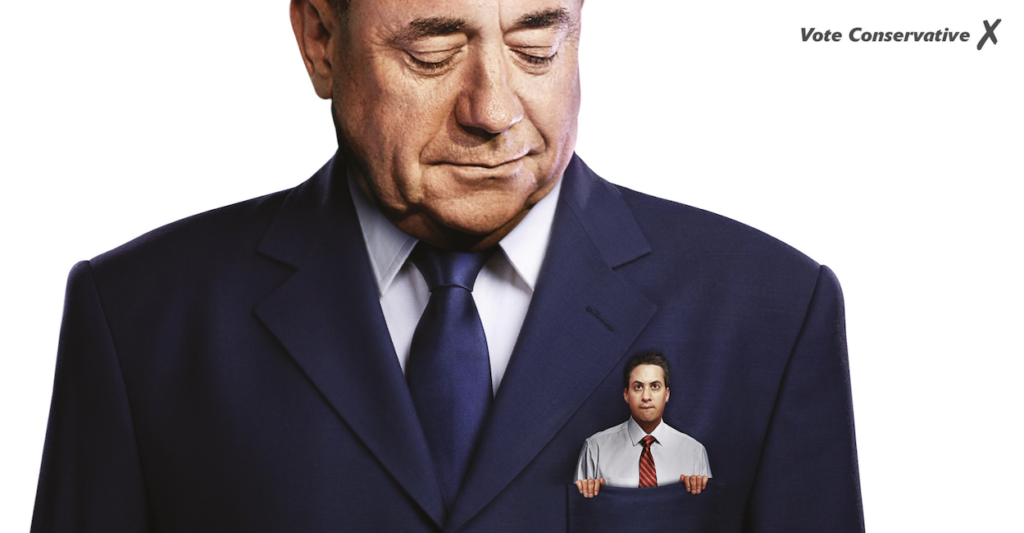
On 9 March 2015, the Conservative Party unveiled a campaign poster that became one of the most memorable images of the general election campaign. It depicted the Labour leader, Ed Miliband, peeking out of the top pocket of the former Scottish first minister, Alex Salmond.
The poster represented a central message of the wider Conservative electoral strategy: to warn voters in England that a minority Labour government could be held to ransom by the Scottish National Party (SNP).
***
The people of Scotland voted to remain part of the United Kingdom in the historic referendum on independence held on 18 September 2014. The ‘No’ campaign won with 2,001,926 votes (55.3%) against 1,617,989 votes (44.7%) for the ‘Yes’ campaign. The result was delivered on an exceptionally high national turnout of 84.6%.
Salmond, who led the pro-independence campaign as first minister of Scotland, resigned in the wake of the result. He was succeeded by his protégé and deputy first minister, Nicola Sturgeon.
Under Sturgeon’s leadership, the SNP surged in the polls ahead of the 2015 general election.
Simultaneously, a steady stream of surveys from all the major companies appeared to show the Conservative and Labour parties as effectively neck-and-neck. The prospect of a hung parliament (a repeat of the 2010 result) with Labour as the largest party – potentially reliant on the voters of smaller parties – was widely seen as a realistic outcome.
The Salmond-Miliband poster came just days after new polling, conducted by Conservative peer Lord Ashcroft, showed that the SNP were on track to take all but three of the 59 Westminster seats in Scotland.
The Conservatives sought to weaponise this possibility.
David Cameron, the incumbent prime minister, unveiled the famous pocket-themed poster in a post to Twitter (now X). “Alex Salmond with Ed Miliband in his pocket”, Cameron commented. “The frightening prospect we must avoid.”
https://x.com/David_Cameron/status/574852580246962177
The prime minister issued a larger comment in a complementary Facebook post.
He said: “Britain needs to wake up to a chilling and real prospect: Ed Miliband as prime minister, propped up by Alex Salmond who says he will call the tune.
“Again and again, Ed Miliband refuses to rule out this possibility. He is so weak, everyone knows he would be in Alex Salmond’s pocket. On every vote, every budget, every decision, the SNP would exact a high price for his support.
“Everyone in Britain will pay with higher taxes, more spending, more debt and weaker defences in dangerous times.”
***
The campaign was produced by the advertising agency M&C Saatchi.
Saatchi companies had worked on Conservative advertising campaigns on and off since 1978. Their most famous contribution came during the 1979 United Kingdom general election, when Saatchi & Saatchi curated the iconic “Labour Isn’t Working” poster for Margaret Thatcher.
In 1992, Saatchi and Saatchi’s “Double Whammy” poster for John Major’s Conservative campaign warned of “more taxes” and “higher prices” via two bright red boxing gloves. Saatchi & Saatchi also produced the controversial “demon eyes” poster targeting Tony Blair during the 1997 general election.
Commenting on Saatchi’s latest contribution to the pantheon of Tory attack-posters, Conservative chairman Grant Shapps said: “With Scottish voters fleeing Ed Miliband faster than Chris Hoy in a velodrome, he knows that a deal with the SNP is his only route to No 10.”
Shapps argued that at “once he’s in Alex Salmond’s pocket, weak Ed Miliband will give in to every demand.”
Salmond dismissed the poster and surrounding Conservative election campaign as “fundamentally stupid”
He added: “One thing I’ve learned in politics is you should never put your political opponents on your posters.”
However, the “Miliband in Salmond’s pocket” poster likely proved highly effective.
It crystallised a complex-sounding but plausible constitutional scenario into a simple image that cut through to the public. The poster sowed doubt in voters’ minds about the stability of a potential Labour government, exploiting English fears surrounding the influence of Scottish nationalism.
Shortly after the poster was released, the UK Independence Party (Ukip) produced a spoof version depicting Cameron in the pocket of EU commission president Jean-Claude Juncker.
https://x.com/Nigel_Farage/status/574907498987143168
***
The outcome of the general election defied almost all pre-election polling.
The Conservatives secured 330 seats, sufficient for a working majority of 12.
The Labour Party won just 232 seats, precipitating Miliband’s resignation as leader.
The SNP surge materialised in spectacular fashion. The party won 56 of the 59 seats in Scotland – almost entirely at Labour’s expense.

Politics.co.uk Newsletters
DAILY
Politics@Lunch
WEEKLY
Week in Review
