Bevan denounces unilateralism in ‘naked into the conference chamber’ speech
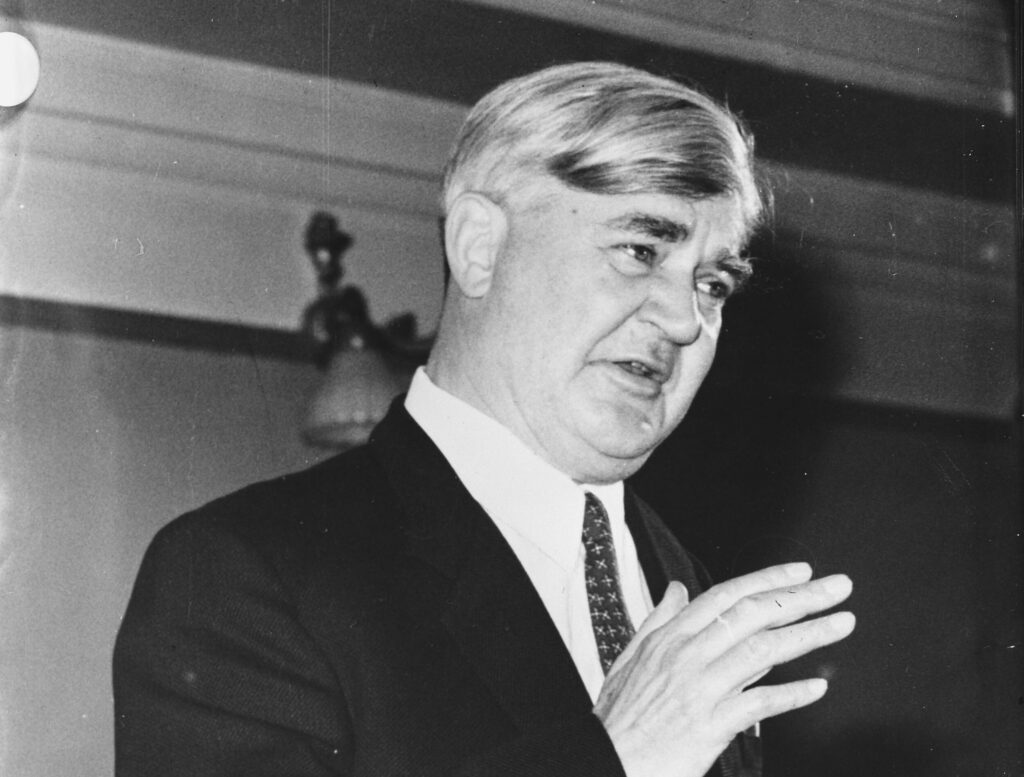
On 3 October 1957, Aneurin ‘Nye’ Bevan, the shadow foreign secretary and stalwart of the Labour left, called for the maintenance of Britain’s nuclear deterrent in a famous speech. The anti-unilateralist address, seen as a volte-face, stunned and angered his Bevanite disciples.
Bevan, credited with founding the National Health Service as health minister, resigned from Clement Attlee’s cabinet in 1951 to protest the introduction of NHS prescription charges. The policy was seen as necessary to fund the Korean war rearmament programme. He stood as the candidate of the left in the 1955 Labour Party leadership election, but lost decisively to Hugh Gaitskell.
Bevan also ran in the 1956 Labour Party deputy leadership election. He secured the support of 111 MPs – 30 less than Jim Griffiths.
In the 1950s, Labour was at war with itself over the issue of unilateral disarmament. A powerful grassroots movement, which would soon form the Campaign for Nuclear Disarmament (CND), pressed for a future Labour government to unconditionally give up its nuclear weapons.
At Labour’s Brighton conference in 1957, this demand came in the form of the unilateralist resolution 24.
The motion called on “the next Labour government to take the lead by itself refusing to test, manufacture, or use nuclear weapons, and that it will appeal to the peoples of the world to follow their lead.”
***
Bevan, appointed shadow foreign secretary in 1956 after reconciling with Gaitskell, was considered to be ideologically aligned with the resolution.
In a commons speech mere months earlier, in July 1957, Bevan had referred to nuclear weapons as instruments of “mutual suicide” that “are any longer means of national self-defence”. In March 1955, Bevan said he could not condone the use of nuclear weapons against those who only employed ‘conventional’ weapons.
In October 1957, however – in an electrifying address – the standard-bearer of the Labour left argued that “refusing to test, manufacture, or use nuclear weapons” would damage Britain’s interests, risking critical international alliances.
In the speech’s most famous passage, Bevan said unilateralism would send a British foreign secretary “naked into the conference chamber.”
He declared: “I knew this morning that I was going to make a speech that would offend and even hurt many of my friends. But you think I am afraid? I shall say what I believe, and I will give the guidance that I think is the true guidance.
“And I don’t care what happens, but I will tell you this: that in my opinion the immediate carrying out of resolution number 24… will do more to precipitate incidents that might easily lead to a third world war”.
Bevan told delegates: “I know that you are deeply convinced that the action you suggest is the most effective way of influencing international affairs.
“I am deeply convinced that you are wrong. It is therefore not a question of who is in favour of the hydrogen bomb, but a question of what is the most effective way of getting the damn thing destroyed. It is the most difficult of all problems facing mankind.
“But if you carry this resolution and follow out all its implications and do not run away from it you will send a British foreign secretary, whoever he was, naked into the conference chamber…
“He could make good sermons. But unilateral action of that sort is not necessarily the way in which you take the menace of this bomb from the world.”
These remarks provoked a series of heckles from Labour delegates.
Bevan responded: “What you are saying is that a British foreign secretary gets up in the United Nations, without consultation… without telling any members of the Commonwealth, without concerting with them, that the British Labour movement decides unilaterally that this country contracts out of all its commitments and obligations entered into with other countries and members of the Commonwealth – without consultation at all.
“And you call that statesmanship? I call it an emotional spasm.”
Bevan added: “I am begging and praying our comrades here to reconsider the demands they have made, because I agree that those who support resolution number 24 do it with complete sincerity. They do it because they believe that the resolution embodies their detestation of the bomb.
“But I am sure that in your secret hearts you will admit that you have not fully thought out the implications of that. You have not realised that the consequence of passing that resolution would be to drive Great Britain into a diplomatic purdah.”
He closed: “After a lot of agonising thinking, I am convinced – deeply convinced – that if resolution number 24 is adopted, with all the implications I have pointed out, it will very gravely embarrass a socialist government and may have disastrous consequences throughout the world.”
The speech dismayed Bevan’s disciples on the Labour left, but it was ultimately instrumental in defeating the unilateralist resolution 24.
The motion was rejected by 5,836,000 votes to 781,000 – a majority of eight to one.
His phrase “naked into the conference chamber” immediately entered the British political lexicon and emerged as a central point of contention in the national debate over nuclear weapons.
***
In a House of Commons debate on 20 February 1958, Bevan addressed his controversial conference comments.
He clarified that the remarks were not intended as a reference to the hydrogen bomb. “I do not believe that the possession of the hydrogen bomb is worthwhile from the point of view of negotiation”, he said, “because it has always been agreed that the possession of the hydrogen bomb can never be an instrument of negotiation.”
He added: “An instrument of suicide can never be an instrument of negotiation.”
The shadow foreign secretary undertook to further clarify his comments. He was insistent that his “naked” point referred to Britain’s need to maintain its alliances.
He said: “I repeat that when I said that we ought not to go naked into an international conference, I meant that we could not possibly throw aside all our allies, all our obligations and all our friends and negotiate with other nations, with Great Britain having no friends anywhere in the world…
“I make a clear distinction between renouncing a weapon on high moral grounds and renouncing it as a means of facilitating negotiation.”
Selwyn Lloyd, the foreign secretary, cited Bevan’s comments as evidence that a “bi-partisan position” now existed on the importance of Nato.
In a commons debate on 27 February 1958, Labour MP Frank Tomney referred to Bevan’s address in Brighton as “probably the greatest speech of his career”.
He said: “At Brighton this year the Labour Party conference, perhaps the most representative body of people in this country, decided by a majority of eight to one, after an interesting and detailed debate riddled with reason and passion, not to renounce Britain’s right to manufacture the hydrogen bomb.
“The man who was more successful than anybody in winning that vote was [Bevan] who, in what was probably the greatest speech of his career – and in very difficult circumstances, in view of his previous associations – persuaded the conference to that opinion in about half an hour.”
Other Labour MPs were less gushing in their references to Bevan’s speech.
Llywelyn Williams, the Labour MP for Cardiff West, speaking in the same debate, said Bevan’s address had “disappointed his friends and pleased other people”.
He accused Bevan of abandoning his principles, telling the House: “I never had the distinction of being what is called a ‘Bevanite’.
“I never belonged to that group of my honourable friends, although for most of the time my views coincided with theirs; but I believed in holding them when others had abandoned them.
“Consistency is, I know, no virtue in this House – it is a great handicap; I have only to glance at either frontbench to realise that.”
Konni Zilliacus, a left-wing Labour MP, said in July 1965: “That speech by Aneurin Bevan was one of the most unfortunate and unsuccessful that he ever made.
“He delivered it in an attempt to rally the party behind the official policy at Brighton. In a later speech, in February 1958… he took back all of that and said that one could not use the H-bomb in negotiations.”
***
Bevan’s forceful 1957 speech, therefore, by no means settled the argument over nuclear weapons in the Labour Party.
Michael Foot, a leading disciple of Bevan’s and his future biographer, broke with his mentor over the address. He would become a founding member of the CND when it was established the following month, November 1957.
Foot also played a prominent role in the Labour Party’s adoption of unilateralism at its 1960 Scarborough conference.
In October 1960, as Labour conference prepared to vote for unilateral disarmament, Gaitskell vowed to “fight, fight and fight again to save the party we love”.
He added: “We will fight and fight and fight again to bring back sanity and honesty and dignity, so that our movement with its great past may retain its glory and greatness.”
The 1983 Labour manifesto, famously referred to as the “longest suicide note in history”, committed the party to unilateral nuclear disarmament. It vowed a Labour government would “cancel the Trident [nuclear] programme”.
The manifesto foreword, penned by Foot in his capacity as leader, stated: “We are the only party that offers a non-nuclear defence policy.”
Foot’s successor as Labour leader, Neil Kinnock, retained the commitment to unilateralism in the 1987 manifesto. However, this policy was dropped in time for the 1992 election.
***
In 1959, Bevan was elected deputy leader of the Labour Party unopposed.
He died on 6 July 1960 from stomach cancer, aged 62.

Politics.co.uk Newsletters
DAILY
Politics@Lunch
WEEKLY
Week in Review