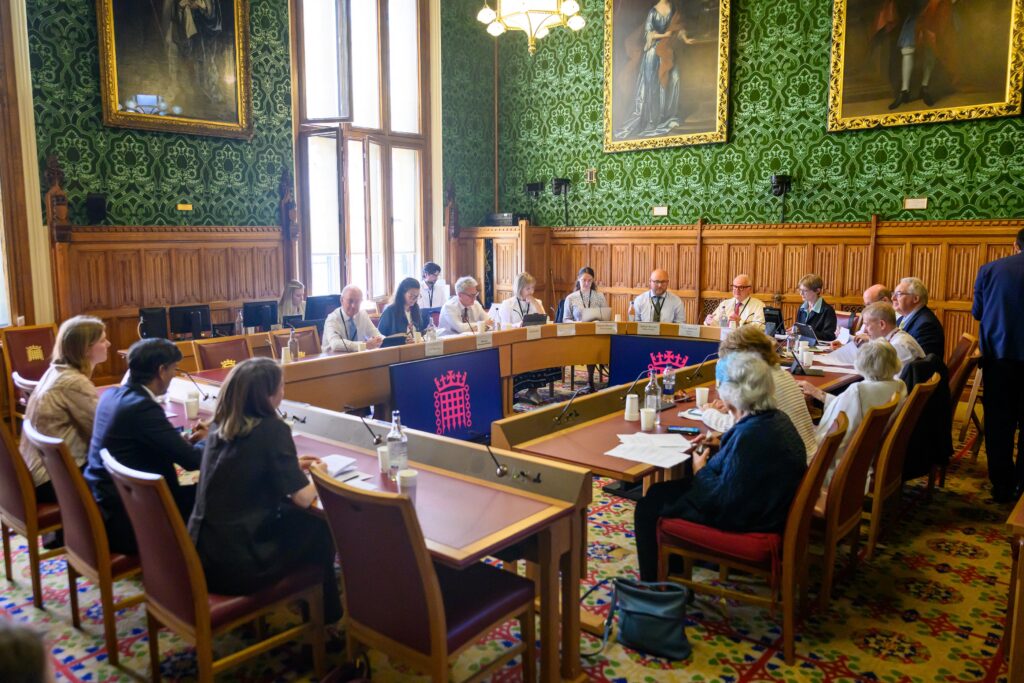
The select committees of the House of Lords are small, cross-party groups of peers. Most are appointed to scrutinise the government and investigate major public policy issues.
They are renowned for their in-depth, evidence-based reports and are a key mechanism through which the House of Lords holds the government to account.
Unlike the departmental select committees in the House of Commons, which shadow specific government departments, Lords committees typically have a broader, cross-cutting or “thematic” remit. They focus on major issues that span across multiple government departments, such as the constitution, the economy or international relations.
Why are House of Lords committees considered influential?
Members of committees in the House of Lords are often life peers with distinguished professional backgrounds. Many are leading figures in their fields, including retired senior judges, former cabinet ministers, eminent academics, scientists and business leaders. As a result, inquiries conducted by Lords committees are frequently informed by a high level of specialist expertise.
Evaluation question
How far does the specialist expertise found within Lords committees compensate for their lack of democratic legitimacy when scrutinising government policy?
Arguably, the “expertise” that exists in the House of Lords is most obvious and impactful when it comes to committee work.
Because Lords committees tend to attract less day-to-day media attention than their counterparts in the House of Commons, their scrutiny is often characterised as more detailed and technical. They are also generally regarded as less partisan. They have a reputation for working collaboratively.
The reports of House of Lords committees are debated in the House of Lords. And they must receive a response from the government.
The different types of Lords committee
Permanent committees
Permanent committees or sessional committees are appointed for the duration of a parliamentary session to examine broad policy areas. They are reappointed at the beginning of a new session.
These include:
- The constitution committee (established 2001)
- The economic affairs committee (established 2001)
- The international relations and defence committee (established 2016)
- The communications and digital committee (established 2013)
- The science and technology committee (established 1980)
The delegated powers and regulatory reform committee (DPRRC) examines all bills before they are debated by the Lords. It reports on whether a bill inappropriately delegates legislative power to government ministers.
The House of Lords secondary legislation scrutiny committee (SLSC) conducts a policy scrutiny of SIs. It is responsible for drawing the special attention of the House to any statutory instruments (the main form of secondary legislation) that it considers to be “politically or legally important”, controversial or which gives ministers inappropriate powers.
The SLSC publishes a report each week, flagging any suspect SIs. Its reports often form the basis for debates in the Lords chamber. The SLSC must report within two weeks of an SI being laid before parliament.
Special inquiry committees
These are ad-hoc committees set up for a single session to investigate a specific, topical issue.
Some examples include the home-based working committee, which was appointed to consider the effects and future development of home-based working in the UK, and the AI in weapon systems committee, which was appointed to consider the use of artificial intelligence in weapon systems.
The select committee on animals in scientific procedures was appointed by the House of Lords in March 2001 to conduct an inquiry into the use of animals in scientific procedures.
When such a committee has reported, it ceases to exist.
How Lords committees operate
Membership and composition
The members and chairs of Lords committees are appointed by the House upon a proposal by the committee of selection, with chairs either similarly proposed or left for committees to elect.
Committee membership varies from around 10 to 18. Generally, the membership of Lords committees is more flexible than their counterparts in the commons. Lords committees are also more flexible when it comes to their party-political composition. There is no formal rule on the political balance of committee membership.
The lack of a formal election process to committees (as is the case in the commons) means Lords committees can be constituted and reconstituted quickly.
In the case of most committees, a “rotation rule” operates, meaning peers who have been members of a committee for three years may not be reappointed in the following two calendar years. Each January the committee of selection recommends the names of members to be appointed to select committees in place of those who are to rotate off those committees.
Operation
Committees in the House of Lords have the power to appoint specialist advisers to assist with their inquiries. They may also travel or meet outside the parliamentary estate, including to gather evidence and as part of inquiries.
Once a committee has launched an inquiry, it will issue a public “call for evidence”, inviting written submissions from interested organisations and individuals.
The committee then holds a series of public evidence sessions, where it questions witnesses. These can include government ministers, civil servants, academics and other experts.
The committee on animals in scientific procedure, upon issuing a call for evidence, received responses from 100 organisations and over 350 individuals. The committee also took oral evidence from nearly 40 organisations and individuals between May 2001 and May 2002.
Like commons committees, their counterparts in the Lords have the power to “send for persons, papers and records.” Ordinarily, witnesses attend and documents are produced voluntarily. Refusal to attend in response to repeated formal summons is reported to the House as a “contempt” of parliament.
The committee will meet in private to discuss the evidence gathered. These meetings take place in parliament, in rooms on the committee corridor.
At the end of an inquiry, the committee publishes a detailed, evidence-based report containing its findings and a series of recommendations for action by the government. The government is expected to publish a formal response to the committee’s report, typically within two months.
The government’s response is also published.
Joint committees: collaboration between the commons and Lords
Joint committees are made up of MPs and peers (members of the House of Lords). There are permanent joint committees, including the joint committee on human rights and the joint committee on statutory instruments (JCSI), as well as temporary joint committees.
The joint human rights committee is responsible for examining matters relating to human rights within the United Kingdom, as well as scrutinising every government bill for its compatibility with human rights.
The JCSI checks whether a piece of secondary legislation (a statutory instrument) is legally sound. It examines if the SI complies with the powers given in its parent act (a piece of primary legislation) and if its drafting is clear. It may make recommendations regarding an SI if it identifies an issue.
Temporary joint committees are appointed for specific purposes. They may examine draft proposals for bills on subjects, ranging from modern slavery to stem cell research.
Joint committees appoint a single chair who may be a member of the commons or Lords.
Certain types of legislation are scrutinised in joint committees, such as consolidation bills. The joint committee of consolidation bills exists for this purpose. It considers bills which bring together a number of existing acts of parliament on the same subject into one act without amending the law.
What is a public bill committee? What’s the difference?
A public bill committee is composed of a small number of MPs with a specific interest in the bill. They are responsible for scrutinising a piece of proposed legislation as part of the parliamentary legislative process.
Additional resources
- House of Lords Youtube – Select Committees in the House of Lords: https://www.youtube.com/playlist?list=PLilBYVf0P9aZ2laTTD2GOaa1JzT-0F3KN
- What did Lords Select Committees do in 2023/24? https://ukparliament.shorthandstories.com/highlights-2023-24-liaison-lords-report/index.html?utm_source=committees.parliament.uk&utm_medium=referral&utm_campaign=liaison-2023-24-highlights-report&utm_content=launch-news-story

