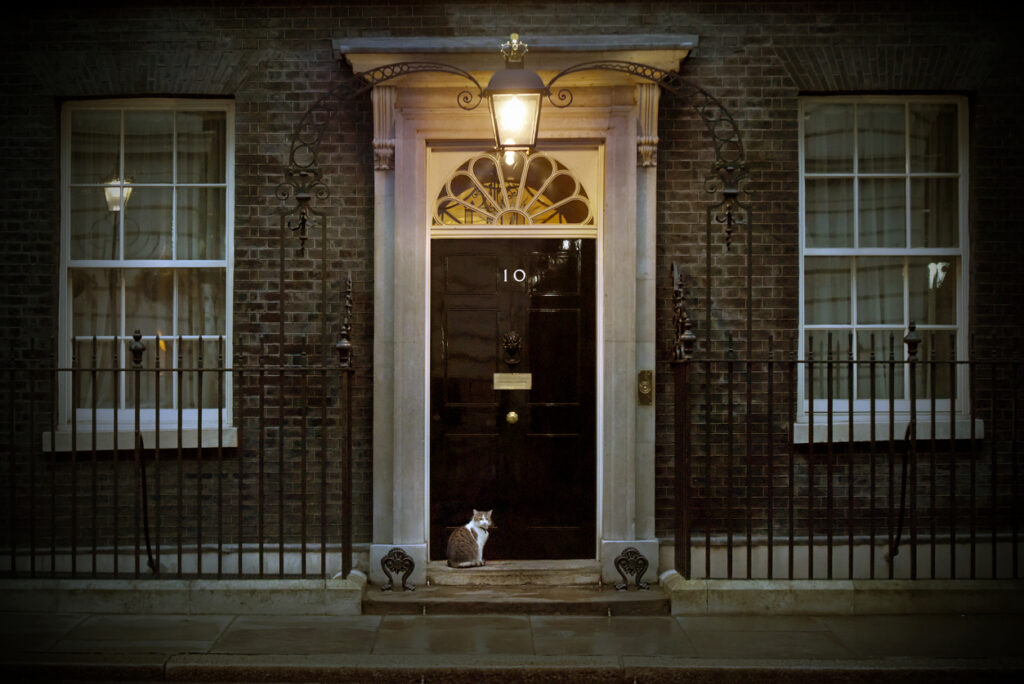
The prime minister’s official spokesperson is a senior civil servant responsible for communicating the official position of the government to the media.
The spokesperson is a politically impartial official who works at the heart of 10 Downing Street.
The role serves as a link between the Prime Minister’s Office and the accredited political journalists based in Westminster, known as the “Lobby”.
David Pares is the current spokesperson for the prime minister.
What does the prime minister’s official spokesperson do?
The prime minister’s official spokesperson’s most visible responsibility is conducting the daily Lobby briefings for Westminster journalists.
They also advise the prime minister and other officials on communication strategy and the handling of government announcements.
The lobby briefings
The core of the prime minister’s official spokesperson’s work is the daily briefing of the parliamentary press gallery.
Historically, the briefings were conducted twice each (commons) sitting day. The morning briefing typically looked ahead to the day’s government business; the afternoon briefing provided updates and responses to events that occurred during the day.
Held at 9 Downing Street, lobby briefings are on the record but not broadcast. Journalists can report the information given to them, but they cannot quote the spokesperson directly or name them as the source. Instead, they attribute the information to “the prime minister’s official spokesperson”, or simply “Downing Street” or “No 10”.
This convention means the spokesperson can provide guidance on the government’s thinking without becoming a public figure themselves.
Lobby briefings: controversies and reform
In December 2025, Tim Allan, then director of communications at Downing Street, unveiled plans to reduce the number of daily lobby briefings to one. On some occasions, this single briefing would be replaced entirely by a press conference.
During lobby briefings, journalists are typically free to ask unlimited questions on any subject. By contrast, government press conferences usually involve a restricted number of questions from a smaller, pre-selected group of journalists. It was also confirmed that attendance at press conferences would be broadened to include content creators.
Evaluation question
To what extent does the shift away from traditional lobby briefings towards controlled formats featuring “content creators” undermine the ability of the independent press to hold the government to account?
During Boris Johnson’s tenure as prime minister, the then Downing Street director of communications, Lee Cain, tried to exclude reporters from the Mirror, the i, HuffPost, PoliticsHome, the Independent and others from an official government briefing.
The lobby responded by boycotting the briefing on the UK’s trade negotiations with the EU, including senior journalists such as the BBC’s Laura Kuenssberg and ITV’s Robert Peston.
Boris Johnson’s failed (but consequential) experiment with televised briefings
In July 2020, the government of Boris Johnson announced plans to introduce White House-style, on-camera televised press briefings to be led by a new political press secretary, Allegra Stratton. Johnson argued that the daily televised Coronavirus briefings showed the public wanted more “direct engagement” with decision-makers.
A dedicated briefing room was built in 9 Downing Street at a reported cost of £2.6 million.
However, the plan was officially abandoned in April 2021 before a single on-camera briefing had taken place. The government stated it would retain the long-standing, off-camera Lobby briefing system.
The deputy Labour leader Angela Rayner responded: “Instead of wasting millions of pounds of taxpayers’ money on a pointless vanity project, the prime minister should have used the money to give our NHS heroes a pay rise.”
On 7 December 2021, ITV News broadcast a 47-second clip that showed Stratton joking about a Christmas party. Stratton, addressing a mock press conference, laughingly said that the party in question “was a business meeting and it was not socially distanced”. The report intensified the political crisis known as ‘Partygate’.
The damning recording was a rehearsal for Downing Street’s proposed daily TV media briefings.
The following day, Johnson told the commons that he was “furious to see” the clip of Stratton. He insisted that “the guidance was followed and the rules were followed at all times.”
Stratton was ultimately forced to resign as Downing Street press secretary.
In January 2025, it was announced that Keir Starmer, the prime minister, had the media room redecorated at a cost of up to £80,000, in order to make the blue room “politically neutral”. The blue panels which formed the backdrop to the press conference stage were replaced with wood panels.

