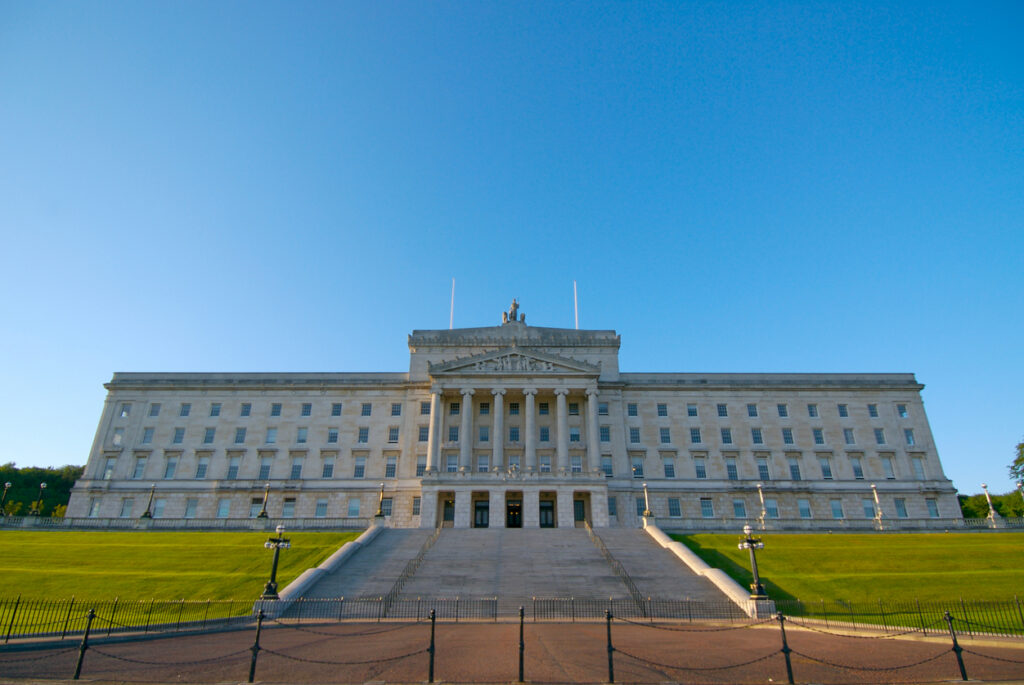
The Northern Ireland Assembly is the devolved legislature for Northern Ireland, established by the Belfast/Good Friday Agreement of 1998. Based at Parliament Buildings, Stormont, in Belfast, the Assembly has the power to legislate on a wide range of domestic matters and is responsible for appointing the power-sharing Northern Ireland Executive.
The assembly’s core feature is its mandatory cross-community power-sharing arrangement. The government, known as the executive, must be formed by both unionist and nationalist parties, ensuring that neither community can govern without the other.
After a two-year period of suspension, the assembly and its power-sharing executive were restored in February 2024.
How the Northern Ireland Assembly operates
The assembly has the power to make laws on a wide range of areas that are transferred to it from the parliament at Westminster, including health, education, agriculture, the environment and justice. Reserved matters, such as defence, immigration and foreign affairs, remain the responsibility of the UK Parliament.
The Northern Ireland executive is, in effect, a mandatory coalition government of the main unionist and nationalist parties.
Evaluation question
Is the mandatory power-sharing arrangement the only viable model for stable government in Northern Ireland, or is it a system that is inherently prone to collapse and deadlock when one major party withdraws its consent?
Each MLA designates themselves as “Nationalist”, “Unionist” or “other”. The Good Friday Agreement states: “At their first meeting, members of the assembly will register a designation of identity – nationalist, unionist or other – for the purposes of measuring cross-community support in assembly votes under the relevant provisions above.”
Representatives from the cross-community Alliance Party (APNI) designate themselves as “other”.
The government is jointly headed by a first minister and a deputy first minister, who have equal power. One must be from the largest unionist party and the other from the largest nationalist party.
Other ministerial positions, which head the various government departments, are allocated to political parties based on their strength in the assembly, using the d’Hondt mathematical formula. This ensures broad cross-party representation in government.
The assembly also has a number of statutory committees. The Northern Ireland Act 1998 requires that the assembly’s standing orders “make provision for establishing committees of members of the assembly (statutory committees) to advise and assist” ministers in the formulation of policy.
Temporary committees can also be established to deal with specific issues.
The cross-community vote
Most decisions of the Assembly are taken by a simple majority vote. But certain decisions of the Northern Ireland Assembly require cross-community support to pass, meaning they must be backed by a minimum number of MLAs from both the nationalist and unionist designations. Matters requiring cross-community support include the election of the chair of the assembly, the first minister and deputy first minister, standing orders and budget allocations.
Under the petition of concern (PoC) mechanism, 30 MLAs can petition the assembly requiring a matter to be passed on a cross-community rather than a simple majority basis.
According to the Belfast/Good Friday Agreement, it is one of the “safeguards” set out in strand one as a mechanism “to ensure key decisions are taken on cross-community basis”.
The Good Friday Agreement states: “Key decisions requiring cross-community support will be designated in advance, including election of the chair of the assembly, the first minister and deputy first minister, standing orders and budget allocations. In other cases such decisions could be triggered by a petition of concern brought by a significant minority of assembly members 30/108.”
If a petition is successfully triggered, a measure can only pass if it receives support from:
- A majority of the members voting, including a majority of the designated unionists and a majority of the designated nationalists; or
- 60% of the members voting, including at least 40% of the designated unionists and 40% of the designated nationalists.
Northern Ireland Assembly elections
The 90 Members of the Legislative Assembly (MLAs) are elected using the single transferable vote (STV) system of proportional representation, which is designed to ensure that the composition of the assembly reflects the votes cast for all parties. They represent 18 different constituencies; each constituency is represented by 5 MLAs.
Elections to the Northern Ireland Assembly are generally held every five years. Under the Northern Ireland (Ministers, Elections and Petitions of Concern) Act 2022, the parties are given 24 weeks to form an executive (following an election or in the event the executive collapses), before the secretary of state for Northern Ireland is compelled to propose a date for an election.
The most recent election to the Northern Ireland Assembly was held in May 2022. The results were as follows:
- Sinn Féin: 27 seats
- Democratic Unionist Party (DUP): 25 seats
- Alliance Party: 17 seats
- Ulster Unionist Party (UUP): 9 seats
- Social Democratic and Labour Party (SDLP): 8 seats
- Traditional Unionist Voice (TUV): 1 seat
- People Before Profit: 1 seat
- Independent: 2 seats
The Northern Ireland Act 1998 originally provided that, unless the assembly was dissolved early, elections would take place every four years on the first Thursday in May. This was changed by the Northern Ireland (Miscellaneous Provisions) Act 2014, which aligned the assembly with the other devolved legislatures by extending its fixed term from four to five years.
Northern Ireland Assembly: legislative process
The Northern Ireland Assembly has the power to pass primary legislation, known as acts of the Northern Ireland Assembly, on all “transferred” matters.
The legislative process is broadly similar to that of the parliament at Westminster. In its first stage, the bill is introduced to the assembly. No debate or vote takes place at this stage; the bill is simply read out and made available to members and the public.
The first substantive debate on the general principles of the bill takes place at second stage. If the bill passes this stage, it moves to the committee stage. The bill is then referred to the appropriate statutory committee. The committee carries out a detailed scrutiny of the bill, before publishing a report suggesting amendments.
The bill returns to the full assembly for its consideration stage. Members debate and vote on each individual clause and any proposed amendments. The further consideration stage provides a final opportunity for members to propose and vote on further amendments to the bill.
The assembly then debates and votes on the bill in its final form. Any bill passed by the assembly is referred to the attorney general for Northern Ireland and the advocate general for Northern Ireland (a position held ex officio by the attorney general for England and Wales).
The attorney general is required to decide whether to refer to the supreme court the question of whether a provision of the bill falls within the legislative competence of the assembly.
If the supreme court decides, following a referral by the attorney general, that a provision of the bill is not within the legislative competence of the assembly, MLAs reconsider the bill and proposed amendments (reconsideration stage).
Following all its stages, the bill is sent for royal assent.
What is the Stormont brake?
Under the Windsor framework, agreed in March 2023, a new mechanism known as the Stormont brake was introduced. This allows a group of 30 MLAs from at least two parties to object to the application of new or amended EU rules in Northern Ireland.
The MLAs who wish to utilise the brake must demonstrate that it being used in the “most exceptional circumstances and as a last resort”, and that the proposed measure “would have a significant impact specific to everyday life of communities in Northern Ireland in a way that is liable to persist”.
The UK government may then reject the proposed measure in negotiations with the EU.
What are legislative consent motions (LCMs)?
Occasionally, the parliament at Westminster may wish to legislate on a matter that is devolved to Northern Ireland. This approval is sought through a legislative consent motion (LCM). The devolved government will introduce an LCM, which is then debated and voted on by its members.
If the motion is passed, consent is granted. If it is voted down, consent is withheld.
This procedure follows the Sewel convention, which states that the parliament at Westminster “would not normally legislate with regard to devolved matters except with the agreement of the devolved legislature.”
The speaker of the Northern Ireland Assembly
The speaker of the Northern Ireland Assembly is the presiding officer of the legislature, responsible for chairing debates, maintaining order and representing the assembly in its official dealings.
The speaker is elected by the assembly at its first sitting following a general election. Unlike the speaker of the House of Commons, who is elected by a secret ballot of all MPs, the speaker of the Northern Ireland Assembly must be elected on a cross-community basis. This means the successful candidate must receive the support of a majority of the designated unionist members and a majority of the designated nationalist members present and voting.
Upon election, the speaker is required to act with complete impartiality. Upon election the speaker must relinquish all party political affiliations. While they remain an MLA for their constituency, they do not participate in debates or vote on assembly business, except in the event of a tie.
The speaker is supported in their duties by three deputy speakers, who are also elected by the assembly. The speaker and the deputy speakers are typically drawn from across the different traditions represented in the assembly.
The current speaker of the Northern Ireland Assembly is Edwin Poots, a member of the Democratic Unionist Party (DUP).
Upon his election, Poots stated: “I do look forward to working with all of you in this assembly. There is so much to do, for the public. I hope that this assembly will move forward together. We are mindful of the huge range of issues that are out there.”
The speaker also chairs the Assembly Commission, the body responsible for providing the assembly with the property, staff and services required for its operation.
Previous speakers of the Northern Ireland Assembly include:
- Lord Alderdice (1998-2004): member of the Alliance Party.
- Eileen Bell (2007): Alliance Party (transitional speaker)
- William Hay (2007-2014): DUP.
- Mitchel McLaughlin (2015-2016): Sinn Féin.
- Robin Newton (2016-2020): DUP.
- Alex Maskey (2020-2024): Sinn Féin.
History of the Northern Ireland Assembly
Ireland, home rule and crisis (1886-1922)
Following the defeat of the first two Gladstonian home rule bills in 1886 and 1893, the Conservative and Unionist governments under the Marquess of Salisbury and Arthur Balfour pursued a policy of “killing home rule with kindness”.
The 1906 general election returned the Liberals to government after an extended period in the wilderness. The January 1910 and December 1910 general elections, which resulted in hung parliaments, placed home rule firmly on the political agenda. The Irish Parliamentary Party (IPP), led by John Redmond, once again held the balance of power.
The Parliament Act 1911, the controversial subject of the 1910 general elections, meant that Irish self-government was now a realisable prospect. The legislation replaced the House of Lords ‘veto’ with a power to delay bills for a maximum of two years spread over three parliamentary sessions. The Lords, dominated by Conservative and Unionist peers, had thwarted Gladstone’s Second Home Rule Bill by 419 votes to 41.
The Third Home Rule Bill, introduced by Liberal prime minister H.H. Asquith in April 1912, provided for limited Irish self-government by way of a Dublin-based bicameral parliament, consisting of a 164-member House of Commons and a 40-member senate. The proposed legislature would be invested with powers to deal with most national affairs, but the UK parliament would also retain authority “over all persons, matters, and things in Ireland”.
The 1912 to 1914 period had a transformative effect on the character of Irish unionism.
The opponents of home rule had largely retreated to the nine counties of Ulster, where the island’s protestant minority was most heavily concentrated. On 28 September 1912, ‘Ulster Day’, over 500,000 unionist (218,206 men and 234,046 women) signed the Ulster Covenant, vowing to use “all means which may be found necessary to defeat the present conspiracy to set up a Home Rule Parliament in Ireland”.
The home rule crisis was overtaken by developments on the continent. The Third Home Rule Bill, which became the Government of Ireland Act 1914, was successively suspended in a series of six month periods until 1920, when it was repealed by new home rule legislation.
On 21 January 1919, Dáil Éireann convened at Mansion House in Dublin and declared Irish independence. The Dáil was composed of 69 Sinn Féin MPs elected in the 1918 United Kingdom general election.
The Government of Ireland Act 1920, or Fourth Home Rule Bill, recognised what would become Northern Ireland (six north-eastern counties in Ulster) and the south of Ireland (the 32 counties that would later constitute the Irish free state). The act envisioned that both polities would exercise self-government in the United Kingdom as “Northern Ireland” and “Southern Ireland”.
Elections were held on 24 May 1921 to these assemblies. Irish republicans used the elections collectively to constitute the second Dáil.
The Irish War of Independence (1919-1921) ultimately resulted in the Anglo-Irish Treaty 1921 and the Irish Free State Constitution Act 1922. Instead of a sovereign republic, the treaty provided for dominion status, which meant Ireland would remain in the British Empire. Members of the Dáil would be required to swear allegiance to “King George V, his heirs and successors”.
Northern Ireland had the option to opt in or out of the Irish Free State. The unionist government, led by James Craig as prime minister, chose the latter option.
On 7 December 1922, the parliament of Northern Ireland agreed on the wording of the following message: “We, your Majesty’s most dutiful and loyal subjects, the Senators and Commons of Northern Ireland in Parliament assembled, having learnt of the passing of the Irish Free State Constitution Act, 1922… do, by this humble Address, pray your Majesty that the powers of the Parliament and Government of the Irish Free State shall no longer extend to Northern Ireland.”
Direct rule: Stormont suspended (1972)
On 30 March 1972, the UK government formally suspended the parliament of Northern Ireland and imposed direct rule from Westminster – a decision aimed at containing the escalating violence of the Troubles. The move, enacted through the Northern Ireland (Temporary Provisions) Act, ended 51 years of devolved unionist-led government from Stormont.
The decision marked the culmination of a political crisis between London and Belfast over the deteriorating security situation in Northern Ireland. The security policy of internment without trial, introduced in 1971, had caused huge resentment within the nationalist community. Following the events of Bloody Sunday on 30 January when British soldiers shot 26 unarmed civilians, the Conservative prime minister, Edward Heath, concluded that his government should take full responsibility for law and order in Northern Ireland to have any chance of finding a political solution.
The Stormont prime minister, Brian Faulkner, was summoned to London on 24 March 1972. Stormont met for the final time on 28 March 1972. Faulkner, leader of the Ulster Unionist Party (UUP), marked the occasion with an address to a crowd of around 100,000 people from the first-floor balcony of parliament buildings.
On 8 March 1973, Northern Ireland held its first referendum on its constitutional status – a “border poll” that resulted in an overwhelming, but in effect meaningless, vote to remain part of the United Kingdom. The poll, which represented the first time that a major referendum had been held in any region of the United Kingdom, was marked by a mass boycott from the nationalist community. It duly produced an almost unanimous majority vote in favour of maintaining the Union with Britain.
Sunningdale and attempts to restore self-government (1973-c.1990)
The border poll was followed by a white paper, Northern Ireland Constitutional Proposals, published on 20 March 1973. It proposed a devolved power-sharing assembly in Northern Ireland and a ‘Council of Ireland’ to consider cross-border matters with the Republic of Ireland.
The new Northern Ireland assembly, created by the ‘Sunningdale Agreement’, met for the first time on 31 July 1973.
The power-sharing Sunningdale executive, which brought together moderate unionists, the nationalist Social Democratic Labour Party (SDLP), and the cross-community Alliance (APNI), took office on 1 January 1974.
Faulkner led the Sunningdale negotiations on behalf of the UUP, and was appointed as chief executive of Northern Ireland under the scheme.
However, the agreement’s cross-border element was fiercely opposed by loyalists and hardline unionist politicians, led by Harry West, Ian Paisley and William Craig, who viewed it as a step towards a united Ireland. The so-called ‘Dublin-dimension’, it was feared, would see the unionist community “trundled into a United Ireland”.
In January 1974, Faulkner was deposed as leader of the UUP, and replaced by the anti-Sunningdale Harry West.
At the February 1974 general election, eleven United Ulster Unionist Council (UUUC) MPs were returned. The UUUC, which comprised unionist opponents of the Sunningdale Agreement, secured the vast majority of Northern Ireland’s available seats (11 out of 12). The campaign slogan of the UUUC, “Dublin is just a Sunningdale away”, captured the concerns of the region’s unionist community.
On 14 May, a motion condemning the cross-border Council of Ireland was defeated in the Sunningdale assembly by 44 votes to 28. A coalition of loyalist paramilitaries and workers, known as the Ulster Workers’ Council (UWC), responded by calling a general strike to begin the following day. The strike brought Northern Ireland to a standstill. UWC barricades blocked roads, and intimidation was used to stop people from going to work. Most critically, electricity supplies were also disrupted with rotating four-hourly power cuts.
On 28 May, with Northern Ireland crippled by the UWC strike, Faulkner and his unionist colleagues resigned from the Sunningdale executive. The power-sharing body, having failed to win cross-community support, collapsed. The assembly itself was prorogued on 30 May, but not officially abolished until 29 March 1975. Responsibility for the government of Northern Ireland thus reverted to the British parliament under the arrangements for direct rule.
The unity of anti-Sunningdale action effectively killed the prospect of power-sharing for the best part of three decades. The Northern Ireland Constitutional Convention (1975) and a second Northern Ireland Assembly (1982-86) proved unsustainable solutions to the region’s political and security situation.
The Good Friday Agreement (1998)
On 10 April 1998, Good Friday, after marathon all-party talks in Belfast, a historic peace accord for Northern Ireland was finally reached. The Good Friday Agreement (GFA), also known as the Belfast Agreement, established a new political framework designed to end 30 years of violent conflict and create a lasting and inclusive settlement.
The deal, which had been brokered by the British and Irish governments and chaired by the US special envoy, senator George Mitchell, was the culmination of years of complex and often fraught negotiations.
Its central pillar was the creation of a new, devolved Northern Ireland Assembly and a power-sharing executive, inviting unionists and nationalists to govern together.
The GFA reads: “This agreement provides for a democratically elected Assembly in Northern Ireland which is inclusive in its membership, capable of exercising executive and legislative authority, and subject to safeguards to protect the rights and interests of all sides of the community.”
The assembly, elected under the single transferable vote (STV) system, was originally made up of 108 members. (This was reduced to 90 in 2017).
Under the terms of the agreement, MLAs (members of the legislative assembly) needed to “designate” themselves as either “nationalist, unionist or other”. This is to ensure cross-community support for key decisions. The assembly executive, meanwhile, is led by the first minister and deputy first minister, leaders of the largest nationalist and unionist.
The agreement was underpinned by the crucial “principle of consent”, affirming that Northern Ireland would remain part of the UK for as long as a majority of its people wished, while also acknowledging the legitimacy of the aspiration for a united Ireland.
The accord established a new ‘North-South’ ministerial council to “bring together those with executive responsibilities in Northern Ireland and the Irish Government” in order to “exchange information, discuss and consult with a view to co-operation on matters of mutual interest”.
The GFA provided for ‘East-West’ co-operation in the form of the British-Irish Council (BIC). The purpose of the BIC, outlined in the accord, is to “exchange information, discuss, consult and use best endeavours to reach agreement on co-operation on matters of mutual interest”.
The Northern Ireland measures, together with the North-South and East-West dimensions, made up the three “strands” of the agreement. The wide-ranging agreement also included commitments on paramilitary decommissioning, policing reform, and the release of prisoners.
The outcome was a triumph for Tony Blair, the UK prime minister, and Bertie Ahern, the Irish Taoiseach.
In Northern Ireland, the agreement was spearheaded by the Ulster Unionist Party (UUP) leader, David Trimble, and the Social Democratic and Labour Party (SDLP) leader, John Hume. The two leaders jointly won the 1998 Nobel Peace Prize.
The deal was subsequently endorsed in referendums in both Northern Ireland and the Republic of Ireland. It was endorsed by 71% of the vote in Northern Ireland and 94% in the Republic.
The first elections to the Northern Ireland assembly took place on 25 June 1998. The results were as follows:
- Ulster Unionist Party: 28
- Social Democratic and Labour Party: 24
- Democratic Unionist Party: 20
- Sinn Féin: 18
- Alliance Party: 6
- United Kingdom Unionists: 5
- Progressive Unionist Party: 2
- Northern Ireland Women’s Coalition: 2
- Others: 3
As in previous decades, the Democratic Unionist Party remained the primary political vehicle for unionists opposed to power-sharing.
The assembly met for the first time on 1 July 1998; Trimble and SDLP deputy leader Seamus Mallon were elected as first minister and deputy first minister respectively. A devolution order was approved at Westminster on 30 November 1999, which transferred the bulk of the Northern Ireland Office’s functions to the assembly on 2 December 1999. Devolution gave the assembly and executive full legislative and executive authority in Northern Ireland over agriculture, economic development, education, the environment, health and social services.
The secretary of state for Northern Ireland retained responsibility for policing, security, prisons, criminal justice, international relations, taxation, national insurance, regulation of financial services, telecommunications and broadcasting, in addition to representing the interests of the province in the cabinet at Westminster.
Subsequently, powers relating to responsibility for policing and justice were transferred to the assembly in April 2010 under the Hillsborough Agreement.
The Northern Ireland Assembly was suspended on 14 October 2002, following allegations about an IRA spy-ring within Stormont. The assembly had been suspended on previous occasions because the unionist parties refused to participate without additional reassurances about the republicans’ renunciation of violence.
The DUP emerged as the largest unionist party in the 2003 Northern Ireland Assembly election. Sinn Féin simultaneously supplanted the SDLP as the predominant representative of nationalism in Northern Ireland.
The St Andrews Agreement (2006-2007)
On 26 March 2007, in a moment of immense historical significance, the leaders of the DUP and Sinn Féin, Ian Paisley and Gerry Adams respectively, sat alongside each other for the first time and publicly announced their agreement to form a power-sharing government in Northern Ireland.
The private negotiating session that preceded the announcement was the first time the two parties had ever held direct talks. A target date of 8 May was set for the restoration of devolved government – which had been suspended for five years.
The Northern Ireland (St Andrews Agreement) Act 2006 stated that, in the wake of an assembly election on 7 March 2007, ministerial offices to be held by Northern Ireland Ministers should be apportioned by 26 March. The meeting of Paisley and Adams, therefore, came just hours ahead of the deadline set out by the British and Irish governments. In the event that Paisley and Adams could not come to an agreement, the act outlined the result: the indefinite suspension of the devolved institutions.
Announcing the deal at a news conference, Paisley declared: “Our goal has been to see devolution returned in a context where it can make a real, meaningful improvement in the lives of all the people of this part of the United Kingdom.
“On Saturday, the DUP executive overwhelmingly endorsed a motion committing our party to support and participate fully in government in May of this year — this is a binding resolution.”
On 8 May 2007, Paisley was sworn in as first minister and Sinn Féin’s Martin McGuinness as deputy first minister, ushering in a new era of devolved government.
On 8 December, during a meeting with US president George W Bush in the White House, McGuinness told the press: “Up until the 26 March this year, Ian Paisley and I never had a conversation about anything – not even about the weather – and now we have worked very closely together over the last seven months and there’s been no angry words between us.
“This shows we are set for a new course.”
This move cemented the DUP’s transition from a party of protest to a party of government.
The DUP’s influence peaked at Westminster a decade later, when its 10 MPs entered a confidence and supply agreement with Theresa May’s Conservative government after the 2017 general election.
The Northern Ireland Assembly was suspended again from January 2017 to January 2020.
This suspension occurred in the aftermath of the Renewable Heat Incentive scandal, and the resignation of McGuiness as deputy first minister. Sinn Féin subsequently withdrew from the assembly and without the formation of a new executive, decisions over Northern Ireland affairs reverted to Westminster.
Following talks between the parties, the assembly resumed in January 2020.
Northern Ireland’s first nationalist first minister (2022-)
In February 2022, the Democratic Unionist Party withdrew its first minister from the executive, collapsing the power-sharing institutions. This action was taken in protest against the post-Brexit trading arrangements known as the Northern Ireland Protocol, which the DUP argued undermined Northern Ireland’s place within the United Kingdom.
The impasse finally broke in late January 2024 after the DUP’s party executive voted to accept a deal with the UK government. The agreement, detailed in a command paper titled Safeguarding the Union, included measures to reduce checks and paperwork on goods moving from Great Britain to Northern Ireland. Some hardline unionists, including Jim Allister of the Traditional Unionist Voice (TUV) party, remained implacably opposed to restoring power-sharing arrangements.
On 3 February 2024, devolved government in Northern Ireland was restored following a two-year political stalemate. The restoration of the power-sharing arrangements resulted in Michelle O’Neill’s appointment as first minister. O’Neill of Sinn Féin became the first nationalist to hold the post since the creation of Northern Ireland in 1921.
Emma Little-Pengelly of the Democratic Unionist Party (DUP) was appointed as deputy first minister.
O’Neill’s appointment also followed the 2022 Northern Ireland Assembly election, which returned Sinn Féin as the largest party. It marked the first time that an Irish nationalist party won the most seats in an assembly election. The DUP’s vote share fell by almost 7%. Sinn Féin’s victory meant the party had the right to nominate O’Neill as first minister under the power-sharing arrangements agreed in 1998.
In her first speech as first minister, O’Neill said her appointment would open “the door to a future – a shared future.”
She added: “We mark a moment of equality and a moment of progress, a new opportunity to work and to grow together, confident in the idea that, wherever we come from and whatever our aspirations, we can and must build our future together…
“As an Irish republican, I pledge cooperation and genuine honest effort with all those colleagues of the British and unionist tradition who cherish the Union. This is an assembly for all: Catholic, Protestant and dissenter.
“Despite our different outlooks and different views on the future constitutional position, the public rightly demand that we work and deliver together, and also that we build trust and confidence in our ability to collectively do that.
“That will require courage and ambition, not just from those of us who are elected but from the public. We should all invest in this. The more of us who do that, the better chance it has to succeed.”
She referred to the Good Friday Agreement as the culmination of a process of “political accommodation that provided a peaceful and democratic alternative to 30 years of conflict.”
O’Neill, who was 20 years old at the time of the agreement, recalled “the sense of hope and that real feeling of optimism.”
She said that there was no doubt that “our society has been fundamentally transformed because of our peace process.”
She continued: “I stand here, an elected first minister, proud as someone who represents that Good Friday Agreement generation and someone who will lead us into the next 25 years. I am also an Ulster woman, a Tyrone woman and a deeply proud Irish and European citizen…
“This is an historic day, and it represents a new dawn. For the very first time, a nationalist takes up the position of first minister. That such a day would come was unimaginable to my parents and grandparents’ generation, but, because of the Good Friday Agreement, that old state that they were born into is gone and a more democratic and equal society exists.
“This is now a better place for all of us. This place that we call “home” and which we all love – the North of Ireland, Northern Ireland – where you can be British, Irish, both or none, is all a changing portrait.
“Yesterday is gone. Today is a new day, and my appointment today reflects the change that is happening.”
Quotes
“I, David Trimble, affirm to the Assembly my commitment to non-violence and exclusively peaceful and democratic means, my opposition to any use or threat of force by others for any political purpose, my commitment to work in good faith to bring into being the arrangements set out in the agreement reached in the multi-party negotiations on 10 April 1998 and my commitment to observe the spirit of the Pledge of Office.” – David Trimble, being sworn in as Northern Ireland’s first minister, (July 1998).
“The refusal of Arlene Foster to recognise the public anger or to exhibit any humility in the context of the RHI scandal is indicative of a deep-seated arrogance, which is inflicting enormous damage on the executive, the assembly and the entire body politic.” – Martin McGuinness, writing in his resignation letter in the wake of the Renewable Heat Incentive scandal, (January 2017).
“Today’s agreement is written in the language of laws and treaties. But really, it’s about much more than that. It’s about stability in Northern Ireland. It’s about real people and real businesses. It’s about showing that our Union, that has lasted for centuries, can and will endure. And it’s about breaking down the barriers between us. Setting aside the arguments that for too long, have divided us. And remembering the fellow feeling that defines us: This family of nations – this United Kingdom.” – Rishi Sunak, announcing the Windsor framework, the deal that helped restore power-sharing (February 2023).
Additional resources
- The Northern Ireland Assembly: http://www.niassembly.gov.uk/
- The Northern Ireland Executive: https://www.northernireland.gov.uk/

