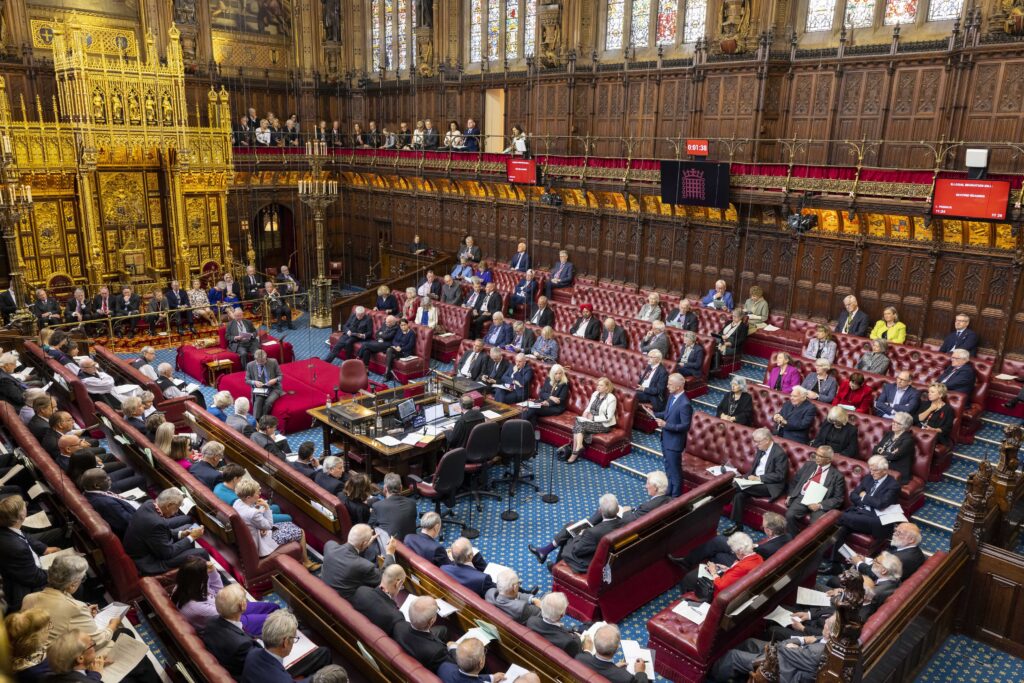
The leader of the House of Lords is the government minister responsible for the passage of government business through the House of Lords. The role is a senior one, with the holder being a member of the cabinet and the principal representative of the government in the Upper House.
While they are a political appointee who heads the government’s team of ministers and whips in the Lords, the leader also has a wider responsibility to the House as a whole, including advising on procedure and upholding its traditions of self-regulation.
The current leader of the House of Lords is Baroness Smith of Basildon, who also holds the historic title of lord keeper of the privy seal.
The role and duties of the leader of the House
The leader of the House of Lords has a dual function, serving both the government of the day and the House as a whole.
Role as a government minister
The leader’s core function is to manage the flow of government legislation and debates in the Lords. This involves negotiating the parliamentary timetable to ensure that all stages of a bill are completed and that the government’s agenda is delivered. This is a particularly challenging role in the upper chamber as no government in the modern era has a majority in the House of Lords.
The leader also represents the government at the highest level in the chamber. A key duty is to repeat any oral statements made by the prime minister in the House of Commons to the House of Lords, and to answer questions on them.
Additionally, as a member of the cabinet, the leader represents the views and concerns of the House of Lords within the government’s central decision-making body.
Role as a servant of the House
The House of Lords is a self-regulating chamber, meaning the lord speaker has no power to call members to order. The leader of the House is responsible for guiding peers and reminding them of the rules and conventions of the House, helping to maintain order. The leader may be called upon to advise on procedure and assist when disputes arise. The 2025 issue of the‘Companion to the standing orders’ explains that because “the lord speaker has no powers to rule on matters of procedure, the leader also advises the House on procedure and order, and is responsible for drawing attention to violations or abuse”.
The leader serves as the representative of the Lords on formal occasions.
When the prime minister sat in the House of Lords – as was common until the early 20th century – they typically also served as leader of the House of Lords. The Marquess of Salisbury, who left office in 1902, was the last prime minister to sit in the Lords.
The ‘usual channels’
Much of the leader’s work is conducted through informal negotiation with other parties, a process known as the “usual channels”. In the upper chamber, this involves discussions between the leader of the House, the government chief whip, and their counterparts in the other party groups as well as the convenor of the crossbench peers.
These discussions are crucial for the smooth running of parliament and the passage of legislation. They allow for agreements to be reached on the timetabling of debates and the allocation of time for contentious legislation, sometimes preventing otherwise protracted procedural battles on the floor of the House.
The Office of the Leader of the House of Lords
The leader of the House is supported by a small government department, the Office of the Leader of the House of Lords, which is based in the Cabinet Office. They are also supported by a Deputy Leader of the House of Lords, who is a more junior minister.
The official description of the OLHC’s duties states: “We provide support to the Leader of the House of Lords. The leader of the House is appointed by the prime minister, is a member of cabinet, and is responsible for the conduct of government business in the Lords.
“The leader advises the House on procedure and order, and she and her office are available to assist and advise all members of the House.”
Leader of the House of Commons
A parallel role exists in the lower chamber. The leader of the House of Commons is the government minister responsible for arranging government business in that House.
Recent leaders of the House of Lords
- The Baroness Smith of Basildon (2024 – Present)
- The Lord True (2022 – 2024)
- The Baroness Evans of Bowes Park (2016 – 2022)
- The Baroness Stowell of Beeston (2014 – 2016)
- The Lord Hill of Oareford (2013 – 2014)
Additional resources
- GOV.UK – Office of the Leader of the House of Lords: https://www.gov.uk/government/organisations/office-of-the-leader-of-the-house-of-lords
- GOV.UK – Leader of the House of Lords: https://www.gov.uk/government/ministers/leader-of-the-house-of-lords
- Hansard Society – Opening Up The Usual Channels: https://www.hansardsociety.org.uk/publications/reports/opening-up-the-usual-channels