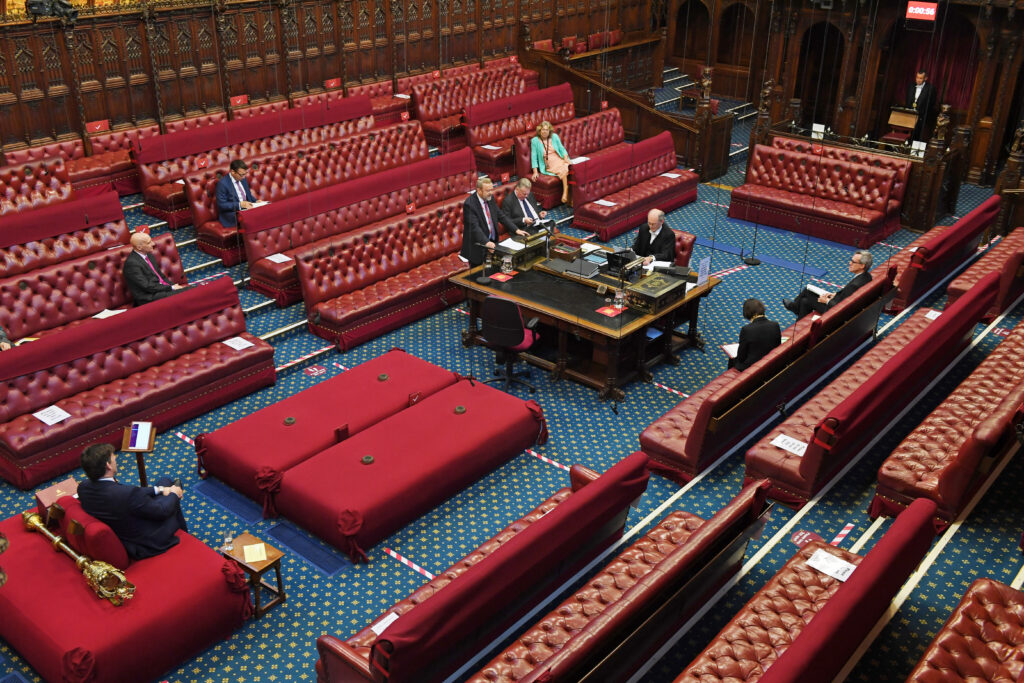
The sitting hours of the House of Lords are governed by a combination of formal rules and conventions. Unlike the House of Commons, the Lords’ daily timetable is generally more flexible, with no fixed time at which proceedings must end. The House will sit for as long as is necessary to complete the business scheduled for that day.
The working year of the House is punctuated by several parliamentary recesses.
The standard weekly timetable
When parliament is sitting, the House of Lords typically meets from Monday to Thursday. The standard start times for business are:
- Monday: 2:30 pm
- Tuesday: 2:30 pm
- Wednesday: 3:00 pm
- Thursday: 11:00 am
The House usually sits until 10:00-11:00 pm. But a sitting can continue until much later and sometimes long into the night.
The House of Lords does not sit every Friday. When it does, business usually begins at 10:00 am. These sittings are often used to consider private members’ bills (PMBs). One sitting Friday a month is ordinarily allocated to debating PMBs.
In exceptional circumstances, the commons has met on Saturday and on Sunday. The most recent Saturday sitting took place on 12 April 2025, for an emergency session to fast-track the Steel Industry (Special Measures) Act 2025 through parliament.
The structure of a typical day in the House of Lords
While the length of a sitting can vary, the order of business generally follows a regular pattern:
- Lord speaker’s procession and the mace: Before each day’s sitting, the lord speaker walks in procession from their room to the chamber, preceded by the mace.
- Prayers: Each day begins with prayers read by one of the lords spiritual (a bishop). Prayers are held in private and usually last for about five minutes.
- Oral questions: Peers question government ministers at the start of each sitting day through oral questions for up to 40 minutes. Four questions are posed to the government as a whole, rather than to particular government departments. Therefore, each question can be for a different department.
- Private notice questions: A private notice question (PNQ) gives members of the House of Lords the opportunity to raise urgent matters on any sitting day. A PNQ is submitted in writing to the lord speaker by 12:00 pm on the day on which it is proposed to ask it, or by 9:30 am on Thursdays, Fridays and any other days when oral questions are taken before 1:00 pm. The decision whether the question is of sufficient urgency and importance to justify an immediate reply rests with the lord speaker, after consultation.
- Ministerial statements: Government ministers also make statements in the House of Lords to announce significant policy developments or to report on national and international issues. Statements made in the commons are repeated in the Lords. Just as in the commons, they are followed in the Lords by a question-and-answer session, allowing peers to scrutinise the minister’s remarks.
- Main business: The core of the day is spent on what is referred to as “main business”. This is usually the detailed consideration of a bill or a general debate on a specific topic.
- Short debates: These can occur at the end of the day’s business and typically last between 60 and 90 minutes. A peer raises a focused question to the government, which is debated by members before the responsible minister delivers a detailed closing response; they are broadly comparable to adjournment debates in the House of Commons.
- Adjournment: At the end of business, a member of the government moves “That the House do now adjourn.” The lord speaker puts the question, but no vote is taken.
Breaks in the House of Lords
Unlike the House of Commons, the proceedings of the House of Lords include scheduled breaks.
The main business of the day is often interrupted, usually around 7.30 pm, to allow other business to be taken during the dinner break. On days when the House sits in the morning, there may instead be a lunch break at around 1.30 pm.
Short debates may take place in the chamber during a lunch break or dinner break.
House of Lords: flexibility and finishing Times
There is no fixed end to a sitting in the House of Lords.
The House rises when all the business scheduled for that day has been completed. The target is to rise by approximately 10:00 pm.
If business is particularly heavy or contentious, the House can, and frequently does, sit much later into the evening.
During the 2023-24 session, the average sitting day was 6 hours and 17 minutes, with 17 sittings continuing after 10:00 pm.
In January 2011, the House sat from 2.30 pm on Monday, 17 January, until 12.52 pm on Tuesday, 18 January. It came as peers considered the Parliamentary Voting System and Constituencies Bill.
In March 2005, the House sat from 11:00 am on Thursday, 10 March, until 7:31 pm on Friday, 11 March. It came as peers considered the Prevention of Terrorism Bill.
A 2022 report by Savanta found that only one in 10 peers (9%) stated that the current working hours have a positive impact on their policy making decisions due to the irregular hours. One peer reportedly described the sitting hours as “antiquated based on Edwardian concepts of work”.
Parliamentary recesses
The parliamentary year is divided into periods of sitting and non-sitting (recess). The typical recess dates for the House of Lords are:
- February recess: A one-week break, usually in mid-February.
- Easter recess: Approximately two weeks around the Easter period.
- Whitsun recess: A one-week break at the end of May or beginning of June.
- Summer recess: The longest break of the year, typically lasting around six weeks from late July to early September.
- Conference recess: A three-week break in late September and early October to allow for the annual conferences of the main political parties.
- Christmas recess: Approximately two to three weeks covering the Christmas and New Year period.
The House can be recalled from recess.
During the 2023-24 session, the House of Lords sat for a total of 102 days, with an average attendance of 410 Lords.
Additional resources
- UK Parliament – What’s on in the Lords: https://www.parliament.uk/business/lords/
- UK Parliament – House of Lords Podcast: https://www.parliament.uk/business/lords/house-of-lords-podcast/