A division is the parliamentary term for a formal vote in the House of Commons.
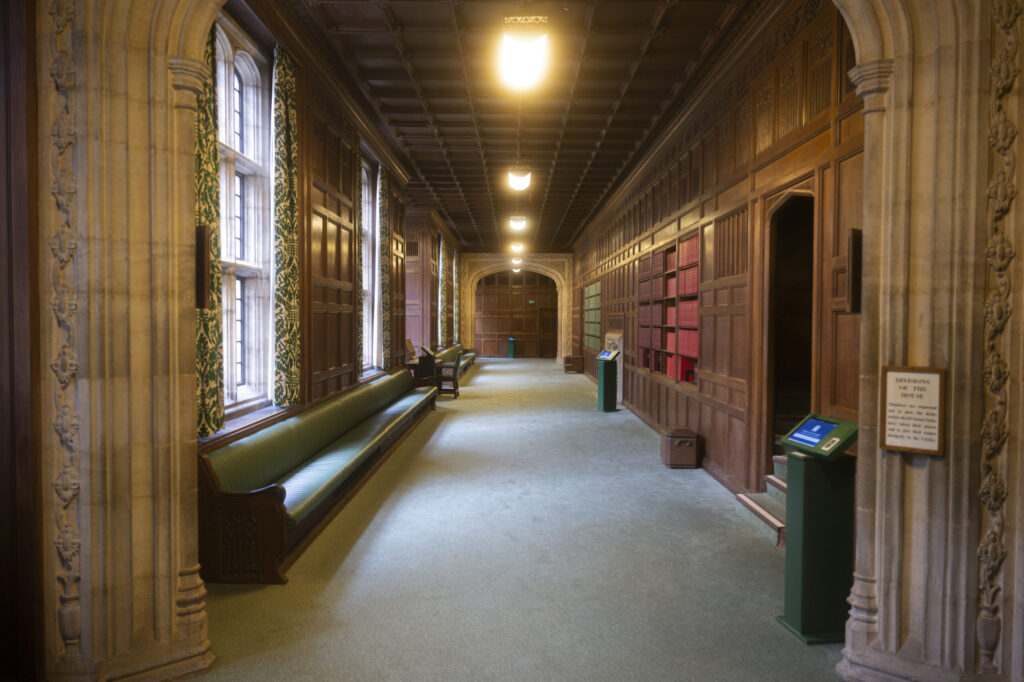
It is a physical method of counting votes where MPs leave the debating chamber and walk through one of two corridors, known as division lobbies, to register their vote. The process is used when the outcome of a so-called “voice vote” is disputed.
How do divisions work in practice?
Speaker puts the question
Initially, the House of Commons speaker, deputy speaker or the chair (if the House is in committee) “puts the question” to the House. This means asking the House to decide on a particular motion. MPs respond by shouting “Aye” or “No”.
The speaker may decide that a motion is rejected or passed based purely “on the voices”. If there is audible disagreement among MPs, then the speaker will call a division, declaring: “Division! Clear the lobbies.”
At this point, division bells are sounded throughout the parliamentary estate and in surrounding locations, such as ministerial offices. Historically, the bell sounded in some nearby pubs and restaurants to alert MPs that a vote was happening.
Tellers and voting
Two minutes after first putting the question, the speaker repeats the phrase, “The question is that…”. If the speaker’s ruling on the outcome is not challenged, or if there are not enough “tellers” (usually whips), the division may be called off. (If two tellers cannot be found for one side, the question is decided in favour of the other). Otherwise, the speaker announces the names of the tellers. Once the tellers are in place, the exit doors from the lobbies are opened and MPs begin to pass through.
From the moment the division is called, MPs have eight minutes to enter one of the two division lobbies, which run along either side of the main chamber. The “Aye” lobby is to the speaker’s right, and the “No” lobby is to their left.
During divisions, MPs are given priority access to escalators and lifts to allow for their swift journey to the division lobbies. The escalators in Portcullis House (where many MPs have their offices) are manually switched so both travel downwards toward the chamber. This one-way priority system is strictly reserved for MPs.
There are pass reader terminals in the division lobbies to record the names of MPs voting. At the exit of each lobby, the four tellers also physically count the members as they pass.
Result announced
Approximately eight minutes after the original question, the speaker orders: “Lock the doors!”. The last occupant of each lobby, usually a whip, then announces “all out”.
Once the vote is complete, MPs return to the chamber and the figures are entered on a card. The four tellers approach the speaker’s chair, and a teller from the winning side formally announces the numbers for both the “Ayes” and the “Noes”.
A clerk then takes the card to the speaker who reads the figures again. The speaker declares the result by confirming: “So the Ayes have it!” or “So the Noes have it!”.
Finally, the speaker instructs the doorkeepers to unlock the doors to the lobbies, by stating: “Unlock!”
Rules and conventions: can an MP abstain?
There is no formal procedure for an MP to record an abstention. The only practical way for an MP to abstain is to not participate in the division at all by not entering either lobby. MPs in recent years have undertaken to vote in both division lobbies as a means of registering an “active abstention”.
For a division to be valid, a minimum number of MPs (a quorum) must participate in the vote. The quorum in the House of Commons is 40, which must include the speaker and the four tellers.
Erskine May, the authoritative account of parliamentary procedure, maintains that “if at any time it appears, on a division, that fewer than 40 members (including the occupant of the chair and the tellers) have taken part, the business under consideration stands over [is deferred] until the next sitting of the House and the next business is taken.”
A convention has evolved to account for MPs who are on the parliamentary estate but are unable to pass through a division lobby. This may be because they are suffering mobility issues, are physically unwell or have a small child with them. The tellers can then agree to add the MP to either the “Ayes” or “Noes” tally, according to which division lobby they would have entered. This practice is known as being “nodded through”.
What is pairing?
Pairing is a long-standing informal arrangement whereby an MP from one party agrees with an MP from an opposing party not to vote in a particular division (a vote). This allows both MPs to be absent from Westminster without affecting the final result, as their absences cancel each other out.
The system is based entirely on trust and is not a formal parliamentary rule. It is organised behind the scenes by the whips (party managers).
While informal, pairing is considered essential for the practical running of parliament, giving MPs flexibility to attend to constituency duties, ministerial business or personal matters without neglecting their party’s position in a vote.
Evaluation question
If the pairing system is entirely informal and based on trust, is it an appropriate mechanism for managing the votes of elected representatives on crucial national legislation?
What happens in the event of a tie?
If a vote is tied, the speaker of the House of Commons casts the deciding vote. There are well-established conventions that guide the speaker’s conduct in such cases (which are extremely rare).
The speaker should always vote for further discussion where possible; if no further discussion is possible, the chair should not create a parliamentary majority where one does not exist.
This latter convention is referred to as ‘speaker Denison’s rule’ – named after John Evelyn Denison, the speaker from 1857 to 1872. Denison was in the chair when a tie arose on a 1867 motion on fellowships at Trinity College, Dublin. Denison, casting his vote against the motion, declared that any decision must be approved by the majority.
In December 2025, the deputy speaker, Caroline Nokes, casted the deciding vote in favour of the UK-EU Customs Union (Duty to Negotiate) Bill. The bill, introduced under the 10-minute rule procedure by Liberal Democrat Europe spokesperson Al Pinkerton, sought to mandate the government to enter into negotiations with the European Union to establish a bespoke customs union. Nokes voted in favour of the bill, breaking a 100-100 tie, to ensure further debate.
In April 2019, John Bercow, the speaker of the House of Commons, used his casting vote to break a tie on a backbench amendment tabled by senior Labour MP Hilary Benn, which sought to secure further parliamentary time for a third round of ‘indicative votes’ on alternative Brexit options. In accordance with precedent, Bercow cast his vote with the ‘Noes’. There was no majority in favour of the amendment and no opportunity for further debate.
Bercow told the House: “In accordance with precedent, and on the principle that important decisions should not be taken except by a majority, I cast my vote with the Noes, so the Noes have it.
“By casting vote, it is 311 to 310. That is the proper way in which to proceed.”
In 1993, Betty Boothroyd, the then commons speaker, was forced to vote against an amendment to a motion approving government’s policy on the Social Chapter of the Maastricht treaty.
Before that, the commons speaker was forced to intervene on a motion for leave to bring in the Televising of Parliament Bill in January 1980. Bernard Weatherill cast his vote in favour (of further discussion).
In 1976, a division held on a Conservative amendment to accept the speaker’s ruling that a proposed bill was a ‘hybrid bill’ (meaning it would be subject to separate and more complex standing orders) resulted in a 303-303 tie. The government had indicated its intention to bypass the speaker’s ruling. Ironically, the speaker, George Thomas, voted against the Conservative amendment and therefore against his own ruling to preserve the bill.
Criticisms and proposed reform: a shift to electronic voting?
The physical process of a division is a long-standing tradition. Supporters argue that the lobbies provide a valuable space for informal discussion between ministers, backbenchers and opposition members. Entering and leaving a division lobby could also be characterised as a more substantive act than merely pressing a button – as would occur if the commons adopted an electronic voting system.
However, the procedure is frequently criticised for being inefficient – especially when compared to the electronic systems used in most modern legislatures around the world, including the Scottish parliament and the Welsh Senedd.
In February 2025, the cross-party House of Commons procedure committee launched a formal inquiry into the introduction of electronic voting for House of Commons divisions. This move followed criticism from new parliamentarians elected in 2024, who argued that the act of walking in and out of division lobbies – often for many votes in a row – was a waste of both House and MPs’ time.
Addressing the commons in July 2024, Green party MP Ellie Chowns said she thought it was “extraordinary” that the House did not have electronic voting.
She stated: “It’s extraordinary to me that we do not have electronic voting… While I’ve been here, I’ve participated in five votes and that’s taken at least an hour and a quarter.
“If you add up each of those votes, it adds up to basically a month’s worth of MP time.”
Chowns estimates that an hour of 650 MPs’ time walking round in circles costs the taxpayer over £30,000. In a piece for Politics.co.uk, published in October 2024, she wrote: “If we assume that MPs do an average of 4 votes per week, that translates into half a day every month wasted walking round in circles, and a total cost of over £1.3 million per year.”
In December 2024, a letter signed by a cross-party group of over 60 backbench MPs urged House authorities to consider introducing electronic voting. 39 Labour MPs signed the joint letter to Lucy Powell, the leader of the commons, including senior backbenchers such as Stella Creasy, John Trickett and Sharon Hodgson.
The letter read: “Spending 15 minutes corralling every MP through two corridors to say aye or no can regularly account for 20% of our working day… With complicated or contested legislation that has multiple votes, hours disappear.
“All other work pauses when the division bell is called – delaying select committees, Westminster Hall debates, meetings and necessitating MPs to second guess when they need to be on the estate to the detriment of their ability to progress work elsewhere, including in their constituency.”
Evaluation question
To what extent, if any, does the preservation of this tradition hinder the ability of the House of Commons to function as a modern, efficient legislature?
During the Covid-19 pandemic, due to social distancing requirements, MPs were able to vote electronically in some divisions in the House. This was known as “remote voting”. But these arrangements lapsed in mid-2021 alongside other pandemic-era procedures.
Several other legislatures around the world – including the UK parliament’s upper chamber, the House of Lords – currently operate some form of electronic voting arrangements. The House of Lords put in place online voting between 15 June 2020 and September 2021. Peers continue to vote online but may only do so when present on the parliamentary estate.
Previous reforms: the introduction of proxy voting
A controversial division in July 2018, when a minister did not follow a pairing arrangement with an opposition MP on maternity leave, spurred a cross-party campaign for reform of voting procedures in the House of Commons.
On 17 July 2018, the commons was due to vote on a series of amendments to the Trade Bill, a piece of Brexit-related legislation. The Liberal Democrat deputy leader, Jo Swinson, was absent from Westminster as she was on maternity leave. Her designated pair was the then-Conservative Party chairman and minister without portfolio, Brandon Lewis. However, Lewis broke the pairing agreement by voting in two crucial divisions on the Trade Bill, one on remaining in the customs union post-Brexit, which the government won by just six votes, and another on medicine regulation, which it lost.
The senior Conservative MP subsequently apologised. However, on 29 January 2019, MPs agreed a proxy voting scheme for MPs who are new parents without a division.
The new system, allowing MPs on parental leave to have their vote cast by a nominated colleague, initially operated as a pilot scheme for 12 months, subject to a review by the procedure committee. On 12 October 2022, the House agreed to changes that MPs “experiencing serious long-term illness or injury should be entitled, but not required, to discharge their responsibilities to vote in this House by proxy.”
On 13 May 2024, the House agreed that an MP barred from the parliamentary estate under the risk-based exclusion policy could apply for a proxy vote.
An addendum to the standing orders, issued in May 2025, means that MPs are eligible for a proxy vote by reason of:
- childbirth;
- care of an infant or newly adopted child;
- complications related to childbirth or pregnancy, miscarriage, baby loss or extended absence for fertility treatment;
- serious long-term illness or injury;
- risk-based exclusion from the parliamentary estate