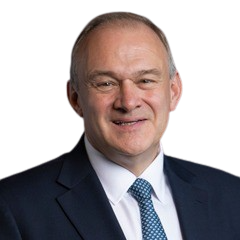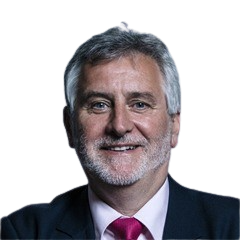
Clive Efford is the Labour MP for Eltham and Chislehurst, first elected for the predecessor seat of Eltham at the 1997 general election.
In the 2024 general election for the new Eltham and Chislehurst constituency, Efford received 20,069 votes (44.0%). The Conservative candidate received 11,640 votes (25.5%), and the Reform UK candidate secured 7,428 votes (16.3%). Efford was duly elected with a majority of 8,429.
The Eltham and Chislehurst constituency is located in South East London, covering parts of the Royal Borough of Greenwich and the London Borough of Bromley, including areas such as Eltham, Mottingham, New Eltham, and Chislehurst. The seat was created for the 2024 election, merging most of the former Eltham seat (held by Labour since 1997, Conservative 1983-1997) with parts of the former Conservative seat of Bromley and Chislehurst.
Efford’s immediate predecessor as the MP for Eltham was Peter Bottomley of the Conservative Party. Bottomley went on to become the MP for Worthing West and, in the 2019-2024 parliament, father of the House. Bottomley’s decision not to contest the Eltham seat was controversial at the time – and widely regarded as a “chicken run” from marginal to safe Conservative territory. At the time, Bottomley reportedly argued that he was “getting a bit old to be fighting a marginal”. He was 53 years of age.
In his 1997 maiden speech, Efford mocked his predecessor’s decision to stand for Worthing West rather than his erstwhile Eltham seat as the incumbent.
Efford commented: “In accordance with the protocol of a maiden speech, I should like to pay tribute to my predecessor who is now the [MP] for Worthing West.
“[Bottomley] announced that he would not stay to contest the seat on the grounds that it was marginal and that he was too old for such a task. I assume that his campaign slogan was, ‘You’re Never Too Old for Worthing West’. I shall bear that in mind.”
Bottomley contested his Worthing West seat at the 2024 general election – finishing second to Labour candidate Beccy Cooper, who won a majority of 3,949 votes.
Political Career
Efford serves as chair of the public accounts commission. He has been a member of the committee he has been a member since 2017.
Efford also sits on the panel of chairs (since June 2020). The panel of chairs is made up of those MPs chosen by the House of Commons speaker, typically at the beginning of every parliament, to chair public bill committees and other commons general committees. In this capacity, Efford may chair debates in Westminster Hall and may also act as temporary chair during a committee of the whole House.
Following the 2024 general election, which saw Labour returned to power and 14 years in opposition, Efford ran for the chairship of the parliamentary Labour Party (PLP). Labour MPs ultimately supported Jessica Morden, Keir Starmer’s former parliamentary private secretary (PPS), in her bid to become chair.
Efford was previously shadow minister for sport from October 2011 to June 2016.
In the last Labour government, Efford served as a parliamentary private secretary (PPS) in the Department for Communities and Local Government from 2008 to 2010 – first for Margaret Beckett as secretary of state and then for John Healey. A PPS acts as an unpaid assistant to a minister, providing a link between the senior frontbencher and backbench MPs.
In June 2016, Efford was among those to resign from the shadow frontbench (as shadow sport minister) in protest at Jeremy Corbyn’s leadership and his approach to the 2016 referendum on Britain’s membership of the European Union (EU).
According to a Guardian report, published 28 June 2016 after his resignation, Efford told Corbyn in a private meeting of the Parliamentary Labour Party (PLP): “Search inside yourself and ask if the electorate really think you are a prime minister because I don’t really think you are.”
According to Politico, Efford commented: “I gave you the benefit of the doubt. It’s not about yourself Jeremy but you’re not a prime minister and you’re not electable.”
Efford later hinted he would be willing to return to the frontbench under Corbyn’s leadership. Speaking to BBC Radio 4‘s The World This Weekend programme, Efford suggested that he had a duty to listen to his party.
He remarked: “I’ve spoken to many members of the party who understand that Jeremy Corbyn is not seen by many people as a prime minister in waiting but are still going to vote for him because they felt there were parts of the parliamentary Labour Party that never gave him a chance, that we never really respected the vote that was given by party members and we don’t deserve to be rewarded as a consequence of that.”
He added: “Whoever wins, they want to see the party back as an effective opposition so if there’s a role for me in that, I would consider it.”
In the 2014-2015 parliamentary session, Efford presented the National Health Service (Amended Duties and Powers) Bill before parliament – a direct legislative challenge to the coalition government’s Health and Social Care Act 2012. Efford’s bill proposed to reverse provisions in the 2012 act that mandated competition and increased the role of the private sector within the health service.
At the time, Efford said: “The NHS as we know it today will disappear if we continue to allow services to be forced out to private companies.
“It will seriously undermine the capacity of the NHS to provide services in the future, leaving us at the mercy of the private sector. This Bill will halt the rush to privatisation and put patients rather than profits at the heart of our NHS.”
Andy Burnham, then Labour’s shadow health secretary, backed the bill at the time, accusing prime minister David Cameron of putting “the NHS up for sale.”
He commented: “If we leave things as they are, the NHS as we have known it for 66 years will not survive. This Bill will free the NHS from that morass and restore the right values to its heart: collaboration over competition; people before profits.”
In the 2015-2016 parliamentary session, in his capacity as shadow sports minister, Efford presented the Football Governance (Supporters’ Participation) Bill to parliament, which aimed to give football fans a formal voice and stake in their clubs by law, responding to a series of club collapses and controversial takeovers that left supporters feeling powerless.
The core bill’s proposals would have required that, upon a change of ownership, clubs offer up to 10% of their shares for purchase by a recognised supporters’ trust. It also sought to mandate that at least two, and up to a quarter, of a club’s board members be directly elected by these fan organisations.
Introducing the bill to parliament, under the 10-minute rule mechanism, Efford told MPs: “Our football clubs are not simply businesses. They exist because generation after generation of people from the communities in which they are situated have sustained their clubs through thick and thin.
“I do not present the bill as a solution to all the problems, but giving fans a voice is a stepping stone to more accountability in the game. Fans are not the solution to every problem, but they can and will be the eyes and ears of an early warning system for emerging problems.”
Efford was a member of the House of Commons culture, media and sport committee from July 2018 to May 2024; the transport committee from July 2002 to January 2009, and again from October 2016 to May 2017; the housing, communities and local government committee from July 2010 to February 2011; and the procedure committee from July 1997 to May 2001.
Efford is listed as a member of the all-party parliamentary groups (APPGs) for football supporters, haemophilia and contaminated blood, and sport and physical activity in the criminal justice system.
He delivered his maiden speech on 25 June 1997. In it, he stated: “London’s underground is in urgent need of investment to meet the challenges ahead as the millennium approaches. Wherever the resources come from, they must not be directed at the behest of the private sector.
“The needs of the environment and of the people of the capital are too pressing. Experience shows that, when it comes to the environment, the market is too slow to respond, if it responds at all. Investment in the London underground system will be more cost-effective if it is co-ordinated with all other forms of transport.
He added: “Let us start to invest in our capital city, but let us do it with the needs of the city at the top of our agenda. Let us make London the world’s premier city once again.”
Political Views
Efford previously served as chair of the Tribune group of Labour MPs, a caucus generally described as occupying the party’s “soft left”.
The Tribune group was initially formed in 1964 to support the newspaper of the same name. It served as a prominent forum for those parliamentarians situated on the left of the Labour Party – but it split over Tony Benn’s campaign for the deputy leadership in 1981. Benn’s supporters founded the Campaign group – which evolved into the Socialist Campaign Group (SCG). Today, the Bennite SCG is strongly associated with the Labour left tradition.
During the 1980s, the Tribune group emerged as a more natural home for those on Labour’s “soft left”. It declined in importance during Neil Kinnock’s leadership of the party, when it ceased to promote a list of candidates for the shadow cabinet, which was elected at the time.
The group folded in the 1990s amid claims that its leadership had been “infiltrated” by New Labour.
In 2005, Efford reformed the Tribune group. A BBC News report on the Tribune group’s reformation noted: “The long-defunct Tribune Group of Labour MPs has reformed in the commons under the guiding hand of Eltham’s Clive Efford.
“It will aim to encourage debate about the future direction of Labour policy and it is probably safe to assume it will not be the direction Tony Blair favours.”
Invitations to join the group were extended to backbench Labour MPs only.
In 2016, Efford announced he would re-launch the Tribune group again as a voice for what he described as the “traditional left”. In an article for the Observer, published September 2016, Efford said the relaunched group had accumulated the support of 60 Labour MPs.
Alongside Ian Lucas, the Labour MP for Wrexham, Efford wrote: “The group will act as a vehicle for ideas to change our party, our country and all our futures. We invite all who share our vision to contribute…
“The two main parties have slugged it out on a very narrow strip of political ground for too long, and the public has grown cynical over the lack of real choices on offer. Tribune will fill the void and be the catalyst for debate to find real alternatives to the status quo and generate the debate needed to face the challenges of the 2020s and beyond.”
https://x.com/DianaJohnsonMP/status/793808707901648896
In 2017, Efford officially re-launched the group with a new mission statement calling for “opportunity and aspiration” to be placed at the heart of the party’s programme. Efford said he had reformed the group to ensure that the centre-left of the Parliamentary Labour Party (PLP) “have a space in which to put forward ideas and debate which has not been there under successive leaders”.
He added: “The view of Labour MPs at the moment tends to be that too much are just Blairites who want to stab Jeremy Corbyn in the back. We want to show that is not where we are, and that we want to develop our own ideas that represent the centre-left of the party.”
Among the MPs to sign-up to the re-formed Tribune Group were prominent parliamentarians Margaret Beckett, Jon Ashworth, Jon Cruddas, Ed Miliband, Lisa Nandy, Steve Reed, Yvette Cooper, Nick Thomas-Symonds, Anneliese Dodds, Shabana Mahmood and Keir Starmer.
Leadership elections and loyalty
Oppose leadership election: In May 2026, Efford was among the over 100 Labour MPs who signed a joint statement insisting it was “no time for a leadership contest.” The letter was an intervention in the political crisis engulfing Keir Starmer’s premiership, after Labour suffered heavy losses in the 2026 local elections and devolved elections to the Scottish Parliament and Senedd Cymru. It was organised as a counterweight to a mounting rebellion that had seen high-profile figures, including some ministers, call for Starmer’s resignation.
The statement read: “Last week we had a devastatingly tough set of election results. It shows we have a hard job ahead to win back trust from the electorate.
“That job needs to start today – with all of us working together to deliver the change the country needs.
“We must focus on that. This is no time for a leadership contest.”
Labour deputy leadership 2025: Efford was one of 117 Labour MPs who nominated Lucy Powell for the party’s deputy leadership in September 2025. The election followed the resignation of Angela Rayner, who stepped down as deputy prime minister and deputy party leader after an investigation into her tax affairs. It marked the first time since 2007 that Labour had held a deputy leadership contest while in government.
Powell, the former leader of the House of Commons, was seen as a candidate representing the party’s “soft left”; she was support by leading soft left figures including Ed Miliband and Andy Burnham. She secured 117 nominations from the Parliamentary Labour Party (PLP), above the 80 required, and went on to win the election – defeating Bridget Phillipson with 54.3% of the vote.
Labour leadership 2020: Efford was one of 82 Labour MPs who nominated Keir Starmer for the party’s leadership in early 2020. The election was triggered by the resignation of Jeremy Corbyn following the party’s defeat in the 2019 general election, which resulted in Labour’s fewest seats in the House of Commons since 1935.
Starmer’s 82 nominations were the highest of any candidate. The shadow Brexit secretary won a decisive victory in the first round with 56.2% of the vote, defeating Rebecca Long-Bailey and Lisa Nandy.
In an article for The House magazine, published September 2022 and co-written with Liam Byrne (Labour MP for Birmingham Hodge Hill), Efford argued that his Tribune group could help Starmer “transform the country”.
Efford and Byrne argued: “Cutting taxes that will disproportionately benefit the already well during a cost of living crisis is not only wrong economically, it’s also cold hearted. Millions will be plunged into poverty in the coming months, unable to pay household bills for the necessities that sustain a basic standard of living. To pretend cutting taxes is the response to the immediate crisis facing our people is a monumental act of betrayal.
“Labour must demonstrate that things can change, and our country can be led in ways that prioritise the needs of its people rather than a wealthy and powerful few. The Tribune Group has been in discussion with academics and experts who share our desire to bring about the change we need.”
The joint op-ed marked the publication of a new volume of essays penned separately by “eighteen of Britain’s leading progressive thinkers” and edited by Efford and Byrne. The book was titled The Change We Need: How A Starmer Government Can Transform Britain. Among the contributors were Gordon Brown, the former prime minister; Torsten Bell, the then-CEO of the Resolution Foundation; and Miatta Fahnbulleh, then the chief executive of the New Economics Foundation. Both Bell and Fahnbulleh would be elected as Labour MPs at the 2024 election and appointed ministers by Keir Starmer.
Labour leadership 2015: Efford was part of a group of MPs who lent their nominations to ensure Corbyn, a veteran backbencher, reached the threshold of 35 required to appear on the ballot, intending to “broaden the debate.” Following Corbyn’s landslide victory with 59.5% of the vote, several of these MPs expressed regret.
Corbyn loyalty list: In March 2016, Efford was labelled as “neutral but not hostile” by the Corbyn leadership in a leaked list which categorised Labour MPs by their perceived loyalty.
Labour leadership 2016: Efford was one of 162 Labour MPs who nominated Owen Smith for the party’s leadership in July 2016. The election was triggered by a challenge to Jeremy Corbyn following the EU referendum, which led to a wave of shadow cabinet resignations and a vote of no confidence supported by 172 MPs. Smith, the former shadow work and pensions secretary, was ultimately defeated by Corbyn, who won with an increased mandate of 61.8% of the vote.
Commenting in 2018, following the fraught challenge to Corbyn’s leadership in 2016, Efford said he did not conceive of the Tribune group as an oppositional force to the Labour leadership – despite his personal criticisms of Corbyn.
He told PoliticsHome: “[At the time of the 2016 leadership challenge] we felt there was a very big body of MPs who didn’t have a voice in that process and were sort of bounced along and we didn’t want that to happen again. We are very much saying the party has made up its mind. The party has settled on the leadership issue and we have got to get on with the job.”
Efford added: “We are not oppositionists – the vast majority of the Tribune group is on the front bench. We are very much trying to play our role in developing coherent policies that make the party ready for government.
Labour leadership 2010: Efford was one of 63 Labour MPs who nominated Ed Miliband for the party’s leadership in May 2010. The election followed the resignation of Gordon Brown, who stepped down as prime minister and Labour leader after the 2010 general election.
Miliband, the former energy and climate change secretary, was seen as the candidate of the “soft left” and secured significant backing from affiliated trade unions. He secured 63 nominations from the Parliamentary Labour Party (PLP), exceeding the 33 required to reach the final ballot. Miliband went on to narrowly defeat his brother, David, in the final round by 50.7% to 49.3%.
Factional identity and party tradition
Mainstream: Efford is now a member of Mainstream, a centre-left network within the Labour Party. The group was launched in September 2025 by the think tank Compass and the activist group Open Labour. It describes itself as a home for “Labour’s radical realists” and aims to influence the direction of the Labour government. It has called on the government to offer a “popular, principled and practical left politics for meaningful change.”
Compass has described the group as “an independent vehicle with the sole task of saving the Labour Party from its clear drift to the right and the unintended paving of the way to a Reform government.”
The group is backed by a number of senior Labour figures, including the mayor of Greater Manchester, Andy Burnham, and includes MPs and peers from various traditions within the party – from the left, soft left and the more progressive elements of New Labour.
Brexit and Europe
Brexit referendum: Efford supported the Remain campaign in the 2016 EU referendum, and therefore disagreed with a majority of constituents, 51.8% of whom voted to Leave.
Article 50: In February 2017, Efford voted in favour of the European Union (Notification of Withdrawal) Bill. The legislation empowered the prime minister to notify the Council of the European Union of the UK’s intention to withdraw, formally triggering the process set out in Article 50 of the Treaty on European Union. MPs supported the bill by 498 votes to 114 at second reading.
Brexit trade deal: In December 2020, Efford was among the 37 Labour MPs to rebel against the leadership’s position on the EU (Future Relationship) Bill – which enabled the government to implement and ratify its post-Brexit trade deal with the EU. Keir Starmer, the newly elected Labour leader, argued that while the trade deal negotiated by Boris Johnson’s government was “thin” and flawed, the only alternative at that late stage was a “no-deal” exit. To enforce the leadership’s position, a three-line whip was imposed. Efford abstained over the bill. One Labour MP, Bell Ribeiro-Addy, voted against the bill.
Welfare
Welfare ‘reasoned amendment’ (June 2025): Efford was one of the over 120 Labour MPs to sign the reasoned amendment to the government’s flagship welfare bill which aimed to reject the proposed legislation.
The amendment, in the name of senior Labour MP Dame Meg Hillier, objected to the fact that the bill had not been subject to a “formal consultation with disabled people” and that “250,000 people will be pushed into poverty” as a result of it, according to a government impact assessment.
The motion also called on the government to wait for the publication of the review into the Personal Independence Payment (Pip), helmed by minister Sir Stephen Timms, and the independent review, conducted by Sir Charlie Mayfield, into how the employment of disabled people could be boosted.
Welfare vote (July 2025): Efford went on to vote against the bill at second reading. The vote came after ministers agreed to significant concessions to avoid defeat via a mass rebellion of Labour MPs on 1 July 2025.
Speaking during the bill’s second reading debate, Efford said the government was making a choice – couched in the language of “tough” decisions – that would “adversely impact those who cannot fight back.”
He told the House: “We talk about choices, and we hear a lot from the leadership about tough choices. I do not consider cutting disabled people’s benefits to be a tough choice for us politicians, but it will mean that people on the receiving end will be forced to make tough choices about the way that they make ends meet.”
Efford went on to propose a series of measures the government could take to raise revenue.
He called on the government to reform capital gains tax “through increasing rates and closing loopholes to raise £12 billion a year”.
He said ministers should close the “carried interest loophole to private equity bosses so that they pay their fair share to raise half a billion pounds.”
Efford also urged the government to apply national insurance to investment income “to raise up to £10.2 billion”; to introduce a 4% tax on share buybacks to “raise between £0.1 billion and £2 billion a year”; to end and redirect fossil fuel subsidies for oil and gas companies to “raise £2.2 billion a year”; to tax private jets to “raise an additional £1.2 billion a year”; and to stop multinational corporations “evading tax”, mandating that they declare their profits wherever they operate to “raise £15 billion a year.”
Assisted dying
Efford voted in favour of the Terminally Ill Adults (End of Life) Bill, better known as the assisted dying bill, at second reading (November 2024). On the third reading of the Terminally Ill Adults (End of Life) Bill (Assisted Dying Bill) in June 2025, Efford did not record a vote.
Social values and conscience issues
Abortion decriminalisation (2025): Efford voted in favour of a backbench amendment to the Crime and Policing Bill that sought to decriminalise abortion in England and Wales in June 2025. The amendment, which was passed by a majority of 242 votes, removed women from the threat of prosecution for ending a pregnancy at any stage. As an issue of conscience, MPs were allowed to vote according to their personal beliefs.
Same-sex marriage (2013): In February 2013, Efford voted in favour of the Marriage (Same Sex Couples) Bill at its second reading. The landmark piece of legislation, which received its second reading by 400 votes to 175, legalised marriage for same-sex couples in England and Wales.
Foreign policy and security
Syria airstrikes (2015): Efford voted against a government motion to extend UK airstrikes against Isis from Iraq into Syria in December 2015. The motion, which was passed by 397 votes to 223 after a ten-hour debate in the House of Commons, authorised the RAF to conduct strikes against Isis targets in Syria.
Syria airstrikes (2013): Efford voted against the government’s motion on the principle of military intervention in Syria in August 2013. The government motion was defeated by 285 votes to 272, a move which effectively ruled out UK participation in any US-led military strikes.
Iraq War authorisation vote (2003): In March 2003, Efford voted against the government motion authorising military action against Iraq. The vote, one of the most contentious in recent parliamentary history, gave the prime minister, Tony Blair, the authority to join the US-led invasion.
Palestine
Palestinian recognition vote (2014): In October 2014, Efford was one of 192 Labour MPs who voted in favour of recognising Palestine as a state. The motion, passed by 274 votes to 12, called on the government to “recognise the state of Palestine alongside the state of Israel as a contribution to securing a negotiated two-state solution”.
Before Politics
Born in Southwark, London on 10 July 1958, Efford was educated at Walworth School and Southwark College.
He initially worked in his family’s jewellery business before qualifying as a licensed London taxi driver in 1987, having completed “The Knowledge”. He continued working as a taxi driver until his election to Parliament in 1997.
From 1986 to 1998, Efford served as a Labour councillor on Greenwich Council, representing the Eltham Well Hall ward. He became the Labour group chief whip on the council in 1990.
Personal Life
Efford married Gillian Vallins in 1981. They have three daughters.
Trivia
Efford is a lifelong supporter of Millwall Football Club and holds an FA coaching certificate.
He has been a regular player for the parliamentary football team.
He previously ran a youth football team in Southwark together with Oliver Heald, who later became the Conservative MP for North East Hertfordshire.
Efford has served as a trustee of the Millwall Community Trust since 2014.
Clive Efford has not written for Politics.co.uk.