SDP co-founder Shirley Williams wins Crosby by-election
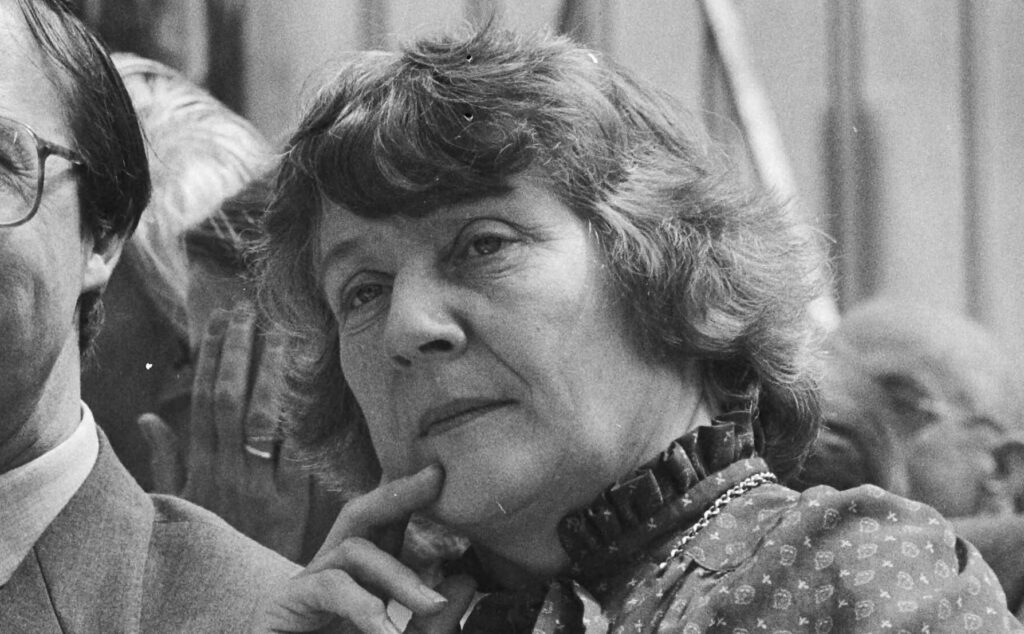
On 26 November 1981, Shirley Williams, one of the founding members of the Social Democratic Party (SDP), won the Crosby by-election. The result marked the first time an SDP candidate had won a parliamentary seat.
The contest was triggered by the death of the sitting Conservative MP, Sir Graham Page, who had held the Merseyside seat since 1953. He had secured a Tory majority of 19,272 votes at the 1979 general election.
In 1981, however, the political landscape was in a state of flux. In January, former cabinet ministers Williams, Roy Jenkins, Bill Rogers and David Owen – the ‘gang of four’ – all left Labour to found the Social Democratic Party (SDP). The SDP, which quickly forged an alliance with David Steel’s Liberals, was formed as a response to Labour’s leftward shift under the leadership of Michael Foot.
Meanwhile, Margaret Thatcher’s premiership was at its lowest ebb. Her monetarist policies, designed to curb inflation, were driving unemployment towards three million. Riots in Brixton, Toxteth, and Moss Side raised the spectre of social upheaval. As such, the new SDP-Liberal Alliance was seen as a potentially existential threat to Thatcher’s deeply unpopular Conservative Party.
Christopher Brocklebank-Fowler, the MP for North West Norfolk, had recently defected from the Conservatives to the SDP. With the new Alliance polling strongly, there were fears more could follow.
But Thatcher refused to change course. On 14 September, the prime minister conducted a wide-ranging cabinet reshuffle. She dismissed senior moderate ministers (‘wets’) and promoted loyalists (‘dries’) who shared her economic convictions.
By November 1981 and the time of the Crosby campaign, the SDP-Liberal Alliance had already exhibited its strength as an electoral force. In July, Roy Jenkins was narrowly bested in the Warrington by-election by 1,759 votes. Then, on 22 October, Bill Pitt – the Alliance-backed Liberal candidate – won the Croydon North West by-election on a swing of 24.2 points.
***
Williams served as education secretary from 1976 to 1979, having first won election to parliament in 1964. In 1976, she stood for the Labour deputy leadership; she secured the support of 128 Labour MPs, but was bested by Michael Foot (166). She lost her seat at the 1979 general election.
Williams was seen as a strong fit for the Crosby contest. The constituency had one of the largest Roman Catholic electorates in England and Wales; Williams, on top of being a well-regarded former cabinet minister, was a practising Catholic.
Williams secured 28,118 votes (49.1%), defeating the Conservative candidate John Butcher, who polled 22,829 votes (39.8%). The Labour candidate, John Backhouse, received only 5,450 votes (9.5%), losing his deposit.
The campaign also featured the candidacy of John Desmond Lewis, who changed his name to Tarquin Fin-tim-lin-bin-whin-bim-lim Bus Stop-F’tang-F’tang-Olé-Biscuitbarrel, a character from Monty Python.
Fin-tim-lin-bin-whin-bim-lim Bus Stop-F’tang-F’tang-Olé-Biscuitbarrel won 223 votes (0.39%).
In her victory speech, Williams quoted the 17th century poet John Dryden: “’Tis well an old age is out, and time to begin anew.”
She declared that “the mould of British politics has been totally shattered.”
Jenkins remarked that the SDP had “broken through across the whole front of British politics.”
In her first commons speech since her re-election to parliament, Williams said it was a “particular delight to be elected the first Social Democrat [MP] – but not, I hurriedly assure the House, the last.”
The victory represented a clear threat to the historic dominance of the established parties. It was followed in March 1982 by another high-profile win for the SDP, when Roy Jenkins captured the Glasgow Hillhead seat.
***
Williams lost the Crosby seat in the 1983 general election, however, following boundary changes and a resurgence in Conservative support after the Falklands War. The Tory candidate, Malcolm Thornton, won with a majority of 3,401 votes over Williams.
The SDP won 25.4% of the vote in the 1983 election – a mere 2.2 points short of Labour. Under the first-past-the-post electoral system, however, this yielded only 23 seats.
Williams stood as the SDP candidate in Cambridge at the 1987 general election. She finished second to the incumbent Conservative MP Robert Rhodes James, who won a majority of 5,060 votes.
Williams was elevated to the House of Lords in 1993 as Baroness Williams of Crosby. She served as leader of the Liberal Democrats in the House of Lords from 2001 to 2004.
Shirley Williams died on 12 April 2021, aged 90.

Politics.co.uk Newsletters
DAILY
Politics@Lunch
WEEKLY
Week in Review
