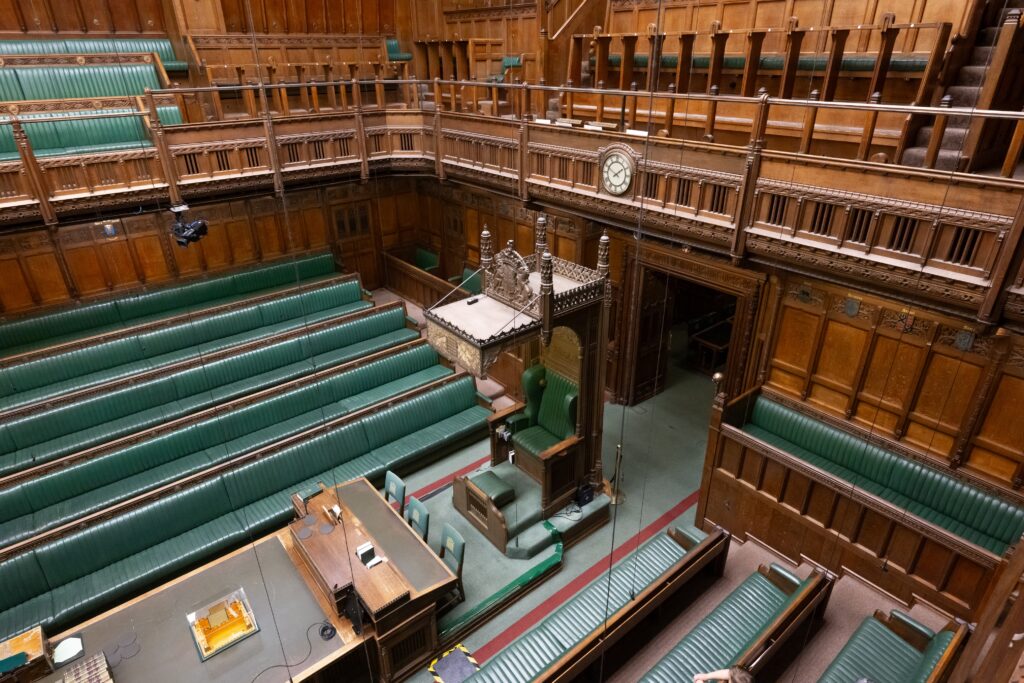
The sitting hours of the House of Commons are the scheduled times each day when the chamber meets to conduct its business.
The current hours, which are mostly confined to the daytime, are a relatively modern innovation designed to make parliamentary work more predictable and effective.
The end of a sitting is governed by a set time known as the “moment of interruption”, after which main business must conclude. The timing of the moment of interruption on each weekday is set down in House of Commons standing orders (formal rules).
This moment of interruption is typically followed by a half-hour adjournment debate – literally a debate on a motion to adjourn the House – after which the House formally rises (finishes) for the day.
When parliament is not sitting, MPs work in their constituencies, including holding surgeries and dealing with constituency “casework”.
Commons sitting hours: the standard weekly timetable
The House of Commons normally sits from Monday to Thursday each week when parliament is not in recess. The standard sitting hours are set by the House’s standing orders, though the times of sittings may be changed at short notice if the House agrees, or may finish earlier:
- Monday:
- The sitting begins at 2:30 pm.
- The moment of interruption for main business is at 10:00 pm.
- After the adjournment debate, the House typically rises at 10:30 pm.
- Tuesday:
- The sitting begins at 11:30 am.
- The moment of Interruption is at 7:00 pm.
- The House typically rises at 7:30 pm.
- Wednesday:
- The sitting begins at 11:30 am.
- The moment of interruption is at 7:00 pm.
- The House typically rises at 7:30 pm.
- Thursday:
- The sitting begins at 9:30 am.
- The moment of interruption is at 5:00 pm.
- The House typically rises at 5:30 pm.
The first day back after a parliamentary recess follows the same timetable as a Monday.
The commons may also conclude its sitting earlier than scheduled if all business has been completed.
In exceptional circumstances, the commons has met on Saturday and on Sunday. The most recent Saturday sitting took place on 12 April 2025, for an emergency session to fast-track the Steel Industry (Special Measures) Act 2025 through parliament.
The last such sittings came after the death of Elizabeth II in 2022, during debates on the UK’s withdrawal from the European Union in 2019 and following the invasion of the Falkland Islands in 1982.
Sitting Fridays
Fridays are not regular sitting days and are usually reserved for MPs to work in their constituencies.
However, the House does sit on a number of Fridays throughout the year, which are allocated for the consideration of private members’ bills (PMBs). The commons generally only sits on 13 Fridays in a session to consider PMBs.
On these sitting Fridays, the House meets at 9:30 am, the moment of interruption is at 2:30 pm, and the House rises at 3:00 pm.
The structure of a typical day in the House of Commons
The order of business generally follows a regular pattern:
- The speaker’s procession and the mace: Before each day’s sitting, the speaker walks in procession from the speaker’s house to the chamber, preceded by the serjeant at arms carrying the mace. The mace is placed on the table of the House to signify that the House is in session and has the authority to pass laws.
- Prayers: Each day begins with prayers read by the speaker’s chaplain. During prayers, MPs stand facing the benches. This tradition is said to have arisen because members would historically have found it difficult to kneel to pray while wearing a sword. Prayers are held in private and last for three minutes. MPs can use prayer cards to reserve seats in the chamber for the remainder of that sitting day.
- Oral questions: MPs question government ministers at the start of each sitting day (except Fridays) through oral questions for up to 60 minutes. Unlike the Lords, these are directed at specific government departments according to a pre-set rota. On Wednesdays, this slot includes 30 minutes of prime minister’s questions (PMQs).
- Urgent questions: An urgent question (UQ) allows an MP to raise an important matter that has arisen suddenly. A UQ must be submitted to the speaker by 11:30 am on Mondays, 10:00 am on Tuesdays and Wednesdays, and 8:15 am on Thursdays. If the speaker deems the matter of sufficient public importance and urgency, a minister is required to come to the House that day to provide an immediate response and face supplementary questions.
- Ministerial statements: Government ministers make oral statements in the House of Commons to announce significant policy changes or report on national and international events. The statement is followed by a period of questioning from the opposition frontbench and then backbenchers.
- Main business: The core of the day is spent on “main business.” This primarily consists of the stages of a bill (such as a second reading, report stage or third reading) or general debates on government/backbench motions.
- Adjournment debate: A half-hour adjournment debate takes place at the end of each day’s business. This provides a backbench MP with the opportunity to raise a specific issue, and receive a direct response from a government minister. The House then rises for the day.
Flexibility and the House of Commons timetable
While the timetable outlined above represents the standard sitting hours of the House of Commons, there is flexibility built into the system.
Standing order 15 allows certain types of business in the House of Commons to continue beyond the usual moment of interruption. This includes bills related to ways and means (financial bills).
Moreover, for most government bills, the House will agree to a “programme motion” at the beginning of the debate. This motion sets out a specific timetable for the bill’s various stages, including a time when the debate must end and any votes must be taken. This time can be earlier or later than the standard moment of interruption.
If the government wishes, it can also table a business of the House motion to exempt business from the moment of interruption, including at short notice.
History and rationale
Between 1997 and 2012, a series of changes were made to the sitting hours of the House of Commons. As a result, the sitting hours of the commons were brought closer in line with normal business hours.
Generally, proceedings now begin earlier and are interrupted earlier; in 1997, the House typically sat from 2:30 pm to 10:00 pm, Monday to Thursday.
In all sessions from 1979-80 to 2001-02, 71% of all sittings finished after 10:00 pm. Over a quarter of commons sittings rose after midnight, according to the House of Commons Library.
In 2012, Labour MP Joan Ruddock said the reforms, which introduced the current framework, were “a very small attempt to make this workplace more manageable”.
Ruddock added: “Most MPs say they are perpetually tired, stressed and they find the late hours a particular problem.”
In the 2021-22 session, only 15% of sittings lasted until after 10:00 pm, and 1% after midnight.
Westminster Hall
Sittings in Westminster Hall take place on four days each week:
- Mondays (4.30pm-7.30pm): e-petition debates scheduled by the petitions committee.
- Tuesdays (9.30am-11.30am and 2.30pm-5.30pm): debates secured by MPs through a ballot run by the Speaker’s Office. The backbench business committee may allocate the 90-minute Tuesday morning slot.
- Wednesdays (9.30am-11.30am and 2.30pm-5.30pm): debates secured by MPs through the ballot system.
- Thursdays (1.30pm-4.30pm): debates chosen by the backbench business committee or on select committee reports selected by the liaison committee, which receives roughly half of the available Thursday time.
If a division is called in the main chamber of the House of Commons, the Westminster Hall sitting is suspended. The lost time is added at the end.
Recesses: when do they happen?
The parliamentary year is structured around a series of recesses, which are broadly aligned with school holidays. The typical recess pattern is:
- February recess: A one-week break, usually in mid-February.
- Easter recess: Approximately two weeks around the Easter period.
- Whitsun recess: A one-week break at the end of May or beginning of June.
- Summer recess: The longest break of the year, typically lasting around six weeks from late July to early September.
- Conference recess: A three-week break in late September and early October to allow for the annual conferences of the main political parties.
- Christmas recess: Approximately two to three weeks covering the Christmas and New Year period.
The current House of Commons recess dates can be viewed here.
Additional resources
- UK Parliament – What’s On: https://www.parliament.uk/business/whats-on/

