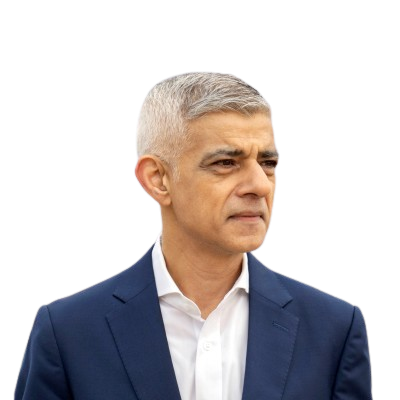
Sir Sadiq Khan is the mayor of London, having first been elected to this role in 2016.
A leading figure in the Labour Party, Khan served as the MP for his home constituency of Tooting from 2005 until 2016. During his time in parliament, Khan established himself as a prominent figure on the frontbench, holding ministerial roles under Gordon Brown and shadow cabinet positions under Ed Miliband.
Khan received a knighthood in the 2022 New Year Honours for political and public service.
Sadiq Khan’s parliamentary career (2005-2016)
Khan was first elected as the Labour MP for Tooting at the 2005 general election. He served on the House of Commons public accounts committee from 2005 to 2007.
Khan became known as a critic of some aspects of Tony Blair’s policy programme in its final years, particularly opposing the proposed introduction of 90-day detention without charge for terror suspects. The Labour rebellion over a government amendment to the Terrorism Bill resulted in Blair’s first major commons defeat as prime minister. The 90-day amendment, introduced at report stage, was defeated by 322 votes to 291 – a majority of 31. A total of 49 Labour MPs, Khan included, defied the government’s three-line whip and sided with the opposition.
Khan’s stance on detention earned him the Spectator magazine’s Newcomer of the Year award in 2005 (the magazine was edited by Boris Johnson at the time).
Khan was appointed as an assistant government whip after Gordon Brown succeeded Blair as prime minister in 2007.
In a 2008 reshuffle, Khan was promoted to parliamentary under-secretary of state in the Department for Communities and Local Government. He then took on the role of minister of state for transport (2009-2010); in this capacity, Khan sometimes attended cabinet to discuss his policy brief, making him the first Muslim to attend the cabinet. Khan also announced his 2009 appointment on Twitter, one of the first politicians to use the platform for such an announcement.
Khan served as campaign manager for Ed Miliband during the 2010 Labour leadership election. The contest followed the resignation of Gordon Brown, who stepped down as prime minister and Labour leader after the 2010 general election. Miliband, the former energy and climate change secretary, was seen as the candidate of the “soft left” and secured significant backing from affiliated trade unions. He secured 63 nominations from the Parliamentary Labour Party (PLP), exceeding the 33 required to reach the final ballot. Miliband went on to narrowly defeat his brother, David, in the final round by 50.7% to 49.3%.
Khan went on to hold a series of shadow cabinet posts under Miliband, serving as shadow secretary of state for transport (2010), shadow lord chancellor and shadow secretary of state for justice (2010-2015). He was also given the role of shadow minister for London (2013-2015).
In the 2015 Labour leadership contest, Khan was part of a group of MPs who lent their nominations to ensure Corbyn, a veteran backbencher, reached the threshold of 35 required to appear on the ballot, intending to “broaden the debate.” Following Corbyn’s landslide victory with 59.5% of the vote, several of these MPs expressed regret.
In March 2016, Khan was labelled as “hostile group” by the Corbyn leadership in a leaked list which categorised Labour MPs by their perceived loyalty. This label suggested the Corbyn leadership viewed Khan as actively and openly antagonistic.
Khan was one of 162 Labour MPs who nominated Owen Smith for the party’s leadership in July 2016. The election was triggered by a challenge to Corbyn following the EU referendum, which led to a wave of shadow cabinet resignations and a vote of no confidence supported by 172 MPs. Smith, the former shadow work and pensions secretary, was ultimately defeated by Corbyn, who won with an increased mandate of 61.8% of the vote.
Khan stood down from the House of Commons upon his election as mayor of London in May 2016.
Sadiq Khan as London mayor
Khan succeeded Boris Johnson as London Mayor in May 2016, after defeating Conservative rival Zac Goldsmith with 57% of the vote in the final round (under the supplementary vote system).
Khan was re-elected in the May 2021 London mayoral election, winning 55.2% of the vote in the final round against Conservative Shaun Bailey.
In May 2024, Khan secured a historic third consecutive term, defeating Conservative candidate Susan Hall with 43.8% of the vote under the first past the post (FPTP) system (used for the first time in mayoral elections since 2000).
As mayor of London, Khan introduced the “toxicity charge” (T-Charge) in 2017 on older, more polluting vehicles entering central London, which was replaced and expanded by the Ultra Low Emission Zone (Ulez) in April 2019.
Ulez was expanded to cover the area within the North and South Circular roads in October 2021, and extended to cover all London boroughs in August 2023. While praised by environmental and health groups, the Ulez expansion faced strong opposition from some outer London residents, businesses and Conservative politicians. In May 2024, it was reported that more than 4,500 Ulez cameras had been vandalised as a form of protest since the expansion.
Ulez was a central issue in the 2023 Uxbridge and South Ruislip by-election, triggered by Boris Johnson’s resignation as an MP. The Conservative candidate, Steve Tuckwell, ultimately held the seat by a margin of just 495 votes. The Conservatives victory was widely attributed to local opposition to the planned expansion of Ulez.
This prompted Keir Starmer, the Labour leader of the opposition, to distance himself from the scheme. Starmer said Ulez was “the reason we didn’t win” in Uxbridge, saying “we’ve all got to reflect on that, including the mayor”.
Khan introduced the “Hopper fare” allowing unlimited bus and tram journeys within one hour for the price of a single fare and oversaw the opening of the Elizabeth Line (Crossrail) in 2022.
Khan has faced persistent criticism, particularly from Conservatives, regarding levels of knife crime and violence. He has defended his record by pointing to investments in the Metropolitan Police, despite the austerity policy of the national government. He established London’s Violence Reduction Unit in 2019. Shaun Bailey, Khan’s Conservative challenger in 2021, argued that “crime in London is out of control”.
In 2022, Khan supported the development of a pilot cannabis diversion scheme in the boroughs of Lewisham, Bexley and Greenwich, where young adults caught with small amounts of cannabis would be offered education or support rather than facing arrest.
Khan also presided over London’s response to the Covid-19 pandemic in 2020 and 2021, as well as the aftermath of the Grenfell Tower Fire in 2017.
In February 2022, Dame Cressida Dick resigned as Commissioner of the Metropolitan Police after Khan publicly stated he had lost confidence in her leadership following a string of scandals impacting trust in the force.
In February 2024, Lee Anderson, the MP for Ashfield, had the Conservative whip suspended for refusing to apologise for comments made about Khan. Anderson claimed that “Islamists” had “got control” of the mayor.
Reacting to the comments, prior to Anderson’s suspension, Khan said: “These comments from a senior Conservative are Islamophobic, are anti-Muslim and are racist.”
Political Views
Khan is generally considered part of Labour’s “soft left”.
Khan was a vocal supporter of Remain in the 2016 Brexit referendum campaign.
Khan appeared as an official Remain advocate in the the BBC’s final Brexit referendum debate held at Wembley Arena. The EU Referendum: The Great Debate programme was hosted by veteran broadcaster David Dimbleby, and featured clashes over immigration, the economy and sovereignty.
During the debate, Khan accused Johnson, his predecessor, of unleashing “project hate” and peddling falsehoods, particularly over the prospect of Turkey joining the EU – which the London mayor referred to as a “big fat lie”. He said immigration brought “huge economic, cultural and social benefits to our country”.
In March 2019, Khan had addressed the anti-Brexit “Put it to the People” march in London.
Khan has attracted international attention for his public disagreements and social media spats with Donald Trump. As mayor of a diverse city and a practitioner of the Muslim faith, Khan is a prominent opponent of Trump’s policies. He argued against offering Trump a full state visit to the UK in 2019. In response, Trump repeatedly attacked Khan, calling him, among other things, a “stone cold loser”.
Welfare
Welfare vote (July 2015): Alongside almost one quarter of his colleagues, Khan voted against the Conservative government’s Welfare Reform and Work Bill at second reading – defying the party whip which instructed Labour MPs to abstain. This decision to abstain, taken by interim Labour leader Harriet Harman, caused a furious backlash within the party, particularly from its left wing. It became a defining issue in the ongoing leadership contest. Jeremy Corbyn was the only candidate to vote against the bill. Overall, 48 Labour MPs voted against the proposed legislation.
Social values and conscience issues
Same-sex marriage (2013): In February 2013, Khan voted in favour of the Marriage (Same Sex Couples) Bill at its second reading. The landmark piece of legislation, which received its second reading by 400 votes to 175, legalised marriage for same-sex couples in England and Wales.
Foreign policy and security
Syria airstrikes (2015): Khan voted against a government motion to extend UK airstrikes against Isis from Iraq into Syria in December 2015. The motion, which was passed by 397 votes to 223 after a ten-hour debate in the House of Commons, authorised the RAF to conduct strikes against Isis targets in Syria.
Syria airstrikes (2013): Khan voted against the government’s motion on the principle of military intervention in Syria in August 2013. The government motion was defeated by 285 votes to 272, a move which effectively ruled out UK participation in any US-led military strikes.
Palestine
Palestinian recognition vote (2014): In October 2014, Khan was one of 192 Labour MPs who voted in favour of recognising Palestine as a state. The motion, passed by 274 votes to 12, called on the government to “recognise the state of Palestine alongside the state of Israel as a contribution to securing a negotiated two-state solution”.
Sadiq Khan height – how tall is the London mayor?
Khan is reportedly 5ft 5 inches (approximately 165cm) tall.
He is therefore one inch shorter than former prime minister Rishi Sunak.
Khan is the same height as former prime minister Margaret Thatcher, and three and a half inches shorter than Keir Starmer, who is 5ft 8.5 inches tall.
Trump once compared Khan unfavourably to “our very dumb and incompetent mayor of NYC [Bill] de Blasio”, although he was quick to point out that Khan was “only half his height”. De Blasio is 6ft 5inches tall.
Khan’s height doesn’t appear to have hindered his influence. He has featured in Time Magazine’s list of the top 100 most influential people in the world.
Personal life
Khan married fellow solicitor Saadiya Ahmad in 1994. Like Khan, Saadiya was raised in the Islamic faith. The couple have two daughters.
Khan is a practising Muslim and was the first Muslim elected mayor of London.
Sadiq Khan the sportsman
Khan is a keen sportsman. He had a trial for Surrey County Cricket Club as a teenager and still enjoys watching cricket.
The mayor of London is also a lifelong supporter of Liverpool Football Club.
Before politics
Khan was born at St George’s Hospital, Tooting, on 8 October 1970, one of eight children in a working-class British-Pakistani family.
Khan often mentions his late father’s job as a London bus driver for over 25 years and his mother’s work as a seamstress.
Khan’s early years were spent in a council flat on the Henry Prince Estate in Earlsfield. He attended the local state comprehensive, Ernest Bevin School, before going to the University of North London to study law.
Khan began practicing as a trainee solicitor in 1994, specialising in human rights law. He became a partner at the law firm Christian Khan (with Louise Christian) from 1997 to 2004. He also served as chair of the human rights group Liberty.
Before being elected to parliament, Sadiq spent 12 years as a councillor for the Tooting ward in the London Borough of Wandsworth (1994-2006). He joined the council at the age of just 23.


Ignore Cameron’s rhetoric. The Tories are the party of falling home ownership
8 October 2015