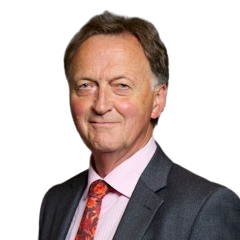
Andrew George is the Liberal Democrat MP for St Ives, having returned to parliament at the 2024 general election. He previously represented the seat from 1997 to 2015.
In the 2024 general election for the St Ives constituency, George received 25,033 votes, representing 52.0% of the vote share. The Conservative candidate, Derek Thomas, came second with 11,247 votes (23.4%), while the Reform UK candidate, Giane Mortimer, secured 6,492 votes (13.5%). George was duly elected with a majority of 13,786.
The St Ives constituency covers the western end of Cornwall. The main towns within the constituency are Penzance, St Ives and Helston.
George succeeded Conservative politician Derek Thomas as the MP for St Ives at the 2024 general election. Thomas previously unseated George at the 2015 general election.
Political Career
George is a member of the House of Commons health and social care select committee (since October 2024). The health and social care committee is a select committee of the House of Commons responsible for scrutinising the work of the Department of Health and Social Care and its associated public bodies.
During his previous stint in parliament, George held a series of frontbench positions for the Liberal Democrats. He served as international development spokesperson (2005-2006), environment, food and rural affairs spokesperson (2002-2005), disabilities spokesperson (1999-2001) and fisheries spokesperson (1997-2001).
Between 2001 and 2003, George served as the parliamentary private secretary (PPS) to Charles Kennedy, the then Liberal Democrat leader. A PPS acts as an unpaid parliamentary assistant, providing a link between the senior frontbencher and backbench MPs.
George has described Kennedy as his “mentor”.
In January 2006, George called for Kennedy to step down as Liberal Democrat leader, threatening to resign as international development spokesperson. Alongside Norman Lamb, he was reportedly the first to pledge he would no longer serve under Kennedy if the Liberal Democrat leader refused to resign.
George was not appointed to the Liberal Democrat frontbench upon Menzies Campbell’s elevation as leader.
A 2011 infographic, produced by Left Foot Forward and MHP Communications, suggested George was the most rebellious Liberal Democrat MP – voting against the whip more than any of his colleagues in the early coalition years. He took part in 28 rebellions at that time.
Notably, George was a leading figure in a Liberal Democrat rebellion against the Health and Social Care Bill. At the time (2011), he urged ministers to hold a summit with medical groups and patients’ organisations to agree a new set of reforms. He also opposed the abolition of the Agricultural Wages Board in 2013.
George has sat on the House of Commons health and social care committee (2010-2015), the housing, communities and local government committee (2007-2010) and the agriculture committee (1997-1999).
George lost his St Ives seat at the 2015 general election as part of the wider Liberal Democrat collapse. Derek Thomas won 18,491 votes (38.3%) and a majority of 2,469 over George in second place. George subsequently contested the constituency at the 2017 and 2019 general elections, losing to Thomas on both occasions.
George was elected to Cornwall Council in the 2021 local elections. He stood down as a councillor at the 2025 local elections.
George is now listed as the vice chair for the all-party parliamentary group (APPG) for international law, justice and accountability.
George delivered his House of Commons maiden speech on 22 May 1997.
In it, he said: “I want to support those who recognise the distinctiveness of those parts of these lands that take pride in their heritage and culture. That sentiment binds the people together across the whole of our land.
“When the Liberal Democrats won the St. Ives seat earlier this month, it was one of the last results to be announced. I pointed out that, with our result, it became clear that, for the first time, the traditional Celtic nations of Scotland, Wales and Cornwall were not represented by a single Conservative member.”
He added: “Of course, the Cornish character is deeply egalitarian. If someone gets a little bit uppity, the Cornish are always swift to put him in his place and delight in doing so…
“Cornwall, like Scotland and Wales, has accepted second best for far too long. The passion and fire of Michael Joseph in the past needs to be rekindled today for the future. There is a fire for a new beginning; there will be new hope. We need a new start and we are making new demands.”
George first contested the seat of St Ives at the 1992 general election.
Before joining the Liberal Democrats, George was a member of the Cornish nationalist party Mebyon Kernow. He was also a founding member of the Cornish Constitutional Convention, which campaigned for a Cornish Assembly.
Political Views
George is a member of the Green Liberal Democrats, an official environmental group within the Liberal Democrats. It aims to “promote a green approach to policy formation within the Liberal Democrats” and “develop links with the wider green movement.” The grouping, formed in 1977 as a faction within the Liberal Party, is “committed to a net-zero and nature positive future and driving ambition across the national party and in local governance.”
George was endorsed by local groups of the cross-party organisation Compass during the 2024 general election. Compass is a thinktank and campaign group. As part of its “Win as One” campaign in the 2024 election, local Compass groups backed a slate of progressive candidates who had pledged their support for electoral reform. The central aim of the initiative was to elect a “caucus” of MPs who would champion the cause of replacing the first past the post (FPTP) electoral system.
Brexit and Europe
Customs union vote (2025): In December 2025, George voted in favour of the UK-EU Customs Union (Duty to Negotiate) Bill. The bill, introduced under the 10-minute rule procedure by Liberal Democrat Europe spokesperson Al Pinkerton, sought to mandate the government to enter into negotiations with the European Union to establish a bespoke customs union. In total, 13 Labour MPs joined the Liberal Democrats in supporting the motion, while the majority of the party abstained.
Electoral reform
Fair elections APPG: George is listed as a member of the all-party parliamentary group (APPG) for fair elections – a cross-party group of MPs and peers that campaigns for electoral reform. The group’s stated aims include replacing the first past the post (FPTP) voting system with a form of proportional representation, eliminating “dark money” and “undemocratic influence” from politics, and countering disinformation.
Electoral reform amendment: In May 2026, George signed an amendment to the Representation of the People Bill, calling on the government to establish a “national commission on electoral reform”. Tabled by Alex Sobel as chair of the fair elections APPG, the amendment aimed to force a rethink of the first past the post voting system.
At the time, Sobel described FPTP as “one of the biggest examples of a broken status quo in UK politics.” He invited colleagues to join this “common sense call to take a fresh look at how parliament is elected in modern Britain.”
Proportional representation bill: In December 2024, George voted in favour of the Elections (Proportional Representation) Bill – introduced by Liberal Democrat frontbencher Sarah Olney under the 10-minute rule procedure. The bill sought to “introduce a system of proportional representation for parliamentary elections and for local government elections in England”.
A total of 138 MPs supported the bill – with 136 opposed. Notably, 59 Labour MPs backed Olney’s bill.
Introducing the bill, Olney told the House: “First past the post is a broken and unfair system. This summer, the Labour party won a landslide election victory, securing 63% of seats in the House of Commons in return for just 34% of the vote.
“The system leaves millions of voices unheard and creates a divisive, adversarial political climate where collaboration is discouraged and accountability is often sidestepped.”
Assisted dying
George voted in favour of the Terminally Ill Adults (End of Life) Bill, better known as the assisted dying bill, at second reading (November 2024) and third reading (June 2025).
Social values and conscience issues
Abortion decriminalisation (2025): George voted in favour of a backbench amendment to the Crime and Policing Bill that sought to decriminalise abortion in England and Wales in June 2025. The amendment, which was passed by a majority of 242 votes, removed women from the threat of prosecution for ending a pregnancy at any stage. As an issue of conscience, MPs were allowed to vote according to their personal beliefs.
Same-sex marriage (2013): In February 2013, George voted in favour of the Marriage (Same Sex Couples) Bill at its second reading. The landmark piece of legislation, which received its second reading by 400 votes to 175, legalised marriage for same-sex couples in England and Wales.
Foreign policy and security
Syria airstrikes (2013): George voted against the government’s motion on the principle of military intervention in Syria in August 2013. The government motion was defeated by 285 votes to 272, a move which effectively ruled out UK participation in any US-led military strikes.
Iraq War vote (2003): In March 2003, George voted for a rebel amendment which argued that the case for war against Iraq had not been established. A total of 139 Labour, 53 Liberal Democrat and 15 Conservative MPs backed the amendment. The government’s unamended motion authorising military action against Iraq passed by 412 votes to 149
Palestine
Palestinian recognition letter (July 2025): In July 2025, George was among the over 254 MPs to sign a cross-party letter calling for the government to immediately recognise the state of Palestine. The letter called on the prime minister and foreign secretary to recognise Palestine at the UN Conference then taking place in New York.
Palestinian recognition vote (2014): In October 2014, George was one of 192 Labour MPs who voted in favour of recognising Palestine as a state. The motion, passed by 274 votes to 12, called on the government to “recognise the state of Palestine alongside the state of Israel as a contribution to securing a negotiated two-state solution”.
Before Politics
Born on 2 December 1958 in Mullion, Cornwall, George attended local schools.
He studied cultural and community studies at the University of Sussex, graduating in 1980. He subsequently earned a master’s degree in agricultural economics from University College, Oxford.
Before entering parliament, George worked in agriculture, research and charity work. He was a rural officer with the Nottinghamshire Rural Community Council in 1981.
In 1987, George became the deputy director of the Cornwall Rural Community Council.
During his time outside of parliament, George served as the chief executive of the affordable housing charity Cornwall Community Land Trust.
Personal Life
George married Jill Marshall in 1987. They have two children.
He is one of eight children born to Reginald Hugh George, a horticulturist, and Diana May George, a music teacher.
George suffers from ankylosing spondylitis and has campaigned for improved availability of drug treatments for the condition.
George has published several works, including The Natives are Revolting Down in the Cornwall Theme Park (1986), Cornwall at the Crossroads (1989), A Vision of Cornwall (1995) and A View from the Bottom Left-Hand Corner (2002).
Trivia
George claims to have been the first MP to use the Cornish language in the commons in 1997.
In his maiden speech, he told the House: “I should like to take this opportunity to make a bit of history by saying:
“Me am beth hanow. Heb dewath ha bry Bisgwethack rag nevra.
“Those words are Cornish. They were spoken by a blacksmith from St. Keverne, in my constituency, where I come from.
“That blacksmith was known locally as ‘An Got’, which is Cornish for the smith, and was called Michael Joseph. He led an uprising from the constituency just one month short of 500 years ago.”
In May 2005, George became the first MP to swear his oath of allegiance in Cornish.
In Cornish, the oath of allegiance is as follows: “Me a le gans Dew Ollgallojak del vedhaf len ha perthy omryans gwyr dhe hy braster an vyternes elisabet, hy Erys ha Sewyoryon, herwyth an laha. Ytho Dew re’m gweressa.”


Comment: No bailout, but will the Elgin marbles do?
28 June 2011