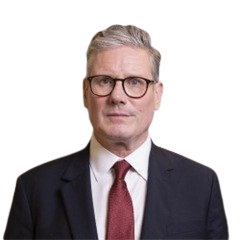
Sir Keir Starmer served as prime minister of the United Kingdom of Great Britain and Northern Ireland from July 2024 to July 2026. He was the MP for Holborn and St Pancras from the 2015 general election until his resignation in September 2026.
Starmer entered office as prime minister after Labour, under his leadership, secured a landslide victory at the 2024 general election. He served as prime minister of the United Kingdom from July 2024 to July 2026.
Starmer was elected as leader of the Labour Party and leader of the opposition in April 2020. Prior to entering politics, Starmer had a distinguished legal career as a human rights barrister and served as Director of Public Prosecutions (DPP) and head of the Crown Prosecution Service (CPS) from 2008 to 2013. Starmer was appointed Knight Commander of the Order of the Bath (KCB) in the 2014 New Year Honours for services to law and criminal justice.
In the 2024 general election for Holborn and St Pancras, Starmer received 18,884 votes, representing 48.9% of the vote share. Independent candidate Andrew Feinstein came second with 7,312 votes (18.9%), while the Green Party candidate, David Stansell, secured 4,030 votes (10.4%). Starmer was duly elected with a majority of 11,572.
Keir Starmer: what is he doing now?
Starmer announced that he would stand down as an MP on 1 September 2026. The news of Starmer choosing to leave parliament was first revealed in a report by the CamdenNewJournal. The former prime minister told his local newspaper that he had decided to step down to focus on “international affairs” and that it was the “right time” to leave frontline politics.
Starmer confirmed his decision in a statement on social media.
In the statement, Starmer said he had spent the summer reflecting on his future and that he had decided to “hand the baton over to a successor”.
He stated: “It’s been an honour and privilege to represent the best constituency in the country since taking over from the great Frank Dobson 11 years ago.
“But it is now time to step aside and focus on other issues: international affairs including defence, security, trade and technology in a fast changing world. I will also continue working with others as I have done over many decades to tackle violence against women and girls.”
He added: “I want to thank my [Constituency Labour Party] team who have always stood firmly by me, and given me the support I needed as I stood for leader of the Labour Party and then as I took my party from political, moral and financial ruin to an historic landslide election win in 2024 and two years as prime minister when we stabilised the economy, rebuilt our public services, invested record amounts in our defence and security, began lifting hundreds of thousands of children out of poverty and transformed Britain’s reputation with international partners…
“There will now be a process to appoint my successor ahead of a by-election. Whoever is lucky enough to become the Labour candidate here will have my full support and backing and I will continue to give my full support to the prime minister and this Labour government.”
Starmer’s resignation triggered a by-election in Holborn and St Pancras.
Keir Starmer: premiership (2024-2026)
Starmer entered office as prime minister following the 2024 general election, which resulted in a spectacular landslide victory for the Labour Party and brought 14 years of Conservative government to a definitive end. Labour secured 411 seats and a commanding House of Commons majority of 174.
The Labour Party’s manifesto for the 2024 general election included a vow not to “increase national insurance, the basic, higher, or additional rates of income tax, or VAT.” The party also pledged to cut NHS waiting times, recruit 6,500 new teachers and introduce free breakfast clubs in every primary school.
In his first speech as prime minister, Starmer said his government would rebuild hope and opportunity in the UK “brick-by-brick” and would show voters that “politics can be a force for good.”
He said: “Our country has voted decisively for change and a return of politics to public service.”
The prime minister added: “From now on, you have a government unburdened by doctrine guided only by the determination to serve your interest, to defy, quietly, those who have written our country off. You have given us a clear mandate, and we will use it to deliver change.
“To restore service and respect to politics, end the era of noisy performance, tread more lightly on your lives and unite our country.”
In July 2024, seven Labour MPs were suspended from the parliamentary party after voting for an Scottish National Party (SNP) amendment to the king’s speech, calling on Starmer’s government to scrap the two-child benefit cap – namely Zarah Sultana, John McDonnell, Ipsana Begum, Richard Burgon, Ian Byrne and Rebecca Long-Bailey.
Upon entering government, Rachel Reeves, the first female chancellor of the exchequer, accused the previous Conservative government of leaving a £22 billion fiscal “black hole” in the country’s finances. As a consequence, Reeves announced the government’s intention to limit the winter fuel payment at the upcoming budget in October.
The centrepiece of the first Labour budget in 14 years was the largest tax-raising budget since 1993. The budget’s primary revenue-raising measure was a significant increase in business taxation, raising employers’ national insurance contributions by 1.2 points to 15% from April 2025 and lowering the threshold at which employers begin paying these contributions (on salaries above £9,100 to £5,000). These tax-raising measures sparked a fraught political debate over whether Labour had broken pledges set out in its manifesto.
The £40 billion worth of tax rises created room for increased spending on public services and investment. Reeves announced the health budget would receive a £22.6 billion increase in day-to-day spending and a £3.1 billion increase in capital investment over the next two years. Overall, the budget left £9.9 billion worth of fiscal headroom – the buffer between the government’s fiscal rules and spending/tax plans (or money available for additional spending).
On 20 December 2024, Starmer announced the appointment of Peter Mandelson as the next British ambassador to the United States of America. Starmer’s decision to dispatch the supposedly diplomatically savvy “Prince of Darkness” to the states was designed to secure influence with the incoming administration of Donald Trump.
On 25 February 2025, Starmer unveiled plans to raise defence spending to 2.5% of GDP from April 2027, funded by cuts to overseas aid. The announcement was timed to precede a crucial meeting between the prime minister and Trump. The spending uplift was designed to demonstrate the UK’s commitment to Europe’s defence. The US president had been critical of European countries for appearing to rely on American military support.
The defence spending announcement, delivered to the House of Commons, came during a period of intense geopolitical turmoil – precipitated by Trump’s return to the White House. The US president had cast doubt on America’s continued support for Ukraine in the ongoing Russo-Ukrainian war, while signalling a willingness to negotiate directly with Vladimir Putin and Russia. Starmer was widely expected to address these issues with the US president in their high-stakes meeting scheduled for 27 February. The central issue was whether the US would provide a “backstop” of security guarantees for Ukraine in the event of any peace settlement.
In his commons statement, Starmer rejected any “false choice between our allies – between one side of the Atlantic and the other.” He described the United States as providing Britain’s “most important bilateral alliance.” He announced a rise in defence spending from 2.3% to 2.5% of GDP, funded by a reduction in the UK’s aid budget from 0.5% of gross national income to 0.3% in 2027.
The move was welcomed by Trump and contributed to a roundly well-mannered meeting in the White House. Starmer’s opening pitch included an invitation from King Charles III for an unprecedented second state visit. Trump described the invite as a “great honour”. However, Starmer’s post-Trump honeymoon was cut short by the resignation of Anneliese Dodds as international development minister.
In a letter to the prime minister, Dodds said the cuts to international aid would “remove food and healthcare from desperate people – deeply harming the UK’s reputation.” Dodds, who served as shadow chancellor from 2020 to 2021, said she had delayed her resignation until after Starmer’s meeting with the US president.
At the spring statement in March 2025, the Office for Budget Responsibility (OBR) revised the UK’s 2025 growth forecast down from 2% to 1%. This reversal of fortunes left Reeves with a £4.1 billion fiscal gap and forced her to announce £14 billion worth of spending cuts to adhere to her own rules.
The plan to cut the welfare and disability benefits bill by nearly £5 billion, including a crackdown on eligibility for personal independence payment (Pip), triggered a significant backlash among Labour MPs.
The local elections in May 2025 represented Starmer’s first major electoral test, occurring approximately 10 months after Labour’s general election triumph. In England, where elections were held in 23 councils, Labour won only 98 seats. This represented a net loss of 187 seats for the party and the loss of control of one council. The party’s estimated national vote share in England was 14%. Labour also lost the Cambridgeshire and Peterborough mayoralty to the Conservatives.
On top of this, Labour placed second in the Runcorn and Helsby by-election. Reform UK’s Sarah Pochin was elected with a majority of just six votes over the Labour candidate in second place. It represented the narrowest majority in a UK parliamentary by-election since World War II. The by-election was triggered after incumbent MP Mike Amesbury pleaded guilty in January to assaulting a constituent after a row in the street on 26 October 2024.
In the wake of the local elections, the government announced that it would row back on its decision to limit winter fuel payments; the policy had proved wildly unpopular and was blamed for Labour’s polling downturn. Some commentators referred to the policy as Labour’s “original sin”.
Then, in July 2025, the government was forced into a dramatic climbdown over its flagship welfare reform bill. Faced with a significant backbench rebellion that threatened his first commons defeat, Starmer sanctioned a series of sweeping eleventh-hour concessions. In the days leading up to the vote, a rebel ‘reasoned amendment’ to the Universal Credit and Personal Independence Payment Bill secured over 120 signatures from Labour MPs.
Starmer initially described the rebellion as “noises off” – a comment that saw his political judgement placed under renewed scrutiny. In the end, just 90 minutes before MPs were due to vote, the minister on duty, Stephen Timms, announced that plans to restrict Pip would be delayed until after a review of the benefit. The gutted bill passed by 335 to 260 votes – a majority of 75. At the time, Labour possessed a working majority of 165. A total of 49 Labour MPs voted against the bill’s second reading – a still sizeable rebellion given the scale of concessions made.
On 16 July, four Labour MPs had the party whip suspended after rebelling against the government. The group, which included Neil Duncan-Jordan, Brian Leishman, Chris Hinchliff and Rachael Maskell, were described as “persistent rebels” by party sources. Starmer justified the suspensions by stating he was “determined” to change the country “for the better”. Following four months sitting as independent MPs, the group had the whip restored on 7 November 2025. This followed what were described as “constructive discussions” with the chief whip, Jonathan Reynolds.
In September 2025, Angela Rayner resigned as deputy prime minister and secretary of state for housing, communities and local government, following an inquiry into her tax affairs related to the purchase of a flat in Hove. The resignation came after the prime minister’s independent adviser on ministerial interests, Sir Laurie Magnus, concluded that she had failed to meet the “highest possible standards of proper conduct”.
The resignation was a significant blow to Starmer. It removed one of Labour’s most high-profile figures from the political frontline, triggering both a cabinet reshuffle and an internal election to fill the vacant deputy leadership post.
On 25 October, former leader of the House of Commons Lucy Powell was elected as Rayner’s replacement as deputy leader. She defeated her rival, education secretary Bridget Phillipson, securing 54.3% of the vote. Powell had been sacked from her cabinet-attending commons leader post in the reshuffle that followed Rayner’s resignation.
In September 2025, Starmer sacked Peter Mandelson – the supposedly savvy “prince of darkness” – as British ambassador to the United States of America. It came after a US congressional committee released a cache of documents from Jeffrey Epstein’s estate. The files revealed a relationship between Mandelson and Epstein that was deeper than had been public knowledge at the time of his appointment. They included a series of messages from a 2003 book compiled by convicted child sex offender Ghislaine Maxwell for Epstein’s birthday.
On 10 September, Mandelson gave a video interview to the Sun and spoke of his “very, very deep regret”. He described Jeffrey Epstein as an “albatross around his neck” and hinted at further “very embarrassing” revelations. Initially, Starmer defended the US ambassador. During a session of prime minister’s questions, Kemi Badenoch, the Conservative leader of the opposition, asked Starmer if he still had confidence in the ambassador. The prime minister insisted that he did, saying Mandelson was “playing an important role in the UK-US relationship”.
Later on 10 September, the Sun published a news story containing further damaging revelations, including an email Mandelson sent in June 2008, after Epstein had been convicted of soliciting prostitution from a minor.
Starmer sacked Mandelson on 11 September 2025 but the controversy over his appointment persisted into 2026.
In January 2026, a release of US Department of Justice files relating to Epstein suggested the paedophile financier made $75,000 (£55,000) in payments to Mandelson in three separate $25,000 transactions in 2003 and 2004. Another email suggested Epstein sent £10,000 to Mandelson’s partner, Reinaldo Avila da Silva, in 2009 to pay for an osteopathy course. Mandelson responded by resigning his membership of the Labour Party, saying he did not want to “cause further embarrassment”.
The following day, on 2 February, a further tranche of emails were released suggesting Mandelson forwarded internal government information to Epstein in June 2009. At the time, Mandelson was business secretary in Gordon Brown’s government and de facto deputy prime minister. One exchange suggested Mandelson gave Epstein advance notice of a €500 billion bailout by the EU to save the Euro. Another suggested that Mandelson tried to secure changes to a planned tax on bankers’ bonuses following conversations with Epstein.
On 4 February, MPs passed a humble address motion, tabled by the opposition Conservative Party, forcing the government to publicly disclose internal papers, electronic communications and vetting materials relating to the appointment. The motion called for the release of “all papers relating to Lord Mandelson’s appointment as His Majesty’s Ambassador to the United States of America”. It specifically questioned Starmer’s “assurance to this House on 10 September 2025 that ‘full due process was followed during this appointment’”.
Labour MPs had threatened to vote against a government amendment to the motion, which sought to limit the disclosures, forcing an eleventh-hour concession. Shortly before the division (formal vote), the government whips agreed to hand power over the disclosures to the intelligence and security committee. This compromise was brokered by senior Labour MPs Angela Rayner, the former deputy prime minister, and Meg Hillier, the chair of the Treasury select committee.
Four days later on 8 February, Morgan McSweeney, the prime minister’s chief of staff since 2024, resigned over his role in Mandelson’s appointment. McSweeney said he took “full responsibility” for the advice he presented to the prime minister. McSweeney’s departure was treated as symbolically significant and deeply damaging given his pivotal role in Starmer’s rise to power.
In a statement, Starmer said it had been an “honour working with Morgan McSweeney for many years. He turned our party around after one of its worst ever defeats and played a central role running our election campaign. It is largely thanks to his dedication, loyalty and leadership that we won a landslide majority and have the chance to change the country.”
In the February 2026 Gorton and Denton by-election, triggered by the resignation of Andrew Gwynne, Labour placed third. Significantly, the result marked the first parliamentary by-election win in the Green Party’s history. Green candidate Hannah Spencer won 14,980 votes, representing 40.7% of the total vote share. The Reform UK candidate, Matt Goodwin, secured 28.7%, while the Labour Party candidate, Angeliki Stogia, fell to a distant third with 25.4%. The last time Labour finished third in a by-election it was defending was in Mitcham and Morden in 1982.
The Gorton and Denton by-election was arguably defined by the decision of Labour’s national executive committee (NEC) to block Andy Burnham’s candidacy. The committee voted 8-1 to block Burnham, the mayor of Greater Manchester. At the time, Burnham was linked with a possible leadership challenge to Starmer. The former Labour MP had previously run in the 2010 and 2015 leadership elections, and under Starmer – especially during his tenure as prime minister – Burnham had emerged as a critic. In a remarkable intervention at Labour’s annual conference in 2025, Burnham criticised a “climate of fear” in the party.
The result of the Gorton and Denton by-election amounted to a significant setback for Starmer’s leadership – and exposed deep fractures in Britain’s established mould of politics. Together, the Greens and Reform accounted for nearly 70% of the vote. Symbolically, the outcome meant that Labour had been unseated in two by-elections in a row by “populist” or insurgent rivals: Reform UK in Runcorn and Helsby (May 2025) and the Greens in Gorton and Denton (February 2026).
In April 2026, the Guardian exclusively revealed that the government overruled a decision to deny Peter Mandelson security vetting clearance. The newspaper reported that Mandelson failed a developed vetting process in January 2025 – some weeks after the announcement that he would be appointed US ambassador. Starmer responded to the story by sacking Olly Robbins as permanent under-secretary at the FCDO. The prime minister insisted that he had no knowledge that security officials advised Mandelson should not be given clearance – a fact he described as “absolutely unforgivable”. Kemi Badenoch, the Conservative leader of the opposition, said that Starmer should resign if he misled the commons over Mandelson’s vetting.
The Mandelson humble address files were released in batches. The first tranche of material was published on 11 March; the second was released on 1 June. The material laid bare the criticisms Mandelson and government ministers were making of Starmer, No 10 and Labour MPs. In an exchange with Pat McFadden, then the chancellor of the Duchy of Lancaster, in May 2025, Mandelson wrote that “Keir lacks verve as does the cabinet as a whole.” McFadden, meanwhile, revealed his annoyance that meetings were dominated by “who can we tax in order to pay benefits”.
The Mandelson scandal contributed to the May 2026 Labour leadership crisis.
Keir Starmer: resignation as prime minister (2026)
Starmer’s resignation as prime minister in June 2026 followed a period of immense political pressure precipitated by the May 2026 local elections and simultaneous elections to the devolved Scottish Parliament and Senedd Cymru. The results of the elections, which were confirmed from 8 to 9 May, sparked an intense political crisis as Labour MPs lined up to call on Starmer to step down/set out a timetable for his departure. In total, over 90 MPs called for Starmer to resign as prime minister.
Matters came to a head on 14 May when Wes Streeting resigned as secretary of state for health and social care and Josh Simons, a former minister, announced his intention to stand down from parliament. Simons’ resignation was designed to create a vacancy that Andy Burnham, the mayor of Greater Manchester, could exploit to return to parliament.
In Makerfield, Burnham stood on a platform of “changing” Labour. During a BBC Question Time special on 4 June, he confirmed that he would seek to enter any future Labour leadership contest should he win the Makerfield by-election. He argued that “Wes Streeting seems to have launched a leadership contest, so if that is running I would seek to join it.”
In the early hours of Friday 19 June, Burnham was declared as the winner of the Makerfield by-election. Starmer spent the weekend of 20-21 June at Chequers, the prime minister’s country retreat, to mull his political future.
On 22 June 2026, Starmer announced his resignation as prime minister and Labour leader outside 10 Downing Street, becoming the sixth person to leave the office in 10 years.
Speaking on the steps of Downing Street, Starmer said that he had inherited a Labour Party that was “politically, financially and morally bankrupt” upon his election as leader in 2020. He described entering office as prime minister following the 2024 general election as “the proudest moment of my life.”
In an emotional peroration, reminiscent of Theresa May’s resignation as prime minister, Starmer said it had been an honour to serve the “country I love”. His voice cracked as he paid tribute to his wife, Victoria, and his sons.
Starmer stated: “When I leave the biggest job in the country, I shall spend more time on the most important job. Being the best husband I can to my fantastic wife, Vic, who has been a rock by my side, through good times and bad. And being the best dad I can to my beautiful children, who are my pride and my joy.”
On 2 July 2026, Starmer delivered a landmark apology in the House of Commons on behalf of the state to victims of historic forced adoption practices. Speaking directly to campaigners watching from the House gallery, Starmer, said: “The shame is not yours. The shame was never yours. The shame is ours.
“And I say that on behalf of the whole country, I say it to every single person impacted, we are deeply and profoundly sorry.”
Andy Burnham delivered his first commons speech since returning to parliament on 14 July. It came during a debate on the Public Office (Accountability) Bill, also known as the “Hillsborough law”. In his address, Burnham praised the outgoing prime minister, hailing Starmer’s commitment to building “a country based on justice”.
In his own contribution, Starmer paid tribute to the Hillsborough families and campaigners.
He declared: “I still remember the first time I met the Hillsborough families with Bishop James Jones. That was nearly 15 years ago, as the director of public prosecutions.
“It was a humbling experience, and I was taken aback by their courage. To be able to campaign after such unimaginable loss – it floored me… To then keep going and going, as the state deployed all its power to obstruct justice and truth – that is a stain on our history.”
The prime minister added: “This bill has been too long coming, but now, as we reach third reading, we stand on the precipice of change. This is a moment of real significance for our country. We arrive here with a bill that is stronger and, above all, worthy of those who fought for it.
“It is a law that will always carry their name: the Hillsborough law.”
On 15 July, Starmer returned to the House of Commons for his final session of prime minister’s questions (PMQs).
In a short statement, the speaker of the House of Commons, Lindsay Hoyle, thanked the “prime minister for his public service and his international leadership, particularly in his steadfast support for Ukraine.”
In his final contribution to the commons as prime minister, Starmer reflected on the “end of my political journey”.
He told the House: “Every prime minister knows when they take up the torch that the day will come when they have to pass it on. That day has come for me…
“In six years, we went from historic defeat in 2019 to historic victory in 2024, and after two years in government, I leave the country in better shape than I found it in. I am proud of everything that we have achieved.”
As he left the chamber, with his family watching on from the gallery, Starmer received a standing ovation from his own benches and from several opposition MPs.
Starmer’s final session of PMQs came after cabinet members presented the outgoing prime minister with a vintage silver carriage clock made in the 1920s by the company responsible for building Big Ben. The gift was coordinated by David Lammy, the deputy prime minister, and presented to Starmer on the morning of 15 July.
The plaque on the clock read: “Change promised, change fought for, change delivered. Thank you Keir – The cabinet.”
At around 11:15am on 20 July, Starmer delivered his final speech as prime minister outside 10 Downing Street, declaring: “My work is done.”
Starmer warned that Britain’s enemies would “stop at nothing to divide us because of our values, our freedom, our decency, and frankly, because of our unflinching resolve towards the brave people of Ukraine.”
He concluded: “So, as I now pass the baton to Andy Burnham, I wish him every success. He has my full support…
“I thank the British people for the opportunity to serve. I go with good grace, I go with a smile, and I go proud of everything that we have achieved.”
Starmer then travelled to Buckingham Palace to formally tender his resignation to King Charles III. Shortly afterwards, Andy Burnham arrived at the palace for an audience with the monarch, who invited him to form a government.
Keir Starmer: leader of the opposition (2020-2024)
Starmer was elected as leader of the Labour Party in April 2020. The 2020 Labour leadership contest was triggered by Jeremy Corbyn’s resignation following Labour’s catastrophic defeat at the 2019 general election – the party’s worst since 1935. Labour returned just 202 MPs.
Starmer received the most nominations from MPs and MEPs at 88, including senior figures such as Yvette Cooper, Ed Miliband and David Lammy. Rebecca Long-Bailey, the shadow business secretary and widely regarded as the continuity candidate for the party’s left/Corbynite wing, won 33 nominations.
During the election campaign that followed, Starmer claimed that Corbyn was “right” to position Labour as the “party of anti-austerity”. He outlined 10 pledges that collectively comprised a Corbyn-lite platform.
In the end, Starmer secured 275,780 votes (56.2%), running on a platform of unity and competence. Long-Bailey placed second with 135,218 votes (27.6%). Lisa Nandy won 79,597 votes (16.2%). The turnout, from a total of 784,181 eligible voters, was 62.6%.
Angela Rayner was also elected as the new deputy leader, winning the contest with 52.6% of the vote in the third round. Labour MPs Rosena Allin-Khan and Richard Burgon finished second and third respectively.
Speaking after the result, Starmer said it was an “honour and the privilege of my life to be elected as leader of the Labour Party.” He vowed to “engage constructively with the government, not opposition for opposition’s sake” during the Covid crisis.
On 23 March 2020, the prime minister, Boris Johnson, had delivered his famous television broadcast, declaring a blanket stay-at-home order. Johnson announced that to stop the “invisible killer” from spreading between households, the British people were required to stay at home, with only four strictly limited exceptions.
Starmer’s victory, and early tenure as leader of the opposition, was therefore conducted in the shadow of the Covid crisis.
Starmer’s election ultimately represented an ideological and strategic shift for the party. From 2020 until his election as prime minister in 2024, the Labour leader signalled a series of symbolic breaks with Jeremy Corbyn’s tumultuous tenure. Having barred Corbyn from standing as a Labour candidate, Starmer celebrated the “changed” nature of his Labour Party.
Long-Bailey was dismissed as shadow education secretary in June 2020. The stated reason was her sharing, on social media, of an interview with the actor Maxine Peake which contained an alleged antisemitic trope regarding Israeli state actors and US police tactics. Long-Bailey stated she did not endorse all aspects of the article.
In October 2020, 34 Labour MPs broke the Labour whip by voting against the covert Human Intelligence Sources (Criminal Conduct) Bill at its commons third reading. The proposed legislation, often referred to as the “spycops bill”, was introduced by the Conservative government to authorise undercover agents and informants to commit crimes while on operations. Starmer had whipped its representatives to abstain on the bill on the basis that the legislation is “far from perfect” yet “necessary” due to “the need to provide a clear lawful framework for the use of human intelligence sources”.
In December 2020, Starmer faced a rebellion of 37 Labour MPs, who voted against the leadership’s position on the EU (Future Relationship) Bill – which enabled the government to implement and ratify its post-Brexit trade deal with the EU. Starmer argued that while the trade deal negotiated by Johnson’s government was “thin” and flawed, the only alternative at that late stage was a “no-deal” exit. To enforce the leadership’s position, a three-line whip was imposed. A total of 36 Labour MPs abstained over the bill. One Labour MP, Bell Ribeiro-Addy, voted against the bill.
In February 2022, following Russia’s invasion of Ukraine, 11 Labour MPs on the left of the party were threatened with losing the party whip after they signed a statement by the Stop the War Coalition which criticised Nato, accusing the military alliance of “eastward expansion”. All 11 MPs subsequently removed their signatures.
Despite early setbacks, Labour went on to make significant gains at local elections and in parliamentary by-elections under Starmer’s leadership. The tide began to turn in Starmer’s favour as reports concerning lockdown gatherings in Downing Street emerged during late 2021 and early 2022.
The Partygate scandal first emerged in late 2021 when the Daily Mirror’s political editor, Pippa Crerar, reported that Johnson had broken rules with a series of Downing Street gatherings during the 2020 festive period. At the time, the prime minister insisted that no rules had been broken, telling MPs “that all guidance was followed completely in No 10”.
On 12 April 2022, Johnson and the chancellor of the exchequer, Rishi Sunak, were issued with fixed penalty notices by the Metropolitan Police for breaching Covid-19 lockdown regulations.
At the start of business on 19 April 2022, the speaker of the House of Commons, Lindsay Hoyle, announced that he would allow a debate to be held on a motion referring Johnson to the privileges committee. The speaker confirmed he had received letters from a number of MPs calling for this course of action, including Starmer. The matter, Hoyle said, concerned “the prime minister’s statements to the House regarding gatherings held at Downing Street and Whitehall during lockdown.”
The commons subsequently debated a motion tabled by Starmer, calling for an investigation on 21 April 2022. The motion noted “the issue of fixed penalty notices by the police in relation to events in 10 Downing Street and the Cabinet Office” and the prime minister’s assertions on the floor of the House, including that “all guidance was followed in No 10”.
On 6 June 2022, Johnson survived a vote of no confidence in his leadership of the Conservative Party by 211 votes to 148 – a victory that technically secured his position under party rules for another year.
However, Starmer described the vote as the “beginning of the end” for Johnson’s premiership. He was right. Mere weeks later on 30 June, Chris Pincher resigned as deputy chief whip following allegations that he had drunkenly groped two men at the Carlton Club in London. Initially, Downing Street insisted that the prime minister considered the matter closed and that Pincher would remain a Conservative MP, having lost only his government job. This position quickly became untenable as a storm of new allegations about Pincher’s past behaviour emerged over the following days.
The “Pincher affair” triggered the collapse of Johnson’s government, beginning with the resignations of cabinet ministers Rishi Sunak and Sajid Javid. When he returned to the commons on 6 July to face prime minister’s questions, Starmer referred to Johnson as a “pathetic spectacle”.
Starmer mocked those who remained in his cabinet, stating: “As for those who are left – only in office because no one else is prepared to debase themselves any longer. The charge of the lightweight brigade.”
Johnson’s resignation as Tory leader triggered a leadership race, which was contested by a series of senior party figures. Liz Truss, the foreign secretary, ultimately defeated Sunak in the final round. She had not resigned from cabinet in July 2022, but later issued a statement calling Johnson’s departure “the right decision” and for “calmness and unity”.
Truss’ disastrous premiership, defined by the “mini-budget”, was quickly followed by a second leadership contest. Johnson initially expressed interest in standing as a candidate, but proved unable to secure the necessary support. Truss was ultimately succeeded as prime minister by Sunak on 25 October 2022.
As leader of the opposition, Starmer faced a total of three Conservative prime ministers in the form of Johnson, Truss and Sunak.
In November 2023, 56 Labour MPs voted in favour of an SNP amendment to the king’s speech in the House of Commons calling for an “immediate ceasefire” in Gaza – defying the instruction set out by Starmer’s frontbench. The Labour leadership tabled its own motion, making a more moderate appeal for a “humanitarian pause” in the conflict and ordered its representatives to support that stance. A total of 10 frontbenchers resigned in order to support the SNP amendment.
On 29 February 2024, the veteran politician George Galloway secured a dramatic return to parliament, winning the Rochdale by-election by a landslide. The victory for his Workers Party of Britain (WPB) came after the Labour Party’s campaign imploded. The Labour campaign descended into chaos after audio recordings emerged of its candidate, Azhar Ali, suggesting that Israel had deliberately “allowed” the 7 October massacre to go ahead. After initially defending him, the Labour leadership was ultimately forced to withdraw all support. This decision came after the Daily Mail newspaper published a fuller recording, allegedly of Ali, which blamed “people in the media from certain Jewish quarters” for the suspension of left-wing MP Andy McDonald from the Labour Party.
This unprecedented situation allowed Galloway to dominate the campaign. He directly targeted Rochdale’s large Muslim population, framing the vote as a referendum on Keir Starmer’s leadership and Labour’s stance on Gaza. Galloway won with 12,335 votes, representing 39.7% of the vote share and a majority of 5,697. In his victory speech, he directly addressed the Labour leader, declaring: “Keir Starmer, this is for Gaza.”
From 2022 to 2024, Starmer secured several defections from the Conservative Party – including Christian Wakeford in January 2022. In his resignation letter, Wakeford cited the prime minister’s conduct during the Partygate scandal, accusing the government of “trying to defend the indefensible”.
In April 2024, Dan Poulter defected from the Conservatives to Labour. Poulter, who worked part time as a doctor, argued that his former party was no longer focused on public services. Mere days later in May 2024, Natalie Elphicke defected from the Conservatives to Labour. She cited “housing and the safety and security of our borders” in a statement.
These defections came shortly before Rishi Sunak decided to call a general election.
Keir Starmer and Angela Rayner
Rayner was elected as deputy leader of the Labour Party after prevailing in April 2020. As part of the 2020 deputy Labour leadership contest, Rayner defeated rival candidates including Rosena Allin-Khan, Richard Burgon and Dawn Butler. She won with 52.6% of the vote in the final round. During the campaign, Rayner promised to “make the case for everyday socialism rooted in people’s lives”.
Rayner and Starmer’s relationship as deputy leader and leader of the Labour Party respectively was initially said to be strained. In 2023, Rayner described her relationship with the Labour leader as an “arranged marriage”.
She said: “I often talk about it as an arranged marriage. We were both elected by the membership differently and independently. We work constructively together.”
In September 2021, Rayner was criticised for reportedly referring to Conservative ministers as a “bunch of scum” at a Labour conference reception. According to the Daily Mirror, she told the event on Saturday night: “We cannot get any worse than a bunch of scum, homophobic, racist, misogynistic, absolute vile… banana republic, vile, nasty, Etonian… piece of scum.”
Rayner initially defended the comments, saying she was trying to convey in a “passionate way” the “anger and frustration that people feel when you have a prime minister, who has said things and not apologised that are racist, that are misogynistic, that are homophobic, that has given billions of pounds of taxpayers’ money to their mates and literally wasted that money”.
At the time, Starmer said that Rayner had deployed “not language that I would use.”
In October, Rayner apologised for the remarks, saying that she had since reflected on “our political debate” and the “abuse that now seems to feature all too often”.
Rayner held a series of roles on Starmer’s frontbench during his tenure as leader of the opposition. Initially, she served as chair of the Labour Party and national campaign co-ordinator from April 2020 to May 2021. Following disappointing local election results for Labour in May 2021, Starmer moved Rayner from these roles in a reshuffle and attempted to demote his deputy.
However, Rayner and her allies resisted attempts to demote her. She eventually secured a host of senior roles, including shadow chancellor of the Duchy of Lancaster and shadow secretary of state for the future of work. She was also retained in the role of shadow first secretary of state (appointed April 2020).
Rayner therefore emerged with a 24-word job title as deputy leader, shadow first secretary of state, shadow chancellor of the Duchy of Lancaster and shadow secretary of state for the future of work. She held this elaborate job-description from May 2021 to September 2023.
In a further reshuffle in September 2023, Rayner was appointed as shadow deputy prime minister and shadow secretary of state for levelling up, housing and communities.
In May 2024, during the general election campaign, Rayner insisted that she and Starmer now “get on really well”, adding: “I think in the early days we were a bit yin and yang.”
She told the Daily Record: “I’m a bit Northern, aren’t I, and loud, and Keir’s from the south and he’s not quite as loud. I would say I am an extrovert and Keir’s an introvert.”
Keir Starmer: rise to prominence (2015-2020)
Before his election as Labour leader, Starmer served in a series of shadow ministerial roles. Most notably, he was shadow secretary state for exiting the European Union (shadow Brexit secretary) from October 2016 to April 2020. In this capacity, serving on Corbyn’s frontbench, Starmer helped craft the Labour Party’s Brexit strategy – spearheading its opposition to Theresa May’s Brexit deal and, eventually, support for a second referendum.
Previously, Starmer served as shadow immigration minister from September 2015 to June 2016.
In June 2016, Starmer was among those to resign from the shadow frontbench in protest at Corbyn’s leadership and his approach to the Brexit referendum.
In his resignation letter, Starmer wrote: “I have never spoken out publicly against you and I do not intend to now. However, the EU Referendum result was catastrophic for the UK, for our communities and for the next generation. We now face a very different future.
“The challenge of leadership in this context is very different to the challenge only a year ago. It is clear that we need a much louder voice on the critical issues of renegotiating the UK’s place in the world and mitigating the damaging impact of our exit from the EU.
“In the last few days I have maintained my support for you, notwithstanding my reservations. However, the resignations across the shadow cabinet and the shadow frontbench yesterday and today materially change this. It is simply untenable now to suggest that we can offer an effective opposition without a change of leader.”
Starmer sat on the House of Commons home affairs select committee from July to October 2015.
Starmer delivered his maiden speech on 28 May 2015 during a debate on the queen’s speech.
In it, he said: “It took us nearly 750 years to journey from the partial application of human rights in Magna Carta to the universal application of human rights in the universal declaration of human rights. As we now celebrate the 800th anniversary of Magna Carta, let us affirm the principle that human rights apply to everyone equally.
“Any proposed British Bill of Rights inconsistent with that principle will not be worth the paper it is written on and will face widespread opposition, not least from me on behalf of my constituents in Holborn and St Pancras.”
Political Views
Leadership elections and loyalty
Labour leadership 2015: Starmer was one of 68 Labour MPs who nominated Andy Burnham for the party’s leadership in June 2015. The election followed the resignation of Ed Miliband after the party’s defeat in the 2015 general election. It was the first contest held under the “one member, one vote” system, which replaced the previous electoral college.
Burnham, the shadow health secretary, was initially considered the frontrunner. He secured 68 nominations from the Parliamentary Labour Party (PLP), comfortably exceeding the 35 required to reach the final ballot. He ultimately finished second in the contest with 19% of the vote, losing to Jeremy Corbyn in the first round.
Corbyn loyalty list: In March 2016, Starmer was labelled as “core group plus” by the Corbyn leadership in a leaked list which categorised Labour MPs by their perceived loyalty. This label suggested the Corbyn leadership viewed Starmer as a reliable supporter.
Labour leadership 2016: Starmer was one of 162 Labour MPs who nominated Owen Smith for the party’s leadership in July 2016. The election was triggered by a challenge to Jeremy Corbyn following the EU referendum, which led to a wave of shadow cabinet resignations and a vote of no confidence supported by 172 MPs. Smith, the former shadow work and pensions secretary, was ultimately defeated by Corbyn, who won with an increased mandate of 61.8% of the vote.
Factional identity and party tradition
Tribune group (2017): Starmer was listed among the supporters of the Tribune parliamentary group – a caucus generally described as representing the party’s “soft left”.
The Tribune group was initially formed in 1964 to support the newspaper of the same name. It served as a prominent forum for those parliamentarians situated on the left of the Labour Party – but it split over Tony Benn’s campaign for the deputy leadership in 1981. Benn’s supporters founded the Campaign group – which evolved into the Socialist Campaign Group (SCG). Today, the Bennite SCG is strongly associated with the Labour left tradition.
During the 1980s, the Tribune group emerged as a more natural home for those on Labour’s “soft left”.
In 2017, Efford officially re-launched the group with a new mission statement calling for “opportunity and aspiration” to be placed at the heart of the party’s programme. Efford said he had reformed the group to ensure that the centre-left of the Parliamentary Labour Party (PLP) “have a space in which to put forward ideas and debate which has not been there under successive leaders”.
He added: “The view of Labour MPs at the moment tends to be that too much are just Blairites who want to stab Jeremy Corbyn in the back. We want to show that is not where we are, and that we want to develop our own ideas that represent the centre-left of the party.”
Brexit and Europe
Brexit referendum: Starmer supported Remain in the 2016 Brexit referendum, and therefore agreed with a majority of his constituents, 73.3% of whom voted to Remain.
Article 50: In February 2017, Starmer voted in favour of the European Union (Notification of Withdrawal) Bill. The legislation empowered the prime minister to notify the Council of the European Union of the UK’s intention to withdraw, formally triggering the process set out in Article 50 of the Treaty on European Union. MPs supported the bill by 498 votes to 114 at second reading.
Welfare
Welfare vote (July 2025): Starmer voted in favour of the government’s flagship welfare bill at second reading. The vote came after ministers agreed to significant concessions to avoid defeat via a mass rebellion of Labour MPs on 1 July 2025.
Assisted dying
Starmer voted in favour of the Terminally Ill Adults (End of Life) Bill, better known as the assisted dying bill, at both second reading (November 2024) and third reading (June 2025).
Foreign policy and security
Trident renewal (2016): Starmer voted in favour of a government motion calling for the renewal of the Trident nuclear deterrent system in July 2016. The motion, which was passed by 472 votes to 117, committed the UK to constructing a new fleet of submarines to carry the nation’s nuclear weapons. Labour was split over the issue with 140 of its 230 MPs going against leader Jeremy Corbyn and backing the motion.
Syria airstrikes (2015): Starmer voted against a government motion to extend UK airstrikes against Isis from Iraq into Syria in December 2015. The motion, which was passed by 397 votes to 223 after a ten-hour debate in the House of Commons, authorised the RAF to conduct strikes against Isis targets in Syria.
Keir Starmer: early life
Born in Southwark, London, on 2 September 1962, Starmer grew up in Oxted, Surrey. His father, Rodney Starmer, was a toolmaker, and his mother, Josephine Baker, was a nurse who later suffered from Still’s disease, a rare autoimmune condition.
Starmer attended Reigate Grammar School. He subsequently studied law at the University of Leeds, graduating in 1985, and then undertook postgraduate legal studies at St Edmund Hall, Oxford University, graduating in 1986.
Starmer was called to the bar in 1987 and specialised in human rights law, practising predominantly in criminal defence. He was a member of Doughty Street Chambers from 1990 and was involved in high-profile cases, including advising during the McLibel case and challenging the death penalty in Caribbean and African countries. He was appointed queen’s counsel (QC) in 2002.
Aged 32, Starmer wrote an article in Socialist Lawyer, in which he said “Karl Marx was, of course, right” – reportedly about the futility of trying to bring about change through abstract declarations of fundamental rights.
Keir Starmer: director of public prosecutions
From 2008 to 2013, Starmer served as director of public prosecutions and head of the Crown Prosecution Service.
During Starmer’s tenure, the CPS prosecuted the murderers of Stephen Lawrence. However, the CPS under his leadership was later criticised for failing to prosecute Jimmy Savile before his death, although reviews concluded Starmer was not directly involved in the decision-making on that case.
Savile was a British media personality who died in 2011. In 2012, widespread reporting emerged alleging his role in extensive sexual abuse.
As DPP, Starmer responded to the Levitt inquiry report, which he commissioned, into the decision not to prosecute Savile.
In January 2013, Starmer said: “I accept the conclusions reached by Ms Levitt QC and, in the interests of transparency and accountability I have decided to publish her report in full. In doing so, I would like to take the opportunity to apologise for the shortcomings in the part played by the CPS in these cases.
“But I also want to go further. If this report and my apology are to serve their full purpose, then this must be seen as a watershed moment. In my view, these cases do not simply reflect errors of judgment by individual officers or prosecutors on the facts before them. If that were the case, they would, in many respects, be easier to deal with.”
In February 2022, Nazir Afzal, the former chief crown prosecutor for North West England, told the BBC that Starmer wouldn’t have been aware of any decision not to prosecute Savile. “None of that would have been escalated beyond the south-east and Keir wasn’t aware of it”, Afzal said.
The comments came after the prime minister, Boris Johnson, raised this matter in response to criticism from Starmer following the publication of an update on senior civil servant Sue Gray’s investigation into “Partygate”. Johnson said Starmer had “spent most of his time prosecuting journalists and failing to prosecute Jimmy Savile” during his tenure as DPP.
At prime minister’s questions on 2 February 2022, Starmer accused Johnson of “parroting the conspiracy theories of violent fascists to try to score cheap political points”.
Personal Life
Starmer married Victoria Alexander, an occupational health administrator and former solicitor, in 2007. They have two children, a son and a daughter.
Before moving to Downing Street, the family lived in Kentish Town, within his Holborn and St Pancras constituency.
Trivia
Starmer is a keen football player and lifelong supporter of Arsenal FC. He plays amateur football regularly.
In June 2021, Starmer told Piers Morgan that if he encountered Boris Johnson on the football field, he would in all likelihood “knock him over”.
Starmer was once a vegetarian. In 2017, he stated that being vegetarian is “better for yourself and for the environment”. However, in a trademark U-turn, he now eats fish.
Starmer’s parents were Labour supporters and named him after Keir Hardie, the party’s first parliamentary leader.
Keir Starmer has not written for Politics.co.uk.